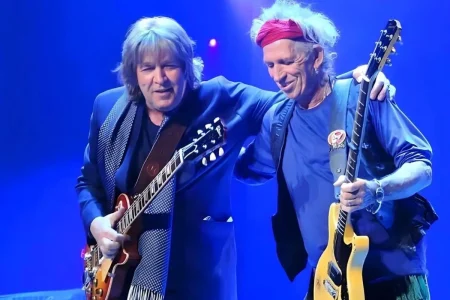
Mick Taylor did what almost no rock musician ever does – he walked away from the greatest gig on earth while the band was at its creative peak.
Since he quit the Rolling Stones in 1974, fans have blamed everything from heroin to hurt egos and Keith Richards. The truth is more interesting: Taylor left because the music, the business and the lifestyle stopped making sense to a 25 year old blues prodigy with a conscience.
The night the Stones got blindsided
The break did not happen in a management office. It happened at Eric Clapton’s birthday party in London on 12 December 1974. As fireworks lit the sky, Taylor quietly told Mick Jagger he was leaving the band, then walked away, leaving Jagger asking Ronnie Wood whether Taylor could possibly be serious.
He was. Sessions for the next Stones album in Munich were about to begin, and suddenly the band had no lead guitarist. In the documentary Crossfire Hurricane, Taylor later said he had become addicted to heroin and was trying to protect himself and his family from the storm that came with being a Rolling Stone.
The polite “official” version
Publicly, the split sounded almost boringly civilised. Taylor issued a formal statement praising his five and a half years with the Stones as “very exciting” and “inspiring,” stressing his respect for the other four members before saying it was simply time to do something new.
Jagger, for his part, told interviewer Jann Wenner that Taylor never really explained himself. He guessed Taylor wanted a solo career, suspected friction with Keith, and in the same breath called him a “very fluent, melodic” player whose style the band had never had before or since.
On paper it looked like the most polite divorce in rock history. Underneath, it was the end of a long, ugly argument about what the Stones were turning into.
A blues prodigy in a band built on chaos
The irony is that Taylor was almost too good for the job he took. The Stones began as blues purists obsessed with Muddy Waters and Howlin’ Wolf, importing Chicago electric blues into British clubs before bending it into rock.
Taylor arrived from John Mayall’s Bluesbreakers with frightening chops and a deep blues vocabulary. His lyrical, almost jazz-like phrasing over Keith Richards’ riffs helped launch the run from Let It Bleed through Sticky Fingers and Exile on Main St. that many fans still treat as the Stones’ holy trinity.
But behind those records, life inside the band was a mess of tax exile, drugs, legal problems and two songwriters whose relationship swung between brilliant and toxic. Taylor walked into that cauldron at 20 years old and, by his mid twenties, he was burning out.

The cocktail of reasons he really left
Songwriting credit and the Jagger-Richards machine
Taylor never pretended songwriting credits were the only issue, but he has been blunt that they mattered. He has said repeatedly that he was promised co-writing credit on songs such as “Sway,” “Moonlight Mile” and “Time Waits for No One,” only to see the familiar Jagger-Richards stamp on the label instead.
As he told Mojo, the band “used to fight and argue all the time,” and the broken promises over credit were one more sign he would always be a junior partner in someone else’s empire.
Drugs, dysfunction and a band at war with itself
In Crossfire Hurricane, Taylor admitted his heroin use escalated during his Stones years and said plainly that he left to get himself and his family away from that drug culture. He has described the period around It’s Only Rock ‘n Roll as an unhappy time in which the band was falling apart even while the records sold.
Later he recalled the office taking back his gold Amex card as soon as he said he was leaving, and Jagger begging him to take six months off instead. Taylor, by his own admission, was impulsive and ignored the advice, convinced he needed to rip the bandage off in one move.
“I just felt like I’d had enough”
Asked years later why he really quit, Taylor gave a disarmingly simple answer. He said he had never seen being in the Stones as permanent, that he “just felt like I had enough” and decided to leave and start a group with Jack Bruce instead. He added that, from the beginning, he somehow knew he would not stay with the Stones forever.
That is not the romantic story fans like to hear. It is more mundane and more human: a gifted young player grew tired of being a hired gun in a dysfunctional circus and wanted to see what his own name on the marquee might feel like.
Why losing Taylor hurt the Stones so much
The emotional fallout inside the band was huge because Taylor had quietly become the musical adult in the room. Keith Richards has called his playing “sweetly sophisticated” and admitted he never really understood why Taylor left, speculating that he wanted to be more of a writer, producer and “all‑rounder” than the Stones would ever allow.
Listen to the early 70s records and you hear what Richards is talking about. Taylor’s slide stabs and melodic runs give Sticky Fingers and Exile on Main St. a kind of dangerous elegance, lifting the songs without ever turning them into prog-rock showpieces.
His main tool in that era was a sunburst Gibson Les Paul that he and Richards passed around like a shared weapon, first overdubbing parts on Let It Bleed and then driving the band on Sticky Fingers, Exile and finally It’s Only Rock ‘n Roll before he walked.

Where his guitar changed the Stones
| Song | Album | What Taylor brings |
|---|---|---|
| Can’t You Hear Me Knocking | Sticky Fingers | That long, Latin‑flavoured jam where his solo turns a riff tune into a mini jazz suite. |
| Sway | Sticky Fingers | Bittersweet, bending leads that sound more like a horn section than a rock guitar. |
| Time Waits for No One | It’s Only Rock ‘n Roll | A soaring, lyrical outro solo that feels more like Santana than bar‑band blues. |
| Midnight Rambler (live) | Get Yer Ya‑Ya’s Out | Elastic, improvising lines that stretch the song into dark, violent theatre. |
Charlie Watts once called Taylor “clearly, the best lead guitar the Stones have ever had,” and even suggested that some of the band’s best recorded work came from that lineup. When the rhythm section of Watts and Bill Wyman says you elevated the music, that is not fan fantasy – that is the engine room talking.
“He didn’t do anything” after the Stones? Not remotely true
Keith Richards has occasionally sneered that Taylor “didn’t do anything” after leaving, which makes for a great Keith one‑liner but a terrible piece of history. Taylor immediately formed a band with Jack Bruce, cut a solo album, then spent years as a hired assassin for other heavyweights.
He toured Europe with Ten Years After and John Mayall, played on a live Bob Dylan album with Mark Knopfler, and even guested with the Grateful Dead at Madison Square Garden. Later he moved back to Britain, worked the blues circuit, joined the Experience Hendrix tour, and eventually reappeared with the Stones on their 50 & Counting and 14 On Fire tours, quietly stealing scenes with extended “Midnight Rambler” solos.
What he never did was chase pop stardom or stadium‑rock cash. Taylor chose the life of a working musician, for better and for worse, and sometimes that is exactly what “doing something” looks like.

So, was walking away a mistake?
If you measure success in money and mythology, Mick Taylor blew it. He left just as the Stones became a permanent touring corporation and traded the private jets for club tours and session fees.
If you measure it by self‑respect and survival, the call looks different. Taylor says the band limited him, that it was great fun but he had to move on, and that the harder question is not whether he regrets leaving, but whether he regrets joining in the first place.
In the end, Taylor’s departure is one of rock’s great what‑ifs. What we do know is this: for five short, volatile years, a quiet blues fanatic with a sunburst Les Paul dragged the Rolling Stones closer to musical greatness than they ever got before or after. Then he looked at the chaos, looked at himself, and had the nerve to walk away.