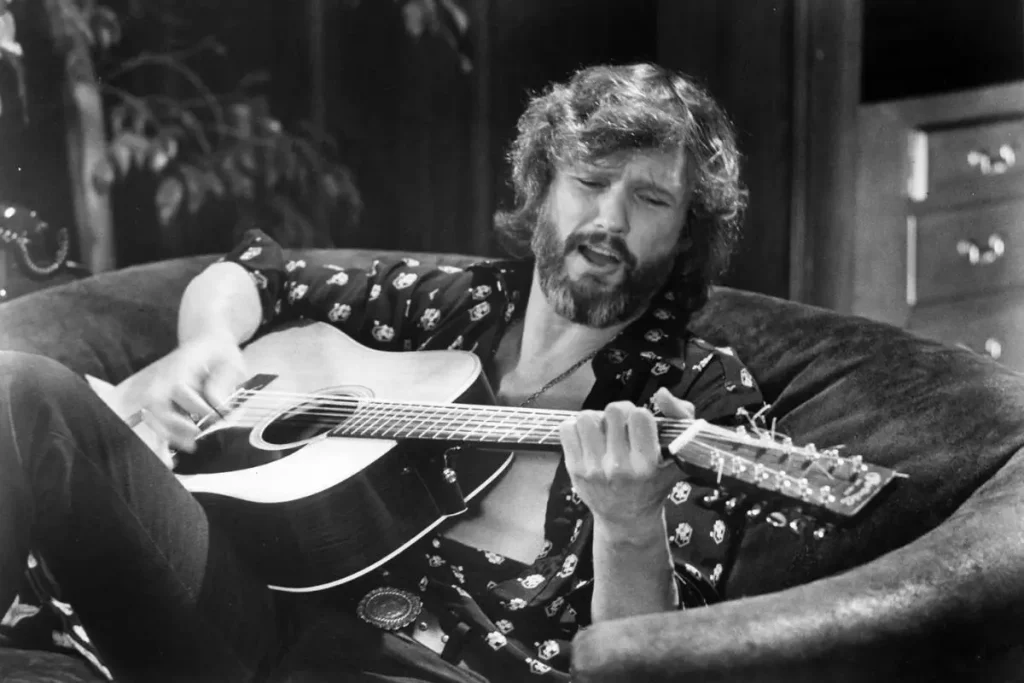
Kris Kristofferson didn’t just write songs. He wrote confessions that somehow made it onto country radio, in an era when Nashville often preferred its pain cleaned up, its sinners fictional, and its endings tidy.
He made a career out of saying the quiet parts out loud: addiction, loneliness, lust, regret, spiritual doubt, political fury, and the kind of love that leaves bruises. The miracle is not that he occasionally offended gatekeepers. The miracle is that the gatekeepers still needed him.
“If you don’t have something to say, you might as well not say anything.”
Kris Kristofferson
Why “truth-teller” is not just a compliment
Calling Kristofferson a “truth-teller” can sound like soft-focus mythology, but his whole arc backs it up. He was not born to the barroom. He chose it, walking away from an elite track that could have kept him safe, respectable, and quietly miserable.
He studied at Oxford as a Rhodes Scholar and later served in the U.S. Army, a résumé so “clean” it almost looks like satire next to the songs he’d become famous for. That contrast is key: Kristofferson wasn’t romanticizing rough lives from a distance. He was deliberately stepping into the mess and reporting back in plain language.
The scandal: he made country music sound like adult literature
Kristofferson’s writing is often described as poetic, but the more interesting truth is that it’s journalistic. He names the hangover, the cheap room, the shame, the physical details you can smell.
In “Sunday Mornin’ Comin’ Down,” the narrator doesn’t get redeemed. He simply survives the morning, and the song’s power comes from refusing to pretend that survival is the same thing as victory. That refusal is the Kristofferson signature.
What he changed in Nashville language
- He normalized imperfection. His narrators are not role models, and that’s the point.
- He made vulnerability masculine. Not “tough guy with a soft spot” – more like “soft guy trying to stay upright.”
- He used plain words to talk about complicated feelings. No spiritual bypassing, no cartoon villainy.

“Not flawless” – and why the flaws are part of the work
It’s tempting to turn Kristofferson into a saint of authenticity, but his best songs are allergic to sainthood. He wrote from the inside of mistakes, not from the podium after he’d conquered them.
That messiness includes drinking, chaotic relationships, and a restless need to test limits. The point isn’t gossip. The point is that his art repeatedly admits, “I did the thing I shouldn’t have done,” and then sits with the consequences without performing virtue for the audience.
He also wasn’t “hardened.” His tone is often gentle, even when he’s describing brutal scenarios. That gentleness is what makes the hard truths land: you don’t feel preached at, you feel included.
Love, but not the Hallmark version
Kristofferson’s love songs don’t sell love as comfort. They sell love as risk: the kind of thing you do even when you know it might wreck you.
“Help Me Make It Through the Night” is a perfect example. It isn’t romantic in the polite sense. It’s human in the frightening sense – a song that admits that loneliness can be physical, urgent, and not particularly interested in social approval, which fits the raw emotional candor highlighted in his biography.
Three Kristofferson love themes you can hear across the catalog
- Need without self-pity. He asks, but he doesn’t whine.
- Desire without moral panic. Sex exists, and pretending otherwise is the real indecency.
- Regret without excuses. When he fails, he doesn’t outsource blame.
The songwriting “trick” that made him hit harder than flashier writers
Kristofferson rarely relies on cleverness for its own sake. Instead, he uses a few repeatable craft moves that any serious songwriter can study.
| Kristofferson move | What it does to the listener | Try it yourself |
|---|---|---|
| Concrete scene-setting | Makes emotion believable | Open with a physical detail (light, smell, temperature) |
| Unheroic narrator | Builds trust fast | Let the “I” admit fault in the first verse |
| Plain-spoken punch lines | Creates a gut-punch without melodrama | Replace one “poetic” line with everyday speech |
| Spiritual tension | Adds weight beyond romance | Hint at meaning, but don’t resolve it neatly |
Outlaw spirit: not a costume, a worldview
Kristofferson is often filed under “outlaw country,” but the deeper outlaw move wasn’t the image. It was his willingness to write songs that made polite society uncomfortable, including songs that challenged war, hypocrisy, and the way institutions chew up ordinary people.
His work and his public positions often leaned toward empathy for outsiders and suspicion of easy patriotic narratives. That stance didn’t always make him industry-friendly, but it made him artistically durable.
His induction into the Country Music Hall of Fame is a useful reminder that the institution eventually honored the guy who spent decades poking at the institution’s comfort zone.
Legacy is not charts – it’s cover versions and conversions
If you want a blunt measurement of Kristofferson’s reach, look at who recorded his songs. When a song survives multiple singers, genres, and decades, it’s no longer just a “hit.” It becomes a standard, a piece of public language.
“Me and Bobby McGee” is a great example: Kristofferson wrote it, but the song took on a huge life through other voices, proving that his writing could be both intensely personal and weirdly universal.
And then there’s the quieter legacy: the people who never wrote a song, never stepped on a stage, but felt seen for the first time because a Kristofferson lyric admitted the same shame they were hiding. That’s not “influence” as a music-industry statistic. That’s influence as emotional permission.
Awards exist – but they’re not the point
Yes, Kristofferson has the official honors. Major institutions have repeatedly recognized his songwriting and long-term impact, including industry awards and lifetime tributes.
BMI, for example, honored him with its Icon Award, a kind of acknowledgment that his songs aren’t just popular, they’re foundational to the writing culture itself, as noted in PBS’s American Masters profile.
But the more interesting reality is that Kristofferson’s greatest “award” is that his songs keep getting used by regular people. They show up at funerals, in recovery rooms, on late-night drives, and in the private moments where someone needs a voice that doesn’t lie.
What musicians can learn from Kristofferson right now
You don’t have to imitate his style to steal his courage. If anything, copying the surface (the gravel, the hangover, the outlaw posture) misses the lesson.
Practical Kristofferson principles (no costume required)
- Write the line you’re afraid to sing. Then make it simpler.
- Let the narrator be wrong. Audiences trust self-incrimination more than self-praise.
- Choose honesty over likability. Being “nice” rarely makes a lasting song.
- Respect the listener’s intelligence. Don’t explain the moral – show the moment.

The real reason he’ll be remembered
Kris Kristofferson will be remembered because his work refuses to fake emotional closure. He doesn’t sell purity, certainty, or triumph. He sells the harder thing: recognition.
He lived with his heart open enough to get it hurt in public, and he wrote with enough humility to admit when he was the cause of the hurt. That’s why his legacy isn’t measured in chart positions. It’s measured in the number of people who heard his words and thought, “So it’s not just me.”
And in a world full of polished branding and strategic authenticity, that kind of real is still dangerous.
“Freedom’s just another word for nothin’ left to lose.”
Kris Kristofferson, “Me and Bobby McGee”
Conclusion: Kristofferson’s greatness is not that he was flawless. It’s that he was brave enough to tell the truth anyway, and generous enough to turn that truth into songs other people could live inside.