
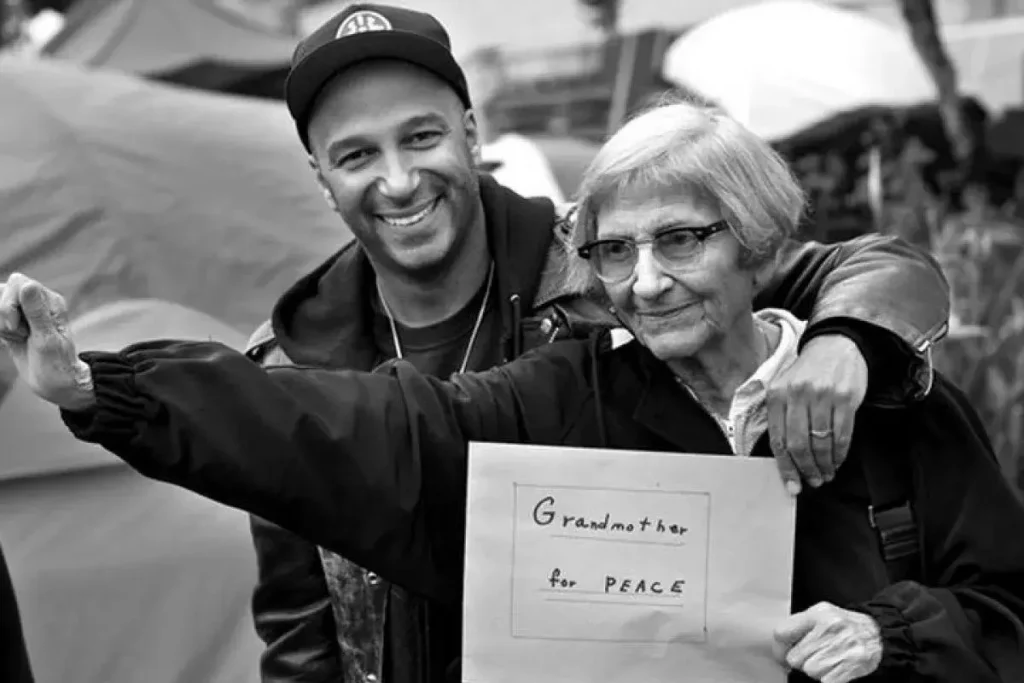
Before Rage Against The Machine told the world “fuck you, I won’t do what you tell me,” there was Mary Morello calmly loading the ammo for that sentiment at her kitchen table.
Tom Morello’s mother is not a background character in his story but the political engine under the hood: a centenarian teacher and free speech activist who founded Parents for Rock and Rap specifically to take on Tipper Gore’s Parents Music Resource Center (PMRC) and the 1980s moral panic around rock and rap lyrics.
Two rock moms, two Americas: Mary Morello vs Tipper Gore
In the mid 1980s, Tipper Gore heard Prince’s “Darling Nikki” with her 11-year-old daughter, panicked about the sexual lyrics and co-founded the Parents Music Resource Center with a small circle of well-connected “Washington wives”. They drew up the notorious “Filthy Fifteen” list of supposedly corrupting songs, hauled rock stars into a 1985 Senate hearing and pushed for ratings, warning labels and even contract penalties for artists who were too sexual, violent or “occult.”
Their pressure campaign succeeded: the record industry adopted the now-famous black and white “Parental Advisory” sticker, and chains like Walmart simply refused to stock labeled albums, a soft form of economic censorship wrapped in “family values.” Ironically, as even mainstream outlets have noted, the sticker quickly became a badge of honor that helped sell records, turning Tipper’s crusade into the greatest marketing device angry teenagers could ask for.
| Tipper Gore & PMRC | Mary Morello & Parents for Rock and Rap | |
|---|---|---|
| Starting point | Shocked by explicit lyrics, wants warning labels and industry self-policing. | Shocked by censorship, wants the First Amendment taken seriously in pop music. |
| Strategy | Use political clout, Senate hearings and retailer pressure. | Use letters, media, coalitions and public argument to defend artists. |
| Target | Rock, metal and later rap seen as moral threat to kids. | Government, courts and pressure groups treating music as a scapegoat. |
| Legacy | That little black sticker and a template for culture-war outrage. | An organized, persistent reminder that parents and fans can fight back. |
Mary Morello’s road to radicalism
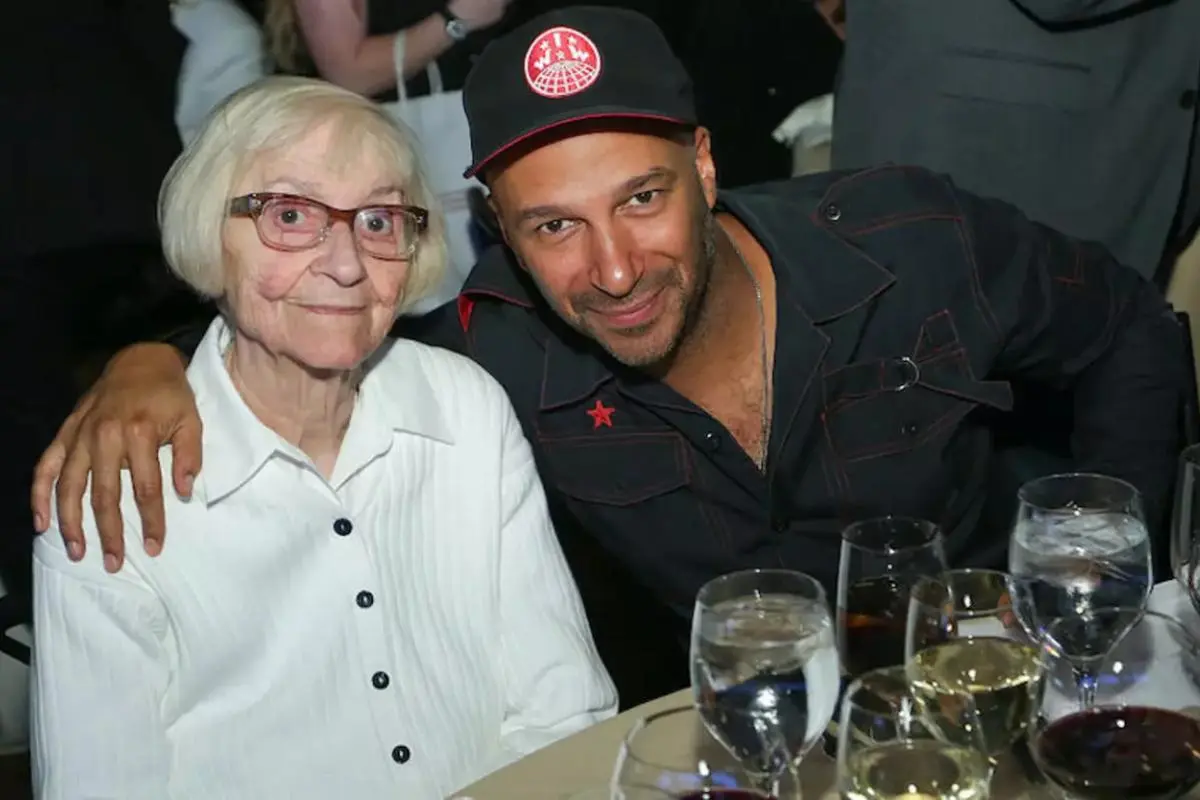
Tom has called his mother “the most radical member of the Morello family,” and when you look at her life, that is not hyperbole. In a birthday tribute, he described her feeding hungry men during the Depression, selling war bonds against fascism in the 1940s, teaching around the world in the 1950s, backing anti-colonial movements in Africa in the 1960s and working as a “radical” high school teacher who backed farm workers and the Urban League in the 1970s.
By the 1980s she was flying on peace delegations to the Soviet Union and Cuba; in the 1990s she opposed the first Gulf War and founded Parents for Rock and Rap to challenge music censorship, then spent the 2000s and 2010s tutoring homeless people and recovering addicts, volunteering in soup kitchens and supporting groups such as Doctors Without Borders and Middle East peace organizations, all while doting on her grandchildren.
Music press accounts and Tom’s own comments add more detail: Mary was involved with the civil rights movement and the NAACP in the 1960s, worked with the Chicago Urban League for years, volunteered teaching adult literacy at a Salvation Army rehabilitation center and joined a Cuba Coalition that campaigned against the US embargo. She also wrote a blistering editorial about death row prisoner Mumia Abu-Jamal, arguing that the death penalty is arbitrary, racist and “cruel and unusual” and that a cop’s life is not worth more than any other citizen’s, an activism streak highlighted when Tom made a surprise Jeopardy! appearance with his mom.
When Rage were inducted into the Rock & Roll Hall of Fame, Tom used his speech to thank the centenarian schoolteacher who taught him to “stand up and speak truth to power” and to treat history, like music, as something you actively make rather than passively consume. That is Mary’s worldview in a sentence, and it echoed the pride he has shown in her during public moments like that Jeopardy! cameo.
A very political household: Tom Morello’s family history
Tom was born in Harlem in 1964 to a wildly political mixed-race family: his father, Ngethe Njoroge, was a Kenyan freedom fighter involved with the Mau Mau independence movement who later became Kenya’s first ambassador to the United Nations, and Tom’s great uncle was Jomo Kenyatta, the country’s first president. His mother, Mary, chose to give him her surname Morello because it would be easier for Americans to pronounce, and because she was the parent raising him day to day, a backstory he has often shared in career-spanning interviews.
After his parents split when he was a toddler, Mary took a teaching job in Libertyville, a conservative, overwhelmingly white suburb north of Chicago. Tom has recalled being the only black kid in town and the lone “pinko” in his high school, where he and a few friends produced an underground paper about South American death squads and apartheid, while Mary filled the house with photos of revolutionaries and movement leaders.
A long Rolling Stone profile paints a starker picture: Mary and Tom were among the first interracial families in Libertyville, and she struggled to get hired because of it, at one point finding a noose hung in her garage. She stayed involved with the Urban League and NAACP, founded Parents for Rock and Rap to fight right-wing attacks on rock and hip hop and taught Tom that he was “no better or less” than anyone while encouraging his obsessive reading about the Black Panthers, anti-apartheid struggles and US foreign policy.

Mary’s fingerprints on Rage Against The Machine
In a Washington Post feature, Tom flatly states that his mother was “always involved with civil rights and anti-censorship issues” and that she founded Parents for Rock and Rap before Rage even existed. He recalls coming home from day care in tears after a white girl called him racial slurs, and Mary, after a talk about Malcolm X, telling her young son not to let that kind of abuse slide and to confront it directly the next day, which he did – ending the harassment for good and giving him an early lesson in refusing to accept illegitimate authority.
Parents for Rock and Rap itself was more than a hobby; it was Mary’s second career. She quit a 22-year teaching job in 1987 to launch the group, which explicitly opposed the PMRC and similar efforts to police lyrics, arguing for the importance of free speech in popular music and defending rock and rap artists caught up in obscenity panics. Her work earned her the Hugh M. Hefner First Amendment Award in the Arts and Entertainment category in 1996, formal recognition that this suburban teacher was one of the loudest pro-music, anti-censorship voices of the era.
That sensibility bled straight into Rage Against The Machine. The same Rolling Stone piece that details Mary’s activism also recounts how Rage’s legendary 1993 protest at Lollapalooza in Philadelphia – standing naked onstage for their entire slot, mouths taped shut with “P M R C” written across their chests while amps blared feedback – was aimed squarely at the censorship climate her group was fighting. Mary was literally mailing her son copies of The Nation on tour while his band was turning her politics into arena-sized spectacle.
From the classroom to the stage
The bond between mother and son is not just political but performative. In a Metal Hammer “My Life Story” interview, Tom jokes that he was “the only rock musician at Harvard” and later a Harvard grad living in a Hollywood squat, but the serious through-line is that both his Kenyan father and his American mother treated activism as non-negotiable, and Mary cemented that in him long before he picked up a guitar.
Mary has not stayed in the wings. At a 1996 Rage show at Chicago’s Aragon Ballroom, she walked out to the mic and introduced the band as “the best fucking band in the universe” before they tore into “People of the Sun,” a moment fans can revisit in live footage and tributes. And in 2023 JamBase noted her 100th birthday party, where Jack Black fronted a band of 12 and 13 year olds (including Tom’s son on guitar) ripping through Ozzy Osbourne’s “Mr. Crowley” in her honor. For a retired history teacher from Illinois, that is a pretty reasonable victory lap.
Censorship, torture playlists and unintended consequences
Here is the twisted punchline of this whole saga: while Mary and Tom spent decades fighting censorship, some of Rage Against The Machine’s own songs later appeared on CIA and military “torture playlists” used to break detainees with deafening, nonstop music in black sites after 9/11. Investigations into US interrogation programs list Rage alongside Metallica, Drowning Pool and even the Barney theme song as tracks blasted at prisoners for days at a time.
The idea that a band born from an anti-PMRC stance, raised by a woman who organized parents to defend offensive music, ended up on a government torture soundtrack is almost too on the nose. It perfectly captures the way states try to domesticate or weaponize rebellious culture even while activists like Mary fight to keep that culture dangerous, uncomfortable and free.
Why Mary Morello matters to rock fans
If you came of age with PMRC stickers on your vinyl or CDs, it is tempting to remember that period as a funny overreaction, a quaint skirmish in the larger culture wars. Mary Morello’s life is a reminder that it was not a joke at all, and that the fight over what you are allowed to hear has always been deadly serious for artists, fans and the people targeted as scapegoats.
Tipper Gore tried to put training wheels on rock and rap; Mary Morello tried to kick them off. Without her, Tom Morello might still have become a virtuoso guitarist, but it is hard to imagine Rage Against The Machine being quite so uncompromisingly militant without decades of his mother’s letters, protests and plainspoken defiance ringing in his ears. The next time you see that Parental Advisory logo, remember there was a radical schoolteacher from Illinois quietly organizing the resistance.