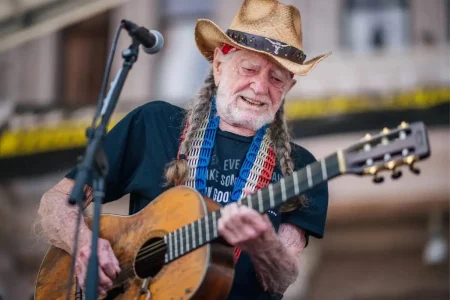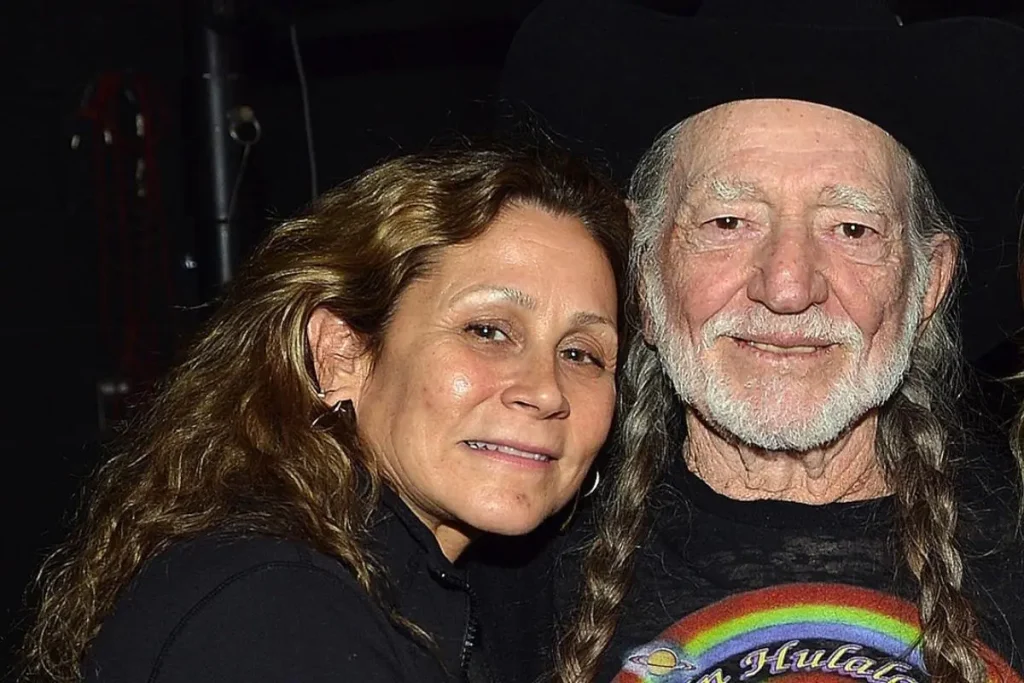
Willie Nelson built a career on songs that treat love like a beautiful accident and commitment like a risky bet. Then Annie D’Angelo showed up and proved the outlaw could, in fact, stay put. Married since 1991, Annie is Willie’s longest marriage, the most private figure in his public orbit, and the quiet force behind a surprisingly functional family band.
This is not a fairy tale. It is a long-haul partnership built around touring, fame, financial chaos, and the daily friction of a creative life. If you want a relationship story that feels more like a road case than a diamond ring, this one is it.
Who is Annie D’Angelo (and how did she meet Willie)?
Annie D’Angelo worked in film production and crossed paths with Willie on a movie set in the 1980s, when he was acting as well as recording. Major profiles note the relationship began during that period, long before the couple made anything official. Willie’s own biography outlines his film work and personal life arc that set the stage for their meeting and eventual marriage.
Annie never chased celebrity the way celebrity often chases Willie. That choice matters. In a world where an artist’s brand can devour everyone nearby, Annie’s low-profile presence has functioned like a pressure valve.
The part people skip: why “longest marriage” is the headline
Willie has been married multiple times, and he does not mythologize that history as “practice.” It is simply a fact of a restless life. The public record lists Annie as his fourth wife and places their wedding in 1991.
That date is not trivia. It lands after his most infamous financial crisis, when the IRS pursued him for unpaid taxes and forced a painful reckoning with business management. In other words: Willie did not marry Annie at the easy part of the story.
Annie as stabilizer: romance, yes – but also logistics
In pop culture, we love the idea that a partner “saves” the artist. The truth is less dramatic and more useful: good partners reduce chaos. Annie is widely described as a steadying influence, especially as Willie kept touring at a pace that would flatten people half his age.
One reason the relationship reads as remarkable is that it looks like an alliance, not a hostage situation. Willie gets to be Willie. Annie’s influence shows up as boundaries, family continuity, and a home base that is not dependent on the spotlight.
“I’m not sure what I’d do without her.” – Willie Nelson, quoted discussing his marriage to Annie D’Angelo
That line hits because it is so un-outlaw. It is an admission of reliance from a man whose persona was built on independence.

How they handled Willie’s “ups and downs” without turning into a tabloid punchline
1) Fame is loud. Annie stayed quiet.
Willie’s career has always been public: the records, the activism, the touring, the image. Annie’s decision to avoid the celebrity feedback loop keeps their marriage from becoming a second stage. When your spouse is a living symbol, privacy becomes a form of protection.
2) They built a family that could travel with the job
The couple’s two sons, Lukas and Micah, grew up with music as a household utility, not a special occasion. If you want to understand how this marriage endured, look at the practical choice to integrate family into the work instead of competing with it.
3) They did not try to “rebrand” Willie into a different person
This is where an edgy claim is warranted: plenty of artist relationships fail because someone tries to sand down the very traits that made the artist compelling. Annie’s reputation is not that she changed Willie’s essence. It is that she helped him survive it.
The sons: Lukas and Micah as the ultimate relationship “receipt”
If your marriage is performative, the kids often become props. If your marriage is real, the kids eventually become peers. Lukas and Micah are not novelty acts riding their father’s name; they are working musicians with distinct identities.
Lukas Nelson: songwriter, bandleader, road-tested
Lukas fronts Lukas Nelson & Promise of the Real and has built credibility in roots-rock and Americana circles. His official site emphasizes his work as a touring artist and songwriter rather than positioning him as “Willie’s son.”
Musically, Lukas tends to bridge classic American songwriting with a modern guitar-forward band sound. That blend makes sense for someone raised around both country tradition and the chaos of constant performance.
Micah Nelson: the experimentalist in the family
Micah (often performing under the moniker Particle Kid) leans more psychedelic and art-rock, with a playful, boundary-testing approach. His label and project home Ocean Rainforest highlights his multidisciplinary work and releases beyond straightforward country.
That creative freedom is a clue about Willie and Annie’s parenting dynamic: the house seems to have had rules, but not a narrow definition of “the right kind of music.”
The “family band” era: love as a stage plot twist
Later-career Willie is not just an elder statesman taking victory laps. He is a working musician who often tours with family involved, turning the Nelson name into a functioning small enterprise. When that works, it is usually because the partnership at the center is stable enough to support everyone else’s gravity.
When you see Willie on stage with his sons, you are watching the byproduct of a long marriage: shared routines, shared values, and a shared tolerance for the unglamorous parts of show business.
Willie’s public legacy, Annie’s private power
Willie’s cultural status is reflected in major institutions that track American music history. The Country Music Hall of Fame frames him as a defining figure in country music, underscoring the scale of the public life Annie married into.
The Grand Ole Opry’s artist profile positions Willie as a cornerstone of the genre’s modern story.
And the Library of Congress preserves materials connected to Willie’s work and influence, reinforcing that his career is treated as part of national cultural memory.
Annie’s contribution is not to compete with that legacy. It is to keep the human being inside it functional. That is not romantic fluff – it is relationship engineering.
What makes their marriage “remarkable” in music terms (not just celebrity terms)
| Pressure Point | What Usually Breaks Couples | How Willie + Annie Seem to Handle It |
|---|---|---|
| Touring | Separate lives, separate rhythms | Family integrated into the working world |
| Fame | Constant public commentary | Annie stays largely private |
| Money | Bad management and stress | More controlled later years, fewer public implosions |
| Creative ego | Competing spotlights | Annie does not appear to seek the spotlight |
These are not guarantees, and no one outside the marriage can audit the details. But the broad pattern is clear: their structure matches the job, instead of fighting it.
A relationship that looks boring – and that’s the point
For people who grew up on Willie’s outlaw image, there is something almost subversive about a decades-long marriage that mostly avoids drama. It is not “settling down” as surrender. It is “settling down” as strategy.
PBS’s American Masters coverage of Willie’s life and career highlights how long and complex his story is, which makes the endurance of a stable partnership even more striking.
Even mainstream biographical summaries keep returning to the same theme: Willie is a survivor. The longer the timeline gets, the more you notice the people who helped make survival possible.
Takeaways musicians can steal from Willie and Annie
- Privacy is a tool, not a vibe: fewer cameras often equals fewer problems.
- Make the family compatible with the schedule: touring does not have to mean “gone.”
- Let the artist be the artist: boundaries beat “fixing.”
- Raise kids around the craft: it builds competence, not entitlement.
Willie Nelson’s life will always look larger than normal, because it is. Annie D’Angelo’s role is not to be larger – it is to be consistent. In a business that sells fantasy, their most provocative move might be the simplest one: they stayed married.
Conclusion: the outlaw found his anchor
Willie and Annie’s relationship is remarkable not because it is flashy, but because it is durable. Their marriage has outlasted trends, scandals, and the basic physics of nonstop touring. And in Lukas and Micah, you can hear the sound of a family that did not just survive a legend – it learned to play alongside him.