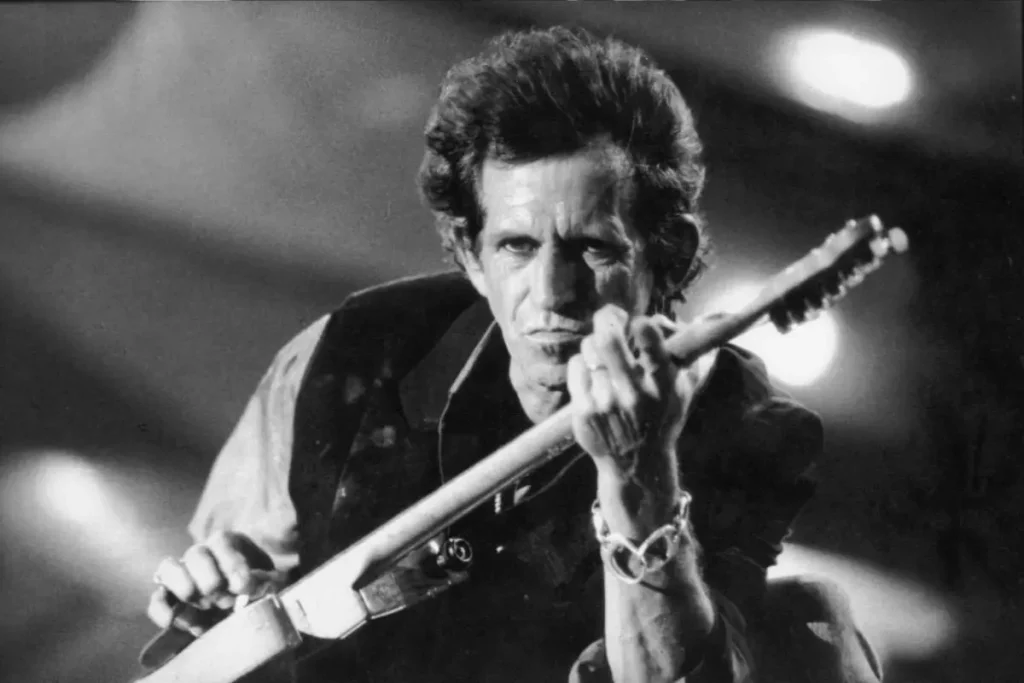
Keith Richards built a career on swagger, danger, and that crooked-smile defiance that powered the Rolling Stones through every cultural firestorm. But behind the “pirate” myth is a more grounded origin story: a working-class kid from Dartford with a father, Bert Richards, who was both a boundary and a backstop.
This relationship was not the stereotypical “my dad hated my music” tale that rock biographies love to sell. It was messier, warmer, and more useful. Keith learned early that rebellion hits harder when it’s forged against real expectations, and that freedom lasts longer when someone teaches you how to endure.
Who was Bert Richards, really?
Herbert William “Bert” Richards was Keith’s father, a factory worker who later became associated with electrical work, and a man Keith often described as pragmatic and unshowy. If Keith became rock’s great romantic of riff and rhythm, Bert was the anti-poet: a doer who valued work, straight talk, and getting on with it. Keith’s own Dartford, working-class roots are the soil this father-son story grows from.
That matters because Richards’ “danger” was never purely aesthetic. It was a kid leaving the narrow lanes of postwar England and stepping into a life that looked, to most parents, like professional unemployment with extra sirens.
The central paradox: the dad who didn’t panic
Many rock stars describe fathers who either tried to crush music dreams or vanished. Richards’ story is stranger: Bert didn’t romanticize Keith’s ambitions, but he didn’t react like a moral cop, either. That low-drama stance gave Keith a psychological advantage – he could rebel without needing to burn down his home life to do it.
Richards’ memoir Life is the major touchstone here, and while it’s a rock memoir (meaning: vivid, subjective, occasionally self-mythologizing), it repeatedly returns to family as an anchor rather than an enemy. The book’s bibliographic record and publication details are documented in its Google Books listing.
A “working man” education: how it shaped Keith’s career choices
Bert’s influence is easiest to see in Keith’s attitude toward the job itself. Richards talks about music in mystical terms, but he also treats touring, recording, and playing night after night as labor. That labor mindset is pure working-class inheritance: show up, do the job, and don’t whine when it gets ugly.
The Rolling Stones’ longevity is often credited to luck, chemistry, and outrageous survival skills. But longevity also comes from a craftsman’s pride – the idea that a band is a machine you keep running even when personalities clash. The Rock & Roll Hall of Fame’s overview of the band’s long arc and sustained impact indirectly supports why a “keep going” mentality mattered.
The edgy claim (with a practical edge)
Richards’ most “reckless” years are usually framed as pure hedonism. A more provocative, arguably truer read: the same man who could disappear into excess also had a deep internalized work ethic that kept him functional enough to keep delivering riffs. That duality – chaos on the surface, discipline underneath – looks like a son who absorbed his father’s toughness while rejecting his father’s ordinary life.
The approval that counts: respect, not praise
In Richards’ telling, Bert wasn’t the type to gush. That’s crucial: Keith didn’t grow up chasing applause from home. He grew up chasing respect. And respect is harder to win, which is why it’s more motivating than simple encouragement.
That psychological wiring shows up in the Rolling Stones’ early years: the band wanted to be taken seriously as interpreters of American blues and R&B, not just pop idols. Their public-facing story (including materials on their roots in blues and early rock influences) highlights those foundations as identity, not a phase.
“I never had the feeling I had to run away from home, because I had a pretty good home.” – Keith Richards, quoted in discussion of his autobiography Life.
That quote lands like a small bomb in rock mythology. A “pretty good home” doesn’t make a tame musician. It can make a braver one, because the artist can take bigger risks without the added weight of unresolved family warfare.

Conflict without catastrophe: why tension helped instead of harmed
It’s unrealistic to paint this as a nonstop hug-fest. Richards’ generation collided with parents over hair, clothes, noise, and the perceived waste of talent. But the key is scale: normal family friction rather than permanent estrangement.
When conflict stays survivable, it teaches a musician how to argue, negotiate, and keep relationships intact under stress. Those skills are not “soft.” They are survival tools in a band where every album is a political campaign and every tour is a long group confinement experiment.
Band dynamics: the father-son template in a band context
Keith’s long-running creative partnership with Mick Jagger depended on rivalry without rupture. That’s a very “family” kind of relationship: disagreements that can be vicious, followed by an unspoken assumption that the project continues. It’s not crazy to see Bert’s steady presence as early training for this kind of emotional endurance.
Masculinity, stoicism, and the Stones persona
Postwar British masculinity often prized stoicism and competence. Richards’ stage persona looks flamboyant, but his core performance values are surprisingly traditional: don’t break, don’t show pain, keep time, keep the engine moving.
That connects to his guitar philosophy too. Richards isn’t a “look what I can do” virtuoso; he’s a groove architect. The focus is on feel and rhythm, the musical equivalent of a dependable shift worker: the beat arrives on time. Even when he later became famous for open tunings and five-string habits, the goal remained functional musical power rather than technical exhibitionism.
The dark side: freedom with a safety net can fuel bigger risks
Here’s the uncomfortable angle: having a stable family base can sometimes enable more dangerous experimentation. If you believe you can always come back to something solid, you may push further out.
Richards’ drug history is complex, and any simplistic “dad made him do it” narrative is lazy. Still, it’s fair to say that a musician with a strong internal core (and a sense of being loved, even quietly) may survive risks that destroy others. Keith’s career suggests a man who repeatedly returned to the work, even when the lifestyle threatened to erase him.
Later life: when the parent becomes the mirror
As Richards aged, the relationship with his father gained a different meaning. You stop arguing about haircuts and start measuring yourself against a parent’s longevity, resilience, and limits. Richards became a father himself, and the “how do you show love without turning soft?” question becomes real, not theoretical.
It’s telling that modern portraits of Richards often pivot away from scandal and toward endurance and craft: the idea of a man who, for all the chaos, remains rooted in something stubbornly human. Even pop-culture profiles that lean into the legend typically acknowledge his unusual capacity to last in interview and feature discussions of his life story.
What musicians can steal from the Richards-Richards blueprint
You don’t need a famous parent to become a durable artist. You need a few psychological assets that Bert’s style of fathering seems to have provided: steadiness, realistic expectations, and space to fail without exile.
Practical takeaways
- Rebel against the right thing: Richards rebelled against small-town limits, not against love itself.
- Earn respect through repetition: riffs are cool; showing up for decades is cooler.
- Keep conflict survivable: if you want a long career, learn how to fight without burning the house down.
- Build an anchor outside the spotlight: family, craft, routine, or community – something that doesn’t applaud you.
A quick timeline of “dad effects” on the Keith Richards career arc
| Life phase | Likely father-son dynamic | Career impact |
|---|---|---|
| Childhood in Dartford | Working-class stability, modest expectations | Confidence to explore music without total family rupture |
| Early band years | Pragmatic tolerance, respect over praise | Drive to prove legitimacy and professionalism |
| Fame and excess | Anchor in identity beyond the circus | Resilience, return-to-work mindset |
| Legacy years | Reflection, inheritance, becoming “the father” | Emphasis on craft, endurance, and stewardship of the Stones songbook |
Where the myth gets it wrong
The common myth is that Richards became Richards by rejecting everything “ordinary.” The more interesting truth is that he carried the ordinary with him: the voice of a father who valued stamina, competence, and not making a spectacle of yourself.
That tension – between spectacle and steadiness – is basically the Rolling Stones’ secret formula. They sold danger, but they ran the band like a trade.

Conclusion: the quiet father behind the loud guitar
Keith Richards didn’t need a stage-dad, a tyrant, or a saint. He needed Bert Richards: a steady presence who didn’t overreact, didn’t overpraise, and didn’t collapse when his son chose a life built on noise and temptation.
The effect on Keith’s career is written in the longest line a rock musician can draw: not just influence, but endurance. The riffs are famous. The relationship behind the nerve to keep playing is the part that deserves a closer listen.