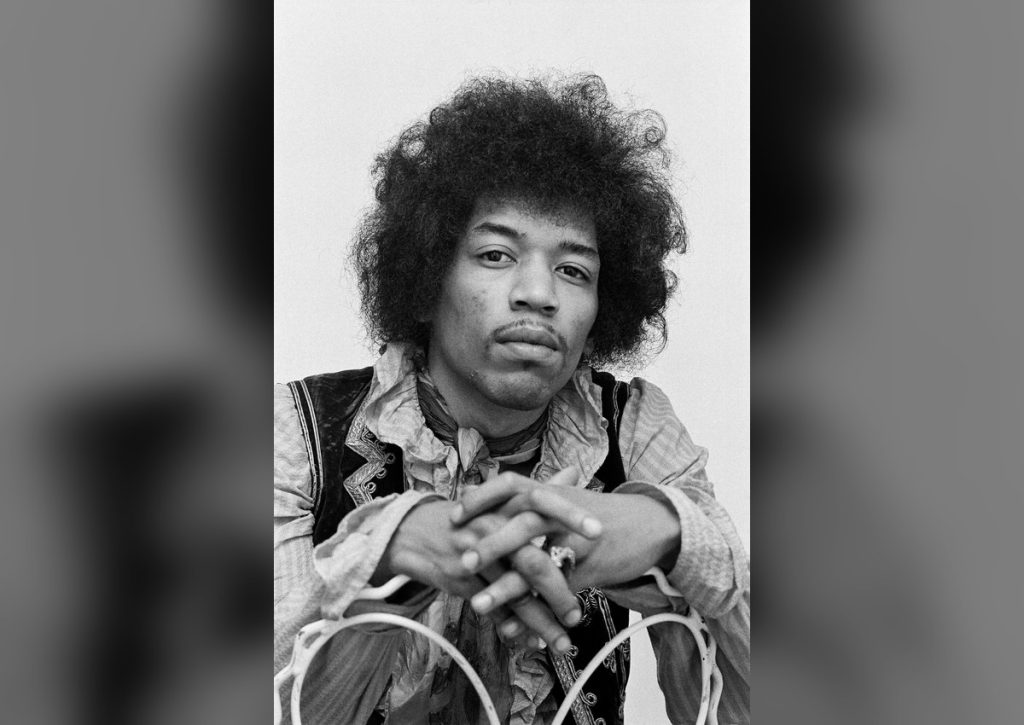
The most influential guitar tone of the twentieth century came from an instrument being played, by any conventional measure, incorrectly. Jimi Hendrix — left-handed in a market that barely acknowledged left-handed players existed — spent his career playing right-handed Fender Stratocasters flipped over and restrung. It started as a workaround. It ended up as a signature no amount of money has ever quite reproduced.
The workaround
The origin was economics, not mysticism. In the early 1960s, left-handed guitars were rare and cost more — when they could be found at all — and a broke sideman on the chitlin’ circuit took what pawnshops offered. So Hendrix bought standard right-handed Strats, turned them over, and restrung them in reverse so the low E sat where a lefty needed it. Countless left-handed players have done the same before and since. What nobody anticipated was how much the flip would change the instrument itself.
What actually changes
A Stratocaster is not symmetrical, and every asymmetry Hendrix inverted became part of his sound.
Start with the bridge pickup, which Fender mounts at a slant. On a normal Strat the slant pushes the pickup’s sensing points closer to the bridge under the treble strings, sharpening them to a bite. Flip the guitar and the angle reverses: the pickup now reads the treble strings further up the string length, producing a noticeably sweeter, rounder tone — while the bass strings, sensed closer to the bridge, tighten up. That’s a meaningful part of why Hendrix’s bridge-pickup sound sings where other players’ Strats spit.
Then there’s what happens behind the nut. A Strat’s headstock places the tuners in a staggered line, so each string runs a different length between nut and tuning post. Reversed, the low strings got the long run and the high strings the short one — subtly altering tension and feel across the neck, slackening the strings he bent hardest. Add the reversed stagger of the pickups’ pole pieces, nut slots cut for the opposite string gauges, and controls that now sat above the strings rather than below, and the flipped Strat was less a mirror image than a different instrument wearing the same body.
Turning defects into technique
The genius was how completely Hendrix metabolised every one of those quirks. The volume knob and vibrato arm, relocated under his hand, became live performance tools — swells, dips and manipulations executed mid-phrase because the controls were finally reachable. The slackened top strings fed the huge, vocal bends. Even the tuning instability that reversed nut slots invite became irrelevant to a player who retuned constantly and treated pitch as negotiable anyway.
This is the part imitators consistently miss. Players have hunted the sound for decades — Fender has even sold reverse-headstock models chasing it — but the tone was never only in the wood and wire. It was in a player who had absorbed everything and copied nothing, running a back-to-front instrument through a technique built, from the first day, around its oddities. The flip and the player co-evolved; you cannot buy one half of that.
It’s worth noting how deep the ambidexterity ran. Photographs and eyewitness accounts show Hendrix could pick up an unmodified right-handed guitar — strung normally — and play it flipped, with the strings effectively upside down, well enough to perform. Years of borrowing instruments before he could afford his own had forced him to learn the mirror world both ways. The restrung Strat was his preference, not his crutch.
The industry eventually chased the accident to its logical conclusion: Fender has issued production Hendrix models with reversed headstocks and reverse-angled bridge pickups, deliberately building right-handed guitars that behave like flipped ones. It is a lovely irony — the company manufacturing, on purpose and at scale, the exact configuration a broke left-handed sideman once assembled out of necessity in the back of a tour van.
The beautiful accident
There’s a broader lesson in the upside-down Strat, and it’s why guitarists still pass the story down like scripture. The modern instrument industry sells solutions: signature models, custom shops, every barrier between player and perfect spec removed. Hendrix’s entire foundation was a barrier — a market that didn’t stock guitars for people like him — and the compensations he invented became the most possessed, least imitable voice the electric guitar has produced.
None of which was the plan. A left-handed kid needed a guitar, the shop only had right-handed ones, and the twentieth century’s most radical musician began by simply refusing to accept that as a limit. Every warm, slurred, singing note off that slanted bridge pickup is the sound of a problem being outplayed.
The wrong guitar, in the right hands, turned out to be the rightest guitar of all — and half a century of players staring at their perfectly-built, correctly-handed instruments are still trying to work out how to sound that free.