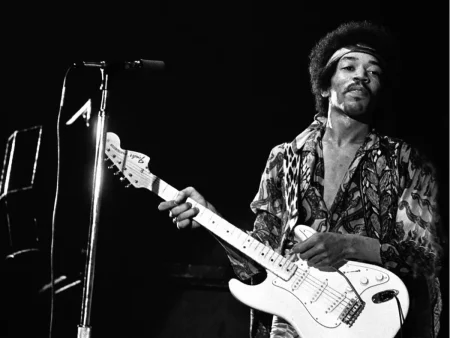
Newport is supposed to be polite. Strummed acoustics, communal choruses, earnest lyrics, and the occasional controversy that still somehow smells like sea air and good intentions. But in 1968, a different kind of “folk music” barged in through the side door: urban, amplified, and unapologetically physical.
Buddy Guy, B.B. King, and Junior Wells were not museum pieces rolled out to “educate” a folk audience. They were working artists with sharp elbows, big volume, and a Chicago club sensibility that did not ask permission. If the Newport Folk Festival was built to preserve roots music, 1968 was a reminder that roots can also kick.
“You should ask what he thought of me because he told me he came from a gig to come see me play because he’d picked up some things from me.”
– Buddy Guy, recalling Jimi Hendrix
Newport 1968: Folk purism meets electricity
The Newport Folk Festival had already lived through its famous “electric” shock earlier in the decade, and the lesson lingered: audiences say they want authenticity, until authenticity shows up plugged in and louder than their ideology. The festival’s larger story is one of constant negotiation between preservation and evolution. That tension is part of what made it a meaningful stage for modern blues – especially in the broader history of the Newport Folk Festival.
By 1968, blues was both foundational and oddly undervalued in the mainstream. Rock was cashing the checks; many of the originators were still fighting for appropriate billing, pay, and respect. When Newport booked major blues artists, it was not a side quest. It was a corrective.
Buddy Guy and Junior Wells: Chicago blues with the gloves off
Buddy Guy and Junior Wells represent one of the great paired energies in postwar blues: the guitarist who plays like a live wire and the harp man-vocalist who can work a crowd like a street preacher. Both are recognized for shaping Chicago blues in ways that later bled directly into rock and modern electric guitar language – an impact reflected in Buddy Guy’s Blues Hall of Fame recognition.
Wells, similarly, is remembered as a defining modern blues harmonica voice and a charismatic frontman who could take a song and turn it into theater. That matters at a folk festival, where the stage can make even great musicians sound like “guests.” Wells did not guest – he owned, as you can feel in live footage of Buddy Guy & Junior Wells.
What “Live at Newport 1968” captures
There is a reason the 1968 performance is still circulated, discussed, and watched. You can hear a band playing for people who may not be fully prepared for it. You can also hear the musicians refusing to shrink themselves to fit the room.
Footage circulating publicly makes the point more brutally than any liner note: Buddy Guy does not play “nicely.” He attacks phrases, snaps bends, and uses time like a weapon. Watching it now, it feels less like a folk booking and more like a raid.
| What you see/hear | Why it mattered at Newport |
|---|---|
| Amplified guitar with sharp, vocal-like phrasing | Put electric blues in the same “serious art” frame as folk balladry |
| Call-and-response between voice, harp, and guitar | Showed blues as a living community language, not a nostalgia act |
| Stage presence that leans into chaos | Refused the festival’s tendency to sanitize “roots” music |
B.B. King: the diplomat with the steel spine
If Buddy Guy was the insurgent energy, B.B. King was the master statesman who could turn a big crowd into one attentive listener. His stature as a defining figure of modern blues is echoed in widely circulated artist fact summaries of Buddy Guy’s era and influence, and by the late 1960s he was already a major-stage presence who carried blues forward without diluting its core.
It is tempting to frame B.B. as “accessible” and Buddy as “wild,” but that is lazy. B.B. was disciplined, not tame. His power was focus: every note weighed, every pause intentional, every vocal line designed to cut straight through noise and into feeling.

The Hendrix connection: “So what. Who in the hell is Jimi Hendrix?”
The quote you provided is the kind of story that flips the usual rock mythology on its head. The common narrative goes: Hendrix arrives, revolution happens, everyone else follows. Buddy Guy’s version reminds you that Hendrix was also a student, and that the blues clubs were laboratories long before arenas were temples.
Buddy Guy has described Hendrix coming to see him play in New York with a reel-to-reel tape recorder, asking to record because he had canceled a gig to catch Buddy’s set. In Guy’s telling, he did not even recognize the name at first because his own north star was older blues royalty: B.B. King, Muddy Waters, and T-Bone Walker – a story that continues to circulate alongside releases connected to “Live at Newport 1968” documentation.
This is not just a funny anecdote. It is an uncomfortable fact for rock-centric histories: many of rock’s most celebrated innovations were accelerated by direct observation of Black American blues performers who were not getting equivalent mainstream credit at the time.
Edgy claim (with context): Hendrix did not “invent” the fire, he upgraded the furnace
Hendrix absolutely expanded the instrument’s vocabulary. But the idea of guitar as a dramatic, expressive, borderline violent voice did not start with him. Buddy Guy’s stage approach, tone, and phrasing show a blueprint that Hendrix could absorb, transform, and reproject to a global audience with different marketing machinery behind it.
If that irritates you, good. That irritation is often the sound of a myth cracking.
Why this 1968 moment still matters to players (and listeners) today
For guitarists and harmonica players, the Newport 1968 material is not “history.” It is a practical clinic in how to communicate when conditions are imperfect: unfamiliar crowd, festival sound, limited time, and the pressure to represent a whole genre without turning it into a lecture.
Three takeaways you can steal for your own playing
- Play like the room owes you money. Buddy’s confidence is not arrogance – it is commitment. If you want people to believe you, stop sounding like you are asking.
- Make dynamics a storyline. Big volume is meaningless without contrast. Listen for the way intensity rises and falls instead of staying pinned at “10.”
- Use call-and-response, even solo. Wells and Guy demonstrate how riffs can answer vocals, and how vocals can answer riffs. You can do this alone by treating every phrase like a spoken sentence.
Finding the performance: what to watch and what to listen for
A straightforward way to start is by watching surviving clips of Buddy Guy and Junior Wells at Newport. Focus less on “which song” and more on the mechanics: how the band locks to the groove, how Guy punctuates vocal lines, and how Wells shapes the crowd’s attention.
Also pay attention to the guitar tone. It is not the smooth, compressed sound many players chase today. It is more vocal, more ragged, and more honest about the physicality of strings and fingers. That “imperfection” is often where the emotion lives.
Newport’s bigger lesson: roots music is not a soothing bedtime story
It is easy to treat folk festivals like they exist to “keep traditions alive.” But traditions do not stay alive because we applaud them politely. They stay alive because artists keep fighting inside them – with new volume, new audiences, and new stakes.
Newport’s legacy includes hosting the arguments as much as the songs, and that is why a 1968 electric blues set belongs there. When Buddy Guy, Junior Wells, and B.B. King show up in that context, the festival is forced to admit something: the blues is not just an ancestor. It is a living, breathing challenger.

Conclusion: The night the blues refused to behave
Buddy Guy, Junior Wells, and B.B. King at Newport in 1968 is not interesting because it is “rare footage.” It is interesting because it shows power dynamics in real time: who gets labeled revolutionary, who gets labeled traditional, and who quietly teaches the revolutionaries how to play.
If you want to understand why electric guitar became the dominant voice of late 20th-century music, do not start with the stadiums. Start with the bluesmen who walked into a folk festival and made the polite crowd deal with the truth.