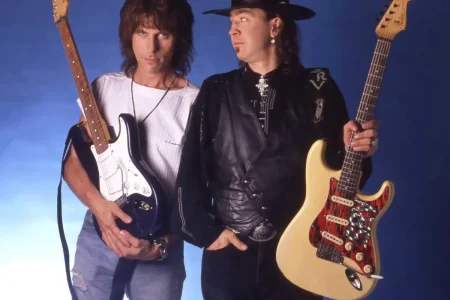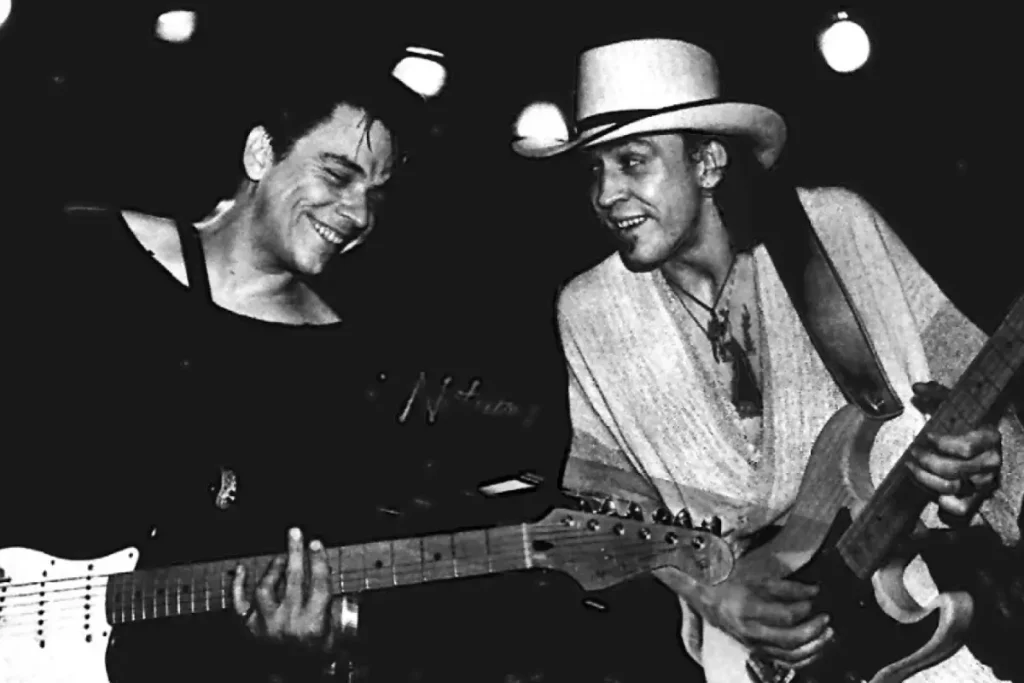
Stevie Ray Vaughan did not descend from the sky holding a battered Strat and a halo of tube-scream. He was built: record by record, riff by riff, and yes, decibel by decibel. The most revealing part of the Vaughan legend is not the arena triumph or the tragic ending, but the domestic scene: a kid in Dallas replaying the same sides until the grooves surrender, while his older brother acts as the human “translation layer” between obsession and musicianship.
In Texas Flood: The Inside Story of Stevie Ray Vaughan, Jimmie Vaughan remembers the first record he bought: “Wine, Wine, Wine” by the Nightcaps, “young white guys from Dallas playing blues and rock and roll.” He and Stevie learned to play “Thunderbird” from that record. Stevie counters with his own origin myth: the first record he bought was Lonnie Mack’s “Wham!” and he wore it out so thoroughly his dad broke it… repeatedly. It is funny, a little dark, and completely on-brand for the kind of drive that turns a bedroom into a training camp.
Why their “first records” matter more than their first guitars
Guitars are tools; records are instruction manuals, peer pressure, and a dare all at once. For the Vaughan brothers, the early 45s and LPs were a curriculum in groove, tone, and feel that no lesson book could deliver.
This is also why the “first record” stories hit harder than gear lists. A player can buy the same model amp, the same guitar, even the same strings, and still miss the point. The point is what they chose to listen to first, and what they were willing to sacrifice to become fluent in that language.
Jimmie’s gateway: The Nightcaps and Dallas blues credibility
Jimmie’s pick, the Nightcaps’ “Wine, Wine, Wine,” is a reminder that Dallas had its own ecosystem of bar-band R&B and blues-rock before it was fashionable. Jimmie’s description is blunt and important: “young white guys from Dallas playing blues and rock and roll.” That sentence contains the tension of the era and the spark of a scene: a local band proving you did not need to be born in Chicago to take the blues seriously.
When you hear that the brothers learned “Thunderbird” from the record, it reveals a specific kind of learning: copying a part, internalizing the pocket, then recombining it into your own vocabulary. That is how regional styles form, and it is how the Vaughans learned to sound like Texas without trying to invent “Texas” from scratch.
Practical takeaway: build a “local heroes” listening stack
If you want the Vaughan-style growth curve, do not only study giants. Add a few “close-to-home” records: players who are great but not mythologized. The psychological effect is real: it makes mastery feel attainable, and it forces your ear onto details rather than legend.

Jimmy Reed: the low, deep boogie that refuses to die
Jimmie says he “always liked that low, deep boogie thing” and that he would “get the records of anybody doing that stuff.” Jimmy Reed is the obvious cornerstone here: hypnotic vamps, simple parts that are deceptively hard to make feel right, and a band sound that is all about the shuffle rather than flashy gymnastics.
Stevie’s side of the story is almost a confession: he knew how Reed sounded, “but I couldn’t play it right. And Jimmie would set me straight.” That is one of the most underrated truths about Stevie’s development: his early superpower was not speed, it was being coachable about groove.
Practical takeaway: “easy” blues is a trap (in a good way)
- Record yourself playing a one-chord boogie for two minutes.
- Listen back for time drift and inconsistent accents.
- Fix one thing (pick attack, palm mute, or swing feel), then repeat.
The Vaughans understood something many modern players dodge: simple forms leave nowhere to hide. If your time is shaky, the song tells on you immediately.
Lonnie Mack’s “Wham!” and the birth of “too fast to believe”
Jimmie describes seeing Lonnie Mack on Dick Clark and being stunned: “he played so fast, I couldn’t even believe what I was hearing.” Stevie calls “Wham!” his first record and says he played it so obsessively his dad broke it, and Stevie just bought it again. That is not just fandom; it is deliberate repetition, the kind that rewires hands and ears.
Mack’s impact makes sense on a technical level. “Wham!” sits at an intersection: blues phrasing, rock urgency, and a lead-guitar voice that feels like it is trying to outrun the band. Mack is frequently credited as an early influence on later blues-rock and southern rock lead styles, and the fact that Stevie latched onto him first explains why Stevie’s playing never stayed politely inside “traditional blues.”
“I saw Lonnie Mack on Dick Clark, and he played so fast, I couldn’t even believe what I was hearing.”
Jimmie Vaughan, quoted in Texas Flood: The Inside Story of Stevie Ray Vaughan
“The first record I ever bought was Lonnie Mack’s ‘Wham!’ … my dad got mad and broke it!”
Stevie Ray Vaughan, quoted in Texas Flood: The Inside Story of Stevie Ray Vaughan
The cousin’s story: an 11-year-old doing real-time music theory
Gary Wiley (a Vaughan cousin) provides one of the most vivid “how did he get like that?” snapshots: Stevie, around eleven, listening hard to the radio, playing along on Jimmie’s inherited Gibson (a Gibson ES-125T), refusing to leave on bikes until he “nailed that part.” Then, suddenly, he is playing along “perfectly,” picking out multiple guitars and combining them into one coherent part.
This is the secret sauce: not just copying licks, but extracting structure. Stevie was already arranging in his head, reducing complex recordings into playable essence, then rebuilding them as a single guitar statement. That is musicianship, not mere mimicry.
Try the “Wiley test” at home
- Put on a recording with two guitars (rhythm + lead) and a busy bass line.
- Play along aiming for a single composite part that implies all of them.
- Keep your part repeatable like a real band arrangement, not a collage.
Loudness as identity: the Shure Vocal Master and the DIY arms race
Stevie’s childhood volume experiments are almost comedic: “When I didn’t think it could be any louder, I borrowed somebody’s Shure Vocal Master PA, put mics in front of the stereo speakers, and then turned the PA up!” That is not refinement. That is a teenager trying to turn a bedroom into a club, chasing the physical sensation of amplified guitar.
The Vocal Master portable PA is historically famous as a system used by countless bands and venues in the era, which helps explain why it would be accessible enough to borrow and abuse in exactly the way Stevie describes.
Here is the edgy claim: a lot of “SRV tone” talk is really “SRV volume” talk in disguise. He learned early that a guitar does not just sound different when it is loud; it behaves differently. Notes sustain, feedback becomes controllable, pick attack compresses, and your phrasing changes because the room is literally pushing back.
Do not copy the danger, copy the principle
- Principle: Learn how your sound changes at different SPL levels and gain stages.
- Modern substitute: Use an attenuator, load box, or modeler at safe volume.
- Goal: Consistent touch and time, not tinnitus and angry parents.
Jimmie as Stevie’s early “producer”: taste, discipline, and correction
Stevie openly admits Jimmie “would set me straight” on getting Jimmy Reed right. That dynamic matters: Jimmie was not just the older brother, he was a filter for authenticity. He kept Stevie connected to the underlying feel while Stevie’s raw horsepower kept trying to burst through the guardrails.
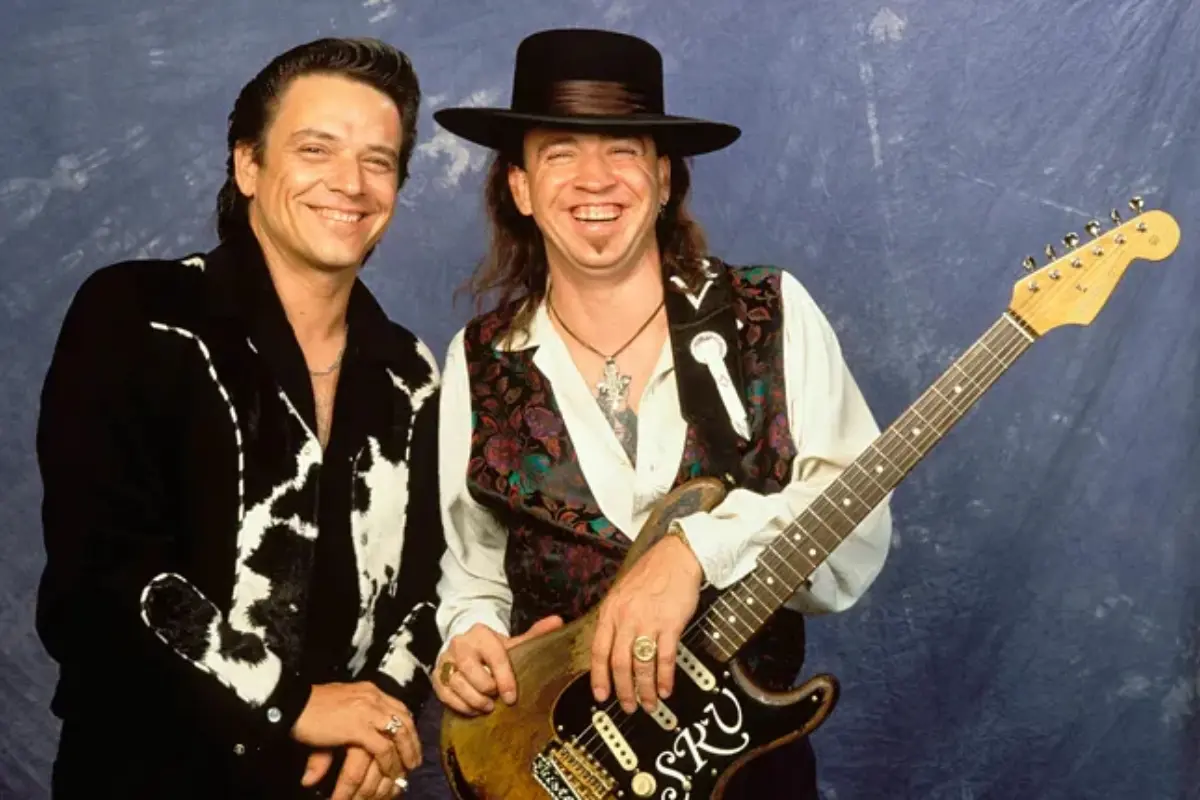
Later, their careers diverged in tone and presentation, but the early blueprint remained: Jimmie’s restraint and Stevie’s intensity are two halves of one family sound. Jimmie has often been framed as the “cool” Vaughan, and Stevie as the firestorm, but in practice they shaped each other’s musical ethics first and foremost.
Jimmie’s long, practical history in Texas blues and roots rock is also documented in formal musician oral histories, including NAMM’s Oral History program, which captures the industry context around players who built careers by serving the song rather than dominating it.
What this origin story says about the Texas blues “revival”
Stevie Ray Vaughan is frequently positioned as a spearhead of the 1980s blues-rock resurgence, and that is fair. But the origin story shows something less romantic and more interesting: it was not a sudden revival, it was continuity.
When you trace Stevie back through Jimmie’s Nightcaps 45, Jimmy Reed’s boogie vocabulary, and Lonnie Mack’s breakneck instrumental rock, you get a lineage that is more specific than “the blues.” It is regional taste plus obsessive listening plus relentless repetition. The Texas State Historical Association’s Handbook of Texas overview of Stevie underscores his Texas identity and career arc in a broader cultural frame.
A quick “Vaughan formula” table
| Ingredient | What it taught | What to practice |
|---|---|---|
| Nightcaps, “Wine, Wine, Wine” | Local blues-rock feel, attainable excellence | Steady rhythm parts with punchy accents |
| Jimmy Reed-style boogie | Time, swing, and minimalism | One-chord vamps with consistent groove |
| Lonnie Mack, “Wham!” | Lead guitar urgency and athletic phrasing | Fast pentatonic lines with clean articulation |
| Bedroom volume experiments | Touch, sustain, and controlled chaos | Dynamics and muting at multiple gain levels |
Listening like the Vaughans: a short, ruthless action plan
If you want to take something real from this story, skip the cosplay and steal their process. Their method was brutally simple: find a sound that hits you in the chest, then do the work until your hands can reproduce it without asking permission.
Step-by-step
- Pick one record that makes you react physically (tap foot, grin, wince).
- Loop 20 seconds and learn it by ear, not tabs.
- Write down what you notice: where the accents fall, where the notes breathe.
- Make one “composite part” that implies the whole band (Stevie’s radio trick).
- Play it at three volumes: quiet, band-loud, and “edge of feedback.”
That is the Vaughan path: equal parts listening, feel, and fearlessness. It is not mystical, but it is demanding.
Conclusion: the real Vaughan legacy is obsession with standards
The Vaughan brothers’ first-record stories are not cute trivia. They are evidence of a value system: groove matters, local scenes matter, mentors matter, and repetition is non-negotiable. If you want to honor Stevie Ray Vaughan, do not start with a signature guitar. Start with a record that scares you a little, and wear it out until it stops being scary.