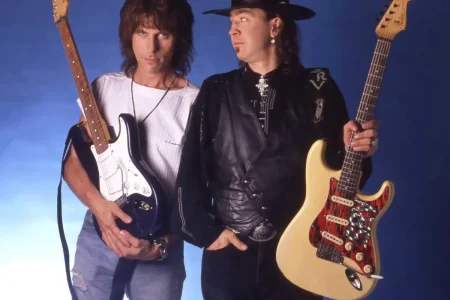
There are guitar heroes, and then there is Stevie Ray Vaughan. Even if you never owned Texas Flood on vinyl, the first sting of his Stratocaster can stop you mid-conversation. He made the blues feel dangerous again in the middle of the slick, neon 1980s, and guitar players have been trying to catch that lightning ever since.
From Dallas kid to blues-world shockwave
Stephen “Stevie” Ray Vaughan grew up in Dallas, Texas, the little brother watching Jimmie Vaughan chase B.B. King, Albert King and Hendrix licks on battered guitars. As a teenager he bailed on school, headed to Austin and worked his way through bar bands before crystallizing his sound with Double Trouble, tearing up the Montreux Jazz Festival, and catching the ears of David Bowie and producer John Hammond. Within a few years he had released Texas Flood, Couldn’t Stand the Weather, Soul to Soul and the Grammy winning In Step, then died at 35 in a post-show helicopter crash after playing Alpine Valley in Wisconsin.
It is a brutally short timeline: barely seven years of mainstream recording, then silence. Yet in that span he dragged Texas roadhouse blues into arenas, onto MTV and back onto the radar of rock listeners who thought the blues had been buried with the 1960s.
The guy who made blues dangerous again
Vaughan did not just play blues standards louder and faster. He fused Texas shuffle rhythms, Hendrix psychedelia and Albert King style bends with a rock frontman’s intensity, becoming a central figure in the 1980s blues resurgence and pulling rock fans into a genre many had ignored. Even years later, our own Know Your Instrument list of the best guitarists on record singles him out as a player who quite literally revived the blues in that decade.
Texas Flood is ground zero. Guitar World has called Vaughan the last great blues guitar hero of the 20th century, noting how that debut was cut in just two days yet vaulted him from clubs to arenas at a time when MTV preferred eyeliner to 12 bar shuffles. While pop radio chased synths, Stevie hit the airwaves looking like a spaghetti western gunslinger, making a Strat and a tube amp sound more dangerous than any gated snare or processed keyboard.

Tone and technique: why he still scares guitar players
Tuned down, cranked up
Part of the shock of Stevie’s sound is physical. He often tuned his guitars a half step down, then attacked them with an upside down whammy bar, using his palm instead of his pinky to wrench chords in and out of pitch. Offstage he devoured soul food and spiritual texts; onstage he hit the strings with the thick end of a pick and his whole arm, turning simple shuffles into controlled riots. Austin writers have pointed out that even modern stars like John Mayer carry his initials tattooed on their arm and describe his playing as a kind of devotional rage.
Then there were the strings. Where most rock guitarists were comfortable on light gauges, Vaughan routinely used heavy sets that went up into the .013 range and at times even thicker, turning his bends into a weightlifting exercise that produced piano like sustain and girth. Premier Guitar has traced how that choice helped spark a generation of players obsessed with heavier strings, vintage Strats and big Fender amps, all in pursuit of that massive roar.
Gear that hit like a truck
The recipe itself looked deceptively simple: beaten up Stratocasters into snarling Fender combos, goosed with a mid humped overdrive and wah when needed. One pedal in particular tells you what he was about. As Know Your Instrument’s pedal guide notes, the Dunlop Cry Baby wah that defined Hendrix and Clapton was also a Vaughan favorite, giving his solos that vocal, pleading quality you hear on tracks like “Voodoo Chile (Slight Return)” and live versions of “Texas Flood.” Plenty of players copy the setup; very few make it sound like a human voice about to crack.
From addiction to terrifying clarity
For all the swagger, Stevie’s story is not a simple guitar fantasy. Years of alcohol and cocaine nearly killed him, culminating in a collapse on a European tour in 1986 and an emergency trip to rehab. As Know Your Instrument’s deep dive into Eric Clapton’s memories of that era recounts, Vaughan emerged sober, focused and channeling his experience into songs like “Wall of Denial” and “Tightrope” on In Step, his first fully sober album.
Clapton, hardly a stranger to guitar genius, later admitted that on their final run of shows Vaughan was playing at a frighteningly high level, calling him flat out the best on the planet and remembering the Alpine Valley performance as a masterclass that left fellow legends standing on the side of the stage with their jaws dropped. The cruel twist is that he died just hours later, precisely when he had finally beaten the habits that had been trying to kill him.
How the blues world talks about him
Ask people who have to listen to guitar for a living and the praise turns almost fanatical. Biographer Alan Paul, co author of Texas Flood: The Inside Story of Stevie Ray Vaughan, says Vaughan quite literally “changed the trajectory of blues guitar” and brought listeners back to a form that had been pushed to the margins. Coming from someone who has spent years buried in tapes, interviews and session notes, that is not casual flattery.
Bruce Iglauer, the hard nosed founder of Alligator Records, goes further and calls Stevie “probably the greatest popularizer of blues guitar in history,” crediting the way he combined deep blues knowledge with modern technique and sheer ferocity. When a label boss who built his life on recording blues lifers says your impact on the audience rivals Clapton’s, it is a serious statement, not fan club hyperbole.

Four essential albums for understanding SRV
| Album | Year | Why it matters |
|---|---|---|
| Texas Flood | 1983 | Raw, almost live snapshot of a bar band suddenly plugged into the wider world. If the opening of “Love Struck Baby” does not move you, check your pulse. |
| Couldn’t Stand the Weather | 1984 | Shows how he could stretch the vocabulary: Hendrix covers, deep slow blues and instrumental ferocity like “Scuttle Buttin'” without losing that Texas swing. |
| Soul to Soul | 1985 | Not as polished, but you hear him pushing arrangements, adding keys and leaning into dynamics. It is the sound of a band trying not to repeat itself. |
| In Step | 1989 | Sober, sharp and emotionally direct. The Grammy winning capstone where songs about recovery sit next to some of his fattest tones and tightest grooves. |
What Stevie Ray still teaches guitar players
It is tempting to obsess over the trivia: the string gauges, the upside down bar, the home state barbecue joints. But the real lesson in Stevie’s playing is about commitment. He did not play licks; he committed to every note as if the song would fall apart if he eased up for half a bar.
That is why, decades after that foggy night in Wisconsin, crowds still gather at statues and tribute shows, and why modern stars talk about his solos like they are scripture. His tone was huge and his technique terrifying, but what really stuck was the feeling that he was betting his entire soul on each chorus. If you are a guitarist, that might be the most provocative part of his legacy: it quietly asks whether you are willing to play with that much truth.
Stevie Ray Vaughan did not live long enough to become the kindly elder statesman of the blues. Instead, he left as a Texas firebrand whose records still sound like a fight between chaos and control. For listeners and players who remember the 50s through the 90s, that mix of tradition and risk is exactly why he is not just another guitar hero, but the one who made the blues feel vital at a time when the world had almost stopped listening.