In early February 1968, the cameras outside Baptist Memorial Hospital in Memphis caught the image every fan wanted to see: Elvis in a sharp coat, Priscilla in a wheelchair, and a tiny bundled Lisa Marie in her arms. It looked like the rock and roll fairytale finally had its family ending, the kind of sweet family moment that would be replayed for decades in fan magazines and documentaries.
What those photographs did not show was the tension humming underneath. Elvis was terrified his career was over, Priscilla was reeling from a brutal pregnancy, and their marriage was already wobbling. The months after Lisa Marie’s birth sit right at the fault line between the King’s domestic dream and his last great comeback.
A baby born into a career crisis
Lisa Marie Presley, Elvis and Priscilla’s only child, arrived on February 1, 1968 in Memphis, nine months to the day after their Las Vegas wedding. At that moment Elvis was 33, a new father and, for the first time in his life, not sure the world still needed him, a far cry from the unstoppable force who had redefined American pop culture in the 1950s. Biographers note that the gap between his legend and his late‑1960s chart performance weighed heavily on him.
The charts told a cruel story. Of eight singles released between early 1967 and mid 1968, only a couple scraped the Top 40, and none came close to his 1950s dominance. The film soundtracks felt stale next to the Beatles and the Stones, and even Elvis knew he was churning out product, not revolution, a drift well documented in career overviews of his 1960s output.
When television director Steve Binder sat down with him to discuss an NBC special later that year, he did not sugarcoat it. As Binder later recalled, he told Elvis his career was essentially “in the toilet” before they rebuilt the show as a raw, live statement instead of a tame Christmas hour. Presley, hungry for honesty, agreed, and the collaboration would become the famed 1968 Comeback Special.
So when Lisa Marie was placed in his arms in that hospital room, Elvis was not just meeting his daughter. He was holding a reminder that time was moving on, even if his career seemed stuck in neutral.

Priscilla’s pregnancy: fairytale, panic, and a near separation
The public saw Camelot. Privately, Elvis and Priscilla had barely had time to be a couple before becoming parents. Priscilla has said they waited until their wedding night in May 1967 to sleep together, and that she became pregnant almost immediately, far sooner than either had planned.
New revelations from her later memoir go darker still. Priscilla writes that when it sank in she was pregnant from that honeymoon, Elvis asked if she wanted an abortion, reflecting both his fear of fatherhood and his obsession with her remaining the perfect, eternally desirable bride. She refused the suggestion, keeping the baby that would become Lisa Marie.
Then, seven months into the pregnancy, he hit her with something colder than any tabloid rumor. Out of nowhere, Elvis suggested a “trial separation,” telling her he was going through things he could not quite name. Within days he dropped the idea, but Priscilla later understood it as sheer panic about how a baby might wreck his carefully managed image and lifestyle.
That emotional whiplash would hang over the birth. For Priscilla, Lisa represented stability and purpose. For Elvis, she represented love, responsibility and the terrifying possibility that being a husband and father might make him look, in his own mind, less like a god and more like a man.
In the delivery room with the King
For all the turmoil, the birth itself gave Priscilla a glimpse of the man behind the myth. She later recalled the nurse placing a tiny Lisa Marie in her arms, and Elvis arriving moments later, relieved that both mother and baby were healthy. He kissed Priscilla, then wrapped them both in a hug that, for once, had nothing to do with cameras or Colonel Parker.
Over the next days, photographers caught them leaving Baptist Memorial Hospital and walking together with their four day old daughter, Priscilla still in a wheelchair, Elvis gazing down at the bundle in her lap. The images suggest a young Southern couple whose lives just got bigger than fame, bigger than Memphis, bigger than rock and roll.
But even there, you can see the split screen. Lisa’s arrival clearly moved him, yet the entourage, the doctors on call, the guards in the halls and the press outside all reminded everyone that this was not an ordinary family. Elvis was trying to plug a baby into a machine built for a phenomenon.
New dad, old habits
Priscilla has been blunt about what happened next. Elvis, she says, was not a hands on father. She embraced changing nappies and night feeds; he kept his nocturnal schedule, slept late, and let the Memphis Mafia orbit around him as always. He adored Lisa, but from a slight remove, more showman than stroller pusher, a dynamic she has described in reflections on her family life.
There was another, more intimate fracture. Priscilla later wrote that after Lisa’s birth, Elvis grew reluctant to sleep with her at all, telling her he had never been able to make love to a woman who had had a child. The man who wanted his wife eternally girlish and unspoiled now struggled to see the mother of his child as a sexual partner, and that contradiction cut straight into their marriage. Friends and biographers have linked this shift to the emotional distance that would eventually define their relationship.
In classic Elvis fashion, emotional discomfort often got answered with gifts and spectacle. The same personality that would later buy strangers Cadillacs on a whim was already operating here: if real closeness felt dangerous, he could still play the generous provider, keep the house humming, keep the toys coming, and hope no one asked why the distance kept growing.
1968 in two tracks: nursery upstairs, comeback downstairs
While Priscilla was learning to be a mother inside the Graceland bubble, something just as important was taking shape on the soundstage. The NBC special that would become famous as the 68 Comeback was filmed in June, barely four months after Lisa’s birth. Elvis went from cradling a newborn at home to stalking a Burbank stage in black leather, sweating under the lights like it was 1956 again, a transformation central to accounts of the special.
The special mattered because it was the first time in years that Elvis faced a live audience without the safety net of a Hollywood script. Binder pushed him to be raw, to sweat, to joke, to remember what it felt like when the music came first. The resulting broadcast pulled huge ratings and proved he could still terrify the competition when he cared enough to show up.
For gear heads, there is another layer of symbolism. On the show Elvis strapped on a cherry red Hagstrom Viking II borrowed from session guitarist Al Casey, chosen largely because it looked stunning on camera. That guitar, seen in the opening medley and later immortalized on the cover of From Elvis in Memphis, has since become one of the most coveted pieces of Presley memorabilia.

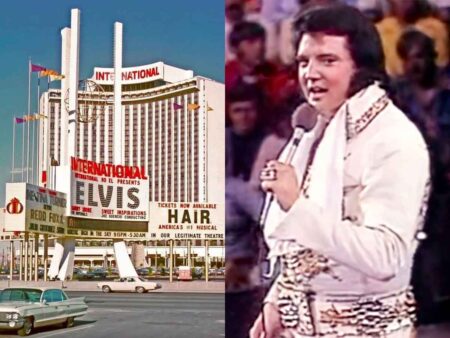
The family drama and the career reboot fed into each other. The special gave him his confidence back and set up the Vegas residency that would define his 1970s, a second act that thrilled crowds even as it pushed his health and addictions toward the breaking point, as detailed in analyses of how Las Vegas both revived and ultimately crushed him.
1968 at a glance: house, baby, broadcast
| Month | Presley family | Elvis’s career |
|---|---|---|
| February 1968 | Lisa Marie is born in Memphis; Elvis and Priscilla pose for those famous hospital photos | Soundtrack singles underperform, doubts about his relevance grow |
| Spring 1968 | Priscilla adjusts to life as a young mother in a mansion full of bodyguards and buddies | Colonel Parker locks in a TV special with NBC |
| June 1968 | Elvis spends long days in Burbank while Priscilla stays home with the baby | 68 Comeback is filmed, mixing staged numbers with feral sit down jams |
| December 1968 | Lisa’s first Christmas, already a celebrity infant | Special airs, tops ratings and jump starts his late career run |
Did Lisa save the marriage or expose its limits?
So what did Lisa Marie’s arrival actually do to Elvis and Priscilla as a couple? On one level, Priscilla has said the baby brought them closer, at least for a time. In the hospital room, she saw a relaxed, vulnerable Elvis who did not have to play the superstar or the sex symbol, just a nervous young father hoping he did not drop his daughter, a scene recalled in later timelines of their relationship.
On another level, the same baby exposed fault lines that had been there since Germany. Elvis liked his women frozen in a kind of permanent adolescence: adoring, dependent, untouched by adult responsibilities. Once Priscilla became a mother, she could not play that role without lying to herself, and Elvis could not square his mother worship with the idea of sharing a bed with a woman who now carried that title.
Biographers and friends have long argued that from 1968 on, the marriage slowly shifted from romance to partnership, then to polite co parenting. Elvis kept touring, working and straying. Priscilla, eventually, would have her own affairs and finally leave. But they never entirely untangled their lives, and Lisa remained the one bond that could get them in the same room without the old battles taking over.
Seen from a distance, 1968 looks like the last moment when all of Elvis’s contradictions were still in one small house: the kid from Tupelo desperate to be loved, the fading movie star plotting a resurrection, the newly married man unsure he wanted to be a husband, and the terrified father cradling a newborn girl who would outlive him and, in time, carry the Presley myth into a new century, even as that myth would later be reshaped by his grueling Las Vegas years.
If you listen to the 68 Comeback with that in mind, the show hits differently. The leather, the grin and the snarling guitar lines are still there, but behind them you can almost hear the clock ticking upstairs in Graceland, where a young woman is figuring out motherhood alone and a baby named Lisa Marie is crying for a father who is already half legend and half ghost.