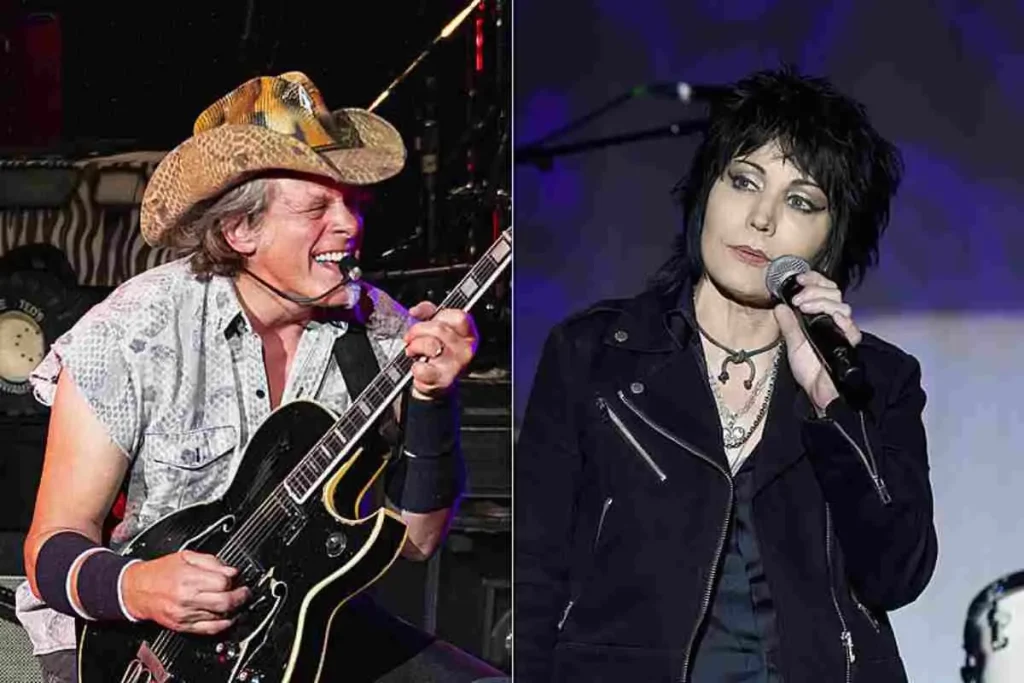
Joan Jett has never needed a PR team to translate her feelings. When she took aim at Ted Nugent with the line, “Ted Nugent has to live with being Ted Nugent. He plays being a tough guy but this is the guy who shit his pants – literally – so he didn’t have to join the army,” she wasn’t merely tossing a celebrity insult. She was detonating a specific kind of rock myth: the chest-thumping, flag-waving hardman who sells aggression as authenticity, while carrying baggage that doesn’t match the pose.
“Ted Nugent has to live with being Ted Nugent. He plays being a tough guy but this is the guy who shit his pants – literally – so he didn’t have to join the army.” – Joan Jett (as reported by NBC News)
This is a story about more than an infamous quote. It’s about how Vietnam-era conscription still functions like a moral X-ray for public figures, why “tough guy” branding in rock is often theater, and why Jett’s bluntness landed so hard.
What Jett was really attacking: persona, politics, and credibility
Jett’s dig works because it’s aimed at a contradiction. Nugent’s public image has long leaned into macho self-mythology: hunter iconography, combative talk, and a brand that frames him as fearless and unfiltered. Jett’s point was that a persona built on toughness becomes fair game if the artist also lectures others about duty, patriotism, or strength.
In other words, she wasn’t just calling him gross. She was calling him performative.
Why it hit a nerve in rock culture
Rock has always rewarded loud certainty. The genre’s history is full of characters who posture as outlaw heroes while the boring paperwork tells a different story. Fans may forgive messy personal lives, but they’re less forgiving about hypocrisy, especially when it’s wrapped in moralizing.
Even a dictionary definition captures why this kind of takedown lands: hypocrisy is a mismatch between stated beliefs and actual behavior. Merriam-Webster defines it as “a feigning to be what one is not”. That’s basically the thesis of Jett’s insult.
The Ted Nugent draft story: what’s known vs. what’s provable
The “shit his pants” line didn’t come from nowhere. Variations of the claim have circulated for years, largely tied to Nugent’s own past comments about the draft and the physical exam process. What makes the story sticky is that it mixes a genuine historical system (Selective Service and induction exams) with rock-star storytelling, which is notoriously elastic.
Here’s what can be stated carefully: Nugent has been criticized for draft avoidance and for telling versions of his own history that critics argue undermine the tough-guy posture. Beyond that, any specific details about bodily functions quickly turn into a game of telephone unless you’re quoting his exact words in context and comparing them with verifiable records.
One reason this controversy never fully resolves is that the most reliable evidence for a specific draft-evasion “tactic” is often missing. The Vietnam era produced an enormous paper trail, but individual medical determinations and draft board outcomes aren’t always public, easy to access, or complete. Meanwhile, the story survives because it functions as a punchline that symbolizes a larger accusation: the gap between image and reality.

What Wikipedia can and can’t do here
Wikipedia is useful for orientation on public narratives, but it shouldn’t be treated as the final authority on disputed personal claims. Still, it’s a quick way to see how widely the draft controversy around Nugent is referenced in public summaries of his life.
Why the Vietnam draft still matters in American arguments
For older music fans, the Vietnam draft isn’t abstract history. It’s a memory that shaped families, politics, and the music of the era. That’s why “draft dodger” remains such a live wire phrase. The accusation isn’t only legalistic; it’s moral and cultural.
Understanding why Jett’s comment resonated requires a quick look at the system she’s referencing.
Selective Service, conscription, and the scale of induction
The Selective Service System’s own induction statistics show how many people were inducted over time, underscoring why the draft was a mass national experience rather than a niche issue.
And for readers who want primary archival context, the National Archives’ Vietnam War resources point to how extensive the documentary record is for the era.
For a plain-language overview of how the system works today, USA.gov’s guide to Selective Service registration is a useful reference point.
Joan Jett’s credibility: why her voice carries weight
Jett’s punchy one-liners matter because she isn’t a random pundit parachuting into rock history. She’s a foundational artist who built her career without asking permission, including early mainstream success as a woman fronting hard rock in an industry engineered to sideline her.
Biography’s overview of her career captures the arc: The Runaways, her solo breakthrough, and her long-term influence. Jett has spent decades being labeled “too much” by people who benefit from men being allowed to be louder, dirtier, and meaner in public.
So when she calls out macho cosplay, it’s not theoretical. It’s lived experience.
The insult as a strategy: how Jett flipped the power dynamic
Jett didn’t debate Nugent on a policy white paper. She attacked his brand identity in a sentence. That matters because Nugent’s persona depends on dominance signaling: intimidation, swagger, and a sense that he “wins” by being more aggressive than everyone else.
A crude image is disarming because it makes “toughness” look ridiculous. It forces a reframing: if your identity is built on being the baddest guy in the room, you don’t get to control the room if someone turns you into a joke.
Why “live with being Ted Nugent” is the sharper blade
The poop detail is the headline, but the deeper cut is the line about having to live with himself. That’s a classic rock-and-roll curse: fame can’t protect you from your own reputation, and reputations are often the longest-lasting artifact an artist leaves behind.
In that sense, Jett’s insult is less about the body and more about consequence.
Media amplification: how a quote becomes a cultural event
Jett’s comment ricocheted because it was tailor-made for the modern news cycle: profane, visual, morally framed, and attached to two recognizable names. NBC News published it in a way that emphasized the confrontation and its political undertones.
AP News, as a baseline example of wire-service influence, helps explain how entertainment-politics stories travel quickly across outlets even when the originating interview is elsewhere. (Wire copy syndication often drives the “everyone covered it” effect.)
What gets lost when the quote goes viral
Viral quotes flatten context. The public ends up discussing the grossest detail rather than the argument underneath: how public figures leverage patriotism, toughness, and judgment against others while being vulnerable to scrutiny of their own choices.
If you’re writing or thinking about this moment historically, the quote is the hook. The real content is the collision between brand identity and Vietnam-era moral memory.
Rock bravado vs. real bravery: a practical listener’s guide
If you want to read moments like this more intelligently (and with less knee-jerk tribalism), try evaluating a “tough guy” artist using criteria that don’t depend on whether you like the riffs.
| Question | Why it matters | What to look for |
|---|---|---|
| Do they moralize about duty or courage? | That invites scrutiny of their own record. | Interviews, speeches, political endorsements. |
| Is the persona consistent over decades? | Long-term consistency suggests conviction, not costume. | Shifts in messaging when the market changes. |
| Do they admit complexity? | People who never admit doubt are often selling something. | Nuanced statements vs. constant dominance posturing. |
| Are claims verifiable? | Rock stories grow in the telling. | Primary records, reputable reporting, direct quotes. |
What this feud reveals about the music world
Jett vs. Nugent isn’t primarily a musical beef. It’s a clash of archetypes. Jett represents competence without cosplay: show up, play hard, outlast. Nugent, fairly or not, is often framed through the lens of provocation and identity politics rather than craft.
And that difference matters to listeners who grew up when rock stars were expected to be rebels. The modern twist is that “rebellion” can be a product, and a product can be mocked.

Conclusion: the quote endures because it’s about consequences
Joan Jett’s takedown stuck because it attacked the foundation of a public image, not a guitar solo. Whether you see it as righteous, crude, or both, it’s a reminder that rock personas are fair game once they’re used as moral weapons.
In the end, the most brutal part of her line isn’t the bathroom imagery. It’s the suggestion that the loudest guy in the room may still be trapped inside the character he built.