When producer Tony Visconti first walked into a tiny London studio to record a strange acoustic duo called Tyrannosaurus Rex, he did not hear radio polish or conservatory technique. What he heard was a small guy with a battered guitar who somehow felt larger than the room.
Visconti later recalled that what struck him in Marc Bolan had nothing to do with strings or ornate arrangements, but with an almost feral spark of personality and sound. That instinctive call would help turn a Tolkien-obsessed folk poet into one of the loudest detonations in British rock history.
The day Visconti met the boogie poet
By 1967 Bolan had already burned through failed singles and a brief stint in John’s Children before forming Tyrannosaurus Rex with percussionist Steve Peregrin Took. The pair became an underground sensation on the UK hippie circuit, singing whimsical, psychedelic folk over hand drums and acoustic guitar, and releasing a run of late 60s albums that slowly nudged toward electricity.
It was this shoestring duo that Visconti was sent to record. He has said they were poor, working class kids with symphonies in their heads, and that he refused to drown them in strings because the songs and Bolan’s presence were already “challenging and full enough.” Instead of hearing a niche folk act, he heard a future rock star hiding inside a budget production and a bongo-driven trance.
Raw talent vs high artistry
Visconti’s comment cuts to a brutal truth many musicians hate to admit: audiences rarely fall in love with high standards of artistry alone. They fall in love with identity, attitude and narrative, then forgive the rough edges. Bolan had all three in absurd quantities long before his chord changes got interesting.
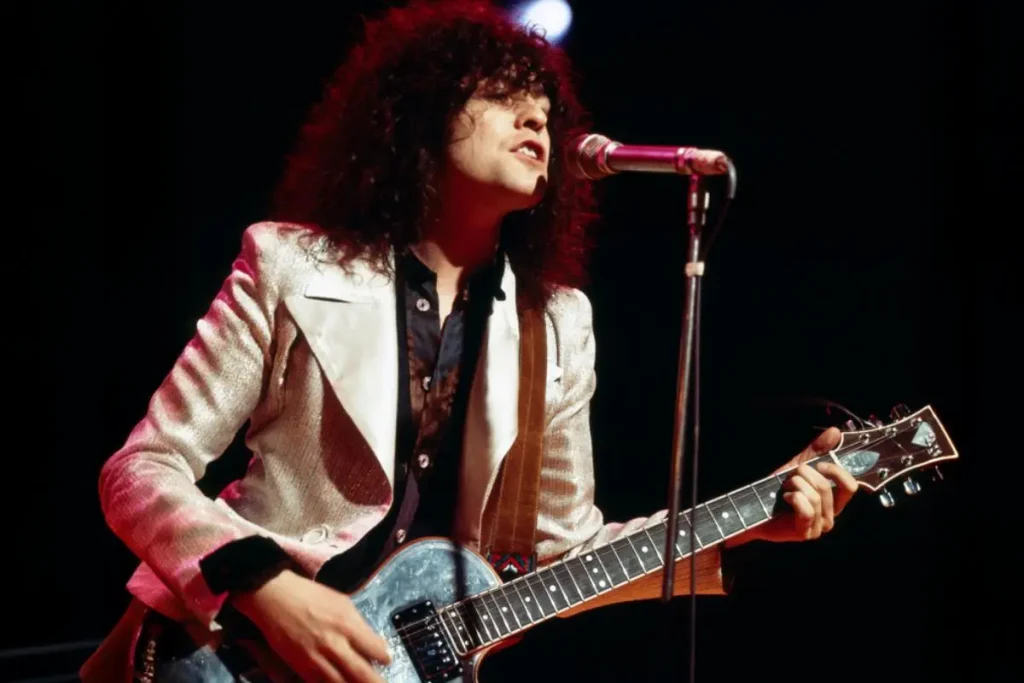
On paper he was not a virtuoso. His songs leaned on simple progressions and repetitive riffs, yet within a few years he had fronted T. Rex to eleven UK Top 10 singles, four number ones, and the landmark Electric Warrior album, while his glitter-dusted Top of the Pops performance of Hot Love is still cited as glam rock’s ignition point. The gap between the bare statistics and the supposed “simplicity” of his music is exactly where raw talent lives.
From Tolkien folkie to glitter messiah
From bongos to boogie
Early Tyrannosaurus Rex shows sounded like a séance run by two kids who had raided both the poetry section and the costume rack. Song titles read like fantasy novellas, Took slapped out pagan rhythms on bongos, and Bolan chanted lines about druids and unicorns with a vibrato that was equal parts Gene Vincent and fairy-tale narrator.
But Visconti could hear the problem: underground adoration does not pay the rent. His gamble was to let Bolan’s pop instincts, not the occult window dressing, move to the front. The duo’s sound thickened with electric guitar, the name was brutally chopped down to T. Rex, and suddenly the incantations sat on top of a rock and roll engine instead of a campfire drone.
Three eras of a short, ferocious career
In barely a decade, Bolan managed to reinvent himself more times than many bands do in thirty years. A quick look at his phases shows how little “purity” mattered compared to momentum and persona.
| Era | Rough years | Core sound | Visconti’s studio focus | Signature track |
|---|---|---|---|---|
| Tyrannosaurus Rex underground | Late 60s | Acoustic psychedelia, bongos, fantasy lyrics | Capturing hypnotic grooves without fancy overdubs | ‘Debora’ |
| Bolanmania glam peak | Early 70s | Crunchy riffs, handclaps, strings, glitter-pop hooks | Stacked arrangements that still sounded loose and dangerous | ‘Get It On (Bang a Gong)’ |
| Restless experimentation | Mid 70s | Rock spliced with funk, soul, disco and R&B | Finding groove and drama in shifting lineups and styles | ‘Dandy in the Underworld’ |
The constant in all three periods was not a particular guitar tone or production trick. It was Bolan’s conviction that his slightly cracked voice, strange poetry and strut deserved to sit in the center of the frame.
Inventing glam: glitter, gender and guitars
By 1971 that conviction had collided with television. When T. Rex performed Hot Love on Top of the Pops with Bolan’s cheekbones dabbed in glitter, it looked like a transmission from another planet. Within a few years critics were calling him a pioneer of glam rock, Electric Warrior a key glam blueprint, and his brief run of hits comparable in UK impact to Beatlemania.
Musically, the breakthrough was just as radical. On Electric Warrior and its singles, Visconti framed Bolan’s chugging Chuck Berry riffs with strings, horns, massed backing vocals and plenty of open space, turning basic grooves into stadium chants. Looking back, Visconti has called Bolan “criminally underrated as a guitarist,” arguing that there is a little bit of T. Rex in almost every rock band that ever tried to balance swagger with pop melody.
Bolan, Bowie and the fight for the future
History classes usually hand the glam rock crown to David Bowie and Ziggy Stardust, but the story is messier, and nastier, than that. A recent documentary, Angelheaded Hipster, leans into Bolan’s role as co-architect, noting that he and Bowie were among the first major rock stars to say out loud that they were bisexual, and to weaponize glitter, makeup and androgyny against rock’s hyper-masculine norms.
The same film and its coverage are blunt about the fallout. In the United States Bolan was effectively filed under “one hit wonder” for Bang a Gong, while Bowie became a deity, even though in early 70s Britain T. Rex were scoring multiple number ones and causing full scale hysteria. The documentary’s director flatly calls Bolan a missing link between the 50s rockers and the new wave and alternative scenes that exploded in the 80s.
Some writers push the claim further, arguing that without Bolan kicking open the door there might have been no Ziggy Stardust, no Slade and Sweet on children’s TV, no Roxy Music swanning through art-school decadence, no Alice Cooper turning shock into pop theatre. Whether you buy that or not, it is hard to deny that Bolan drew the outline that others later colored in.

From glam rock to Sunset Strip excess
A decade after Bolan first smeared glitter on his face, the same cocktail of androgyny, hooks and hedonism was blowing up again on Los Angeles’ Sunset Strip. The 80s glam metal scene of Mötley Crüe, Ratt and Quiet Riot simply swapped Bolan’s English whimsy for L.A. sleaze, but the basic equation was identical: huge choruses, cartoon sexuality and the sense that a rock show was half ritual, half circus.
Legacy: still raw, still dangerous
Bolan’s car crash in 1977 froze the story at 29, but it did not end it. T. Rex were finally inducted into the Rock & Roll Hall of Fame in 2020, with Ringo Starr calling Bolan “a poet” during the ceremony, and a parade of admirers from Billy Idol to Joan Jett lining up to testify to his influence.
Decades after his death, previously unheard recordings are still emerging. In 2025 the Bolan estate released I’m Dazed, a slick but strange track cut in 1975 with the classic T. Rex lineup, while English Heritage marked his 78th birthday by installing a blue plaque at his former London home. For a supposed cult figure, that is a remarkable amount of noise.
What musicians can learn from Visconti’s gamble
Visconti was not betting on flawless guitar solos or perfectly tuned vocals. He was betting on the fact that when Bolan opened his mouth, you knew exactly who it was within one bar, and that no amount of money could buy that kind of fingerprint.
- For producers: listen for identity before technique. If a singer or guitarist sounds like nobody else, resist the urge to sand it down into something generic.
- For songwriters: simple chords are not a crime. Bolan proved that a three chord boogie can reshape culture if the phrasing, rhythm and attitude are unmistakably yours.
- For guitarists: chase feel, not fretboard gymnastics. The riffs on Electric Warrior are not complex, but they punch because they are played with absolute commitment and a clear sense of drama.
- For performers: image is not shallow if it is honest. Bolan’s glitter, curls and satin were extensions of the songs, not a disguise for weak material.
- For everyone: do not wait for “high standards of artistry” before you act. Bolan’s greatest records sound loose, occasionally sloppy, and completely alive.
The producer, the misfit and the birth of glam
Visconti’s first impression of Marc Bolan was not of a meticulous craftsman but of a misfit who made the air in the room change. Trusting that feeling, he built records that magnified the chaos instead of tidying it away, and in the process helped invent glam rock. For players and producers today, the lesson is uncomfortable but liberating: perfection is optional, personality is not.