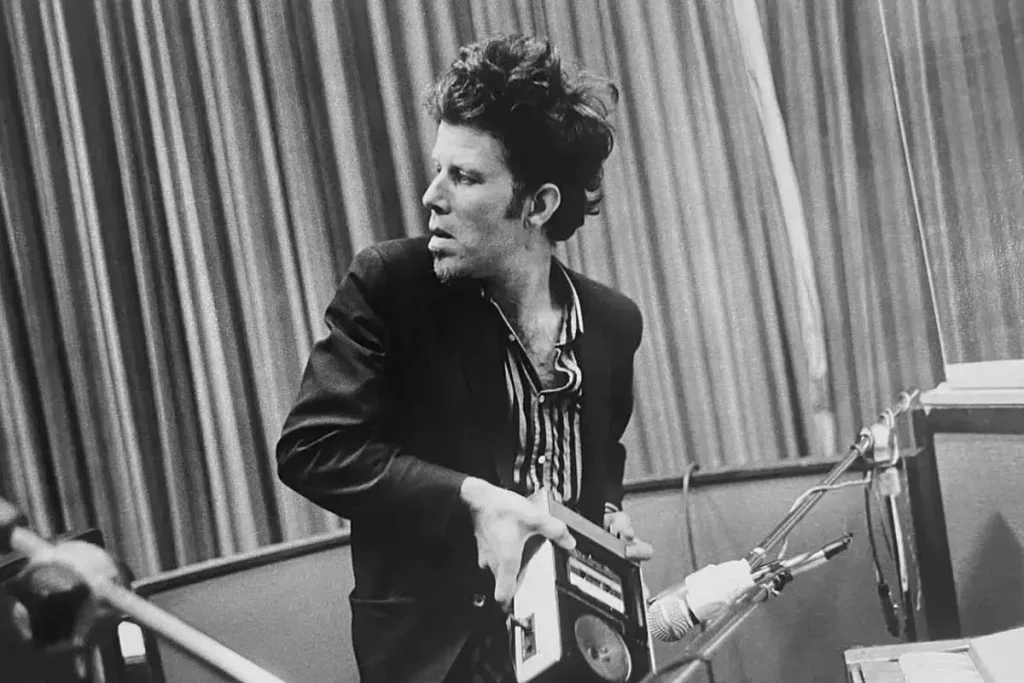
Tom Waits has never talked about songwriting like a professional who “delivers product.” He talks like a hunter, a cook, and a saboteur of tidy expectations. In one of his most vivid riffs, he warns that songs become “domesticated, complacent little creatures” once they’re recorded, and says he prefers them “raw, with the pulp and seeds” because “those are nutrients” – a jab at what he calls “highly processed music” and the spiritual ailments it supposedly causes.
It’s funny, grotesque, and strangely practical. Waits is describing an approach to art where friction is not a bug – it’s the power source. If you’ve ever wondered why his records feel alive decades later, this is the blueprint: keep the bird, not just the feathers.
The “wild song” idea: art that refuses to behave
Waits frames songs as creatures that panic the moment they sense capture. The “crack of that rifle” is the studio, the schedule, the expectation that a song must become a clean, repeatable object. His cure is preparation and patience: he jokes about having “three days worth of food and a scope,” implying you earn the song by staking out its truth rather than forcing it.
Behind the comedy is a serious claim: a song is not the demo, the chart, the hook, or the playlist placement. It’s a living event that can die when you over-handle it. That’s not anti-technology, either – it’s anti-sanitization.
“You want to avoid recording the feathers and throwing away the bird.” – Tom Waits, quoted by Edna Gundersen
What Waits really attacks when he mocks “highly processed music”
Waits isn’t diagnosing actual “rheumatic fever” from pop radio. He’s mocking how modern music can be flattened into something over-compressed, over-edited, and emotionally risk-averse. When everything is corrected, nothing is surprising, and surprise is a big part of why humans keep listening.
His point lands because we all recognize the sonic equivalent of fast food: songs engineered to hit the same pleasure buttons, the same way, every time. Waits argues for the opposite: food you can chew, with grit you can feel.
Raw vs processed: a simple listening test
| If the record feels like… | You’re hearing… | What you may be missing |
|---|---|---|
| Polished glass | Control and uniformity | Accidents, breath, unstable emotion |
| Rusty machinery | Texture and risk | Perfect pitch, predictable “shine” |
| A room with air in it | Space, distance, dynamics | Maximum loudness all the time |
Misunderstanding as a creative weapon
Waits doesn’t merely tolerate mishearing – he loves it. He describes enjoying a song “from a radio far away,” broken up by “a tractor or an airplane or the wind,” because the missing pieces let your brain complete the story. That’s a surprisingly accurate description of how perception works: we don’t passively receive sound; we predict it and fill gaps.
He even celebrates other people’s errors. He recounts filmmaker Terry Gilliam mishearing “in a Portuguese saloon” (from “The Part You Throw Away”) as “On the porch, the geese salute,” and he calls the misheard version “better.”
“That’s better! I hope more people misunderstand me.” – Tom Waits, quoted by Edna Gundersen
If you’re a songwriter, that’s not just a quirky anecdote. It’s permission to treat language as sound first and literal meaning second. It also explains why Waits’s lyrics often feel like overheard fragments, half-dream logic, and street-corner poetry: ambiguity is part of the instrument.
Studio “filters,” lint, and the art of keeping the noise
Waits’s metaphor of the recording process as a machine with a “filter” is a killer image. It suggests that when you press record, some essential grime gets trapped, some emotion gets lost, and you have to ask what you’re trading away for fidelity.
Then he flips it: sometimes you “pull out that lint and make other songs.” That’s basically a mission statement for musique concrète, found sound, and experimental production techniques. It’s also a reminder that mistakes are not merely acceptable; they can be recyclable fuel.
A practical “Waits-style” approach to recording raw songs
- Leave one element uncorrected. Keep a vocal crack, a timing wobble, a guitar squeak. Let the body stay in the track.
- Print a sound with commitment. If you love the distorted mic, record it distorted instead of “fixing it later.”
- Record distance on purpose. A far mic or a hallway capture can add story and mystery.
- Build a “lint bin.” Save odd takes, count-ins, room tone, and broken loops. Mine them later.
Waits’s catalog is often used as shorthand for “weird,” but the method is disciplined. The oddness is curated, not random. That’s why it lasts.
Why discomfort works: tension as a form of honesty
Waits says he “thrives on pain and discomfort” and likes “misunderstandings.” Taken literally, that sounds masochistic. Taken artistically, it’s a philosophy: if your work never risks embarrassment, it probably never risks revelation.
In music, comfort is often the enemy of character. A flawless vocal can still be lifeless. A beat locked to the grid can still be boring. Waits argues for the value of abrasion: the part that catches in your throat is often the part that proves something human happened.
The voice as an instrument (and a legal identity)
Waits’s vocal sound is so distinctive that it has been treated as something protectable, not just stylistically recognizable. In Waits v. Frito-Lay, Inc., a U.S. court case centered on an alleged sound-alike commercial, the dispute highlights how a singer’s vocal identity can be more than “tone.” It can be persona, authorship, and brand.
That matters to the “raw songs” argument: if your voice is truly yours, polishing it into generic smoothness can be a kind of self-erasure. Waits built a career out of doing the opposite.
Listening like Waits: get away from the lab and back to the street
One reason Waits’s “far away radio” comment hits is that it describes a real listening environment: imperfect, interrupted, and physical. The modern default is the opposite: isolated, high-resolution, optimized, and always available. Convenience is great, but it can bleach the romance out of sound.
There’s also a literal health angle worth taking seriously: loud listening over time can damage hearing. The World Health Organization’s overview of deafness and hearing loss frames hearing loss as a major global health issue and emphasizes preventable risk factors.
Noise exposure is also a workplace safety issue, with OSHA’s guidance on occupational noise exposure outlining how hazardous noise can harm hearing and how exposure is assessed.
And the U.S. National Institute on Deafness and Other Communication Disorders explains why noise-induced hearing loss can be permanent.
A “raw listening” checklist that doesn’t wreck your ears
- Lower the volume and increase the detail. If the track is good, you don’t need it brutal to feel it.
- Change the context. Listen in the kitchen, the garage, or on a walk. Let life leak into the music.
- Try imperfect sources. AM radio, a cheap speaker, an old mono mix. Notice what still communicates.
- Take quiet breaks. Your ears fatigue. So does your attention.
Waits the myth vs Waits the craftsman
Waits is often treated like a mystical swamp creature who crawled out of a piano bar. But he’s also a songwriter with a long, traceable career arc and a documented body of work. Reference sources that map his discography and credits show the scope and consistency behind the “wild” persona.
Profiles and archives also place him in a broader American tradition of storytelling, stage voice, and character songwriting rather than pure rock posturing, with the Library of Congress listing a Tom Waits collection among its holdings.
Even mainstream outlets that cover him tend to emphasize how his work resists typical commercial logic while still commanding serious attention, as seen in an interview around Bad as Me.
And if you want the quick-and-dirty context of how the world summarizes him, a standard biographical overview captures the broad outlines: singer-songwriter, actor, and a career defined by an unmistakable voice and experimental turns.
Three provocative takeaways (use at your own risk)
- Over-cleaning is cowardice disguised as professionalism. If you remove every flaw, you also remove evidence of a real event.
- Mishearing is a free co-writer. The brain is a remix engine. Let it hallucinate new lines.
- The best songs are not “content.” They’re creatures. Treat them like trophies and they die; treat them like wildlife and they surprise you.
Conclusion: keep the bird
Tom Waits’s metaphors are extreme because he’s fighting a real cultural gravity: the pull toward smoothness, predictability, and frictionless consumption. His answer is rawness, misinterpretation, and the courage to keep what most producers are trained to remove.
If you want your music to feel alive, stop trying to make it perfect. Make it edible – pulp, seeds, nutrients and all.