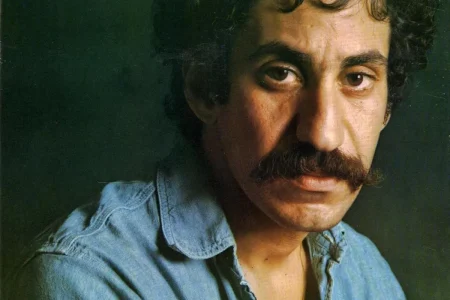
By the end of the 1970s, Tom Waits looked destined to grow old as the house pianist in his own mythology: a cigarette-scorched barfly croaking lullabies to drunks at closing time. Then he married Kathleen Brennan, a quiet Irish-American with a wild record collection and no patience for his self-pity. What followed is one of pop music’s great mid-life detonations, where a beatnik balladeer became a junkyard avant-blues composer almost overnight.
The barstool poet hits the wall
Across seven Asylum albums, from 1973’s ‘Closing Time‘ to 1980’s ‘Heartattack and Vine’, Waits specialised in piano-led story songs about nighthawks, boozers, drifters and con men, sung in a gravelly croak that sounded soaked in whiskey and Chesterfields. Rhino’s label bio places him in seedy motels like the Tropicana, living out his lyrics while touring small clubs with a smoky jazz combo.
The image was compelling but corrosive. In a 2006 interview he looked back on that era as an alcohol problem disguised as a career, saying his early work was steeped in drink and that his future wife Kathleen ‘saved my life’, adding with typical gallows humour: ‘I didn’t just marry a beautiful woman, I married a record collection’.
Enter Kathleen Brennan: record collection as detonator
Brennan was a script editor, not a groupie. Waits first met her on the set of ‘Paradise Alley’, then fell hard while scoring Coppola’s ‘One from the Heart’; they married in 1980 at a 24-hour chapel and soon left Los Angeles for a farm in northern California. He later tied that domestic shift directly to changing labels, saying the move and family life were bound up with protecting his musical freedom from industry expectations.
More important than geography was what Brennan brought into the house. In an interview archived at Tom Waits Library he jokes that ‘a good woman will push you beyond your normal restricted safe area’, then admits that before her he was ‘still in the box’. Her immaculate LP shelves held the Animals, Mitch Ryder, Captain Beefheart, Gavin Bryars’s ‘The Sinking of the Titanic’, Harry Partch, New Orleans street chants by the Wild Tchoupitoulas, Louis Prima and cabaret singer Mabel Mercer, while his own records were ‘all scratched and had cheese on them’.
Beefheart stains and homemade instruments
Biographers now draw a sharp line at that 1980 marriage. With Brennan’s encouragement, Waits split from manager Herb Cohen and Asylum, and started aiming for something harsher and stranger than his smoky jazz-blues. He has said outright that she introduced him to Captain Beefheart and maverick composer Harry Partch, later quipping that ‘once you’ve heard Beefheart it’s hard to wash him out of your clothes. It stains, like coffee or blood’, and crediting her for the idea that junk percussion and found objects could be the engine of his songs, not just background noise.

Money shock and firing the grown-ups
The artistic break coincided with brutal numbers. In a Mojo interview, preserved as ‘The Business‘, Waits recalls leaving Cohen, assuming he was rich, then discovering ‘I thought I was a millionaire, and it turned out that I had, like 20 bucks’. Years of litigation followed, with Brennan at his side as they managed his career themselves; she was the one who told him ‘look, you can do this’ and pushed him to walk into the studio without an outside producer for the first time.
Even his cherished producer Bones Howe had to go. As Howe later told Far Out magazine, Waits realised he was writing while asking ‘if I write this, will Bones like it?’, a fatal question for any artist. Brennan urged him to trust his own ear, and when he brought the jagged, self-produced ‘Swordfishtrombones’ to Asylum, label president Joe Smith refused to release it, warning he would ‘lose all [his] old fans and gain no new ones’.
‘Swordfishtrombones’: the rejected masterpiece
Waits wrote much of ‘Swordfishtrombones’ on a trip to Ireland, then cut it at Sunset Sound in Hollywood with himself in the producer’s chair. When Elektra-Asylum balked, Island Records founder Chris Blackwell snapped it up; a later label retrospective notes how stunned the old company was by an ’embarrassment of inventive riches’, and quotes Waits praising Brennan as the first person who convinced him that wildly different artists – James White and the Blacks, film scorer Elmer Bernstein, folk legend Lead Belly – could all ‘be on the bill together in you’.
The record sounds like that philosophy in action. The cocktail piano and muted sax that defined his 1970s work give way to marimba, Salvation Army horns, martial drums, pump organ, accordions and clattering junk metal, with characters who feel less like barroom sketches and more like figures in a crooked folk tale. ‘Swordfishtrombones’ did not suddenly turn him into a pop star, but it blew open the door for ‘Rain Dogs’ and ‘Franks Wild Years’ and effectively created a new subgenre: gutter poetry scored for broken orchestra.
Before Kathleen vs after Kathleen
A 2025 Pitchfork deep dive on ‘Rain Dogs’ bluntly divides his career into ‘before Kathleen’ and ‘after Kathleen’. It traces how, once free of Cohen and Howe, Waits signed to Island, produced ‘Swordfishtrombones’ himself and moved to New York, where Brennan helped him pull in downtown experimenters like guitarist Marc Ribot and drummer Stephen Hodges, building bands around marimba, glass harmonica, marching-band bass drums and kits with few or no cymbals, so the rhythms roll and lurch instead of politely keeping time.
For listeners who lived through both eras, the contrast is easy to hear:
| Era | Typical sound | Creative setup |
|---|---|---|
| Before Kathleen – Asylum years | Smoky piano, sax and brushed drums in a late-night jazz club haze. | Managed by Herb Cohen, produced by Bones Howe, songs written alone to serve a fixed barfly persona. |
| After Kathleen – Island junkyard years | Clattering percussion, marimba, accordions and brass working like a street-carnival band, with little or no cymbal wash. | Self-managed with Brennan, self-produced, songs co-written with her and arranged for shifting casts of adventurous players. |
The voice stayed rough, but the frame around it changed completely. Where the Asylum records sound like one long night in the same bar, the Island albums feel like a fever-dream travelogue, jumping from New Orleans funerals to Balkan circuses to backwoods gospel tent revivals, all stitched together in Brennan and Waits’s kitchen.
Why Brennan’s influence still matters
Four decades later, Brennan is still in the engine room. When Waits’s five Island-era studio albums – ‘Swordfishtrombones’, ‘Rain Dogs’, ‘Franks Wild Years’, ‘Bone Machine’ and ‘The Black Rider’ – were remastered from the original tapes, the work was personally overseen by the couple, right down to approving new vinyl editions.
Listen across that run and a pattern emerges. Every time Waits risks turning into a self-parodying growler, Brennan seems to yank the wheel toward stranger harmonies, sparser ballads or more percussive soundscapes, keeping the music one step ahead of the caricature. He likes to joke that she is ‘the brains behind Pa’, but on the evidence of the records, she is also the hidden producer who made sure the old barfly did not simply sober up – he mutated.

The real alchemy behind the junkyard genius
Tom Waits did not wake up one morning and randomly decide to abandon his beatnik-hobo routine. The alchemy that turned him into the junkyard auteur of ‘Swordfishtrombones’ was a messy mix of romance, bankruptcy, legal war and a woman who believed his music could hold Beefheart, doo-wop, field recordings and torch songs all at once. If you love those crooked, clattering Island records, you are really listening to a collaboration: the day the guy at the piano finally let someone else steer.