Before four long-haired men took a casual stroll across a zebra crossing in St John’s Wood, they were just another band on a cigarette break, half awake and already sick of one another. The Abbey Road cover freezes them mid stride. The real story lies in the oddly ordinary minutes just before and after the shutter clicked.
Those minutes show you more about the end of the 1960s, and the end of The Beatles as a functioning band, than a thousand fan theories ever did.
London, August 1969: a band on the brink
By early August 1969 The Beatles were finishing what would become their final recorded album, working inside EMI Studios on Abbey Road while business rows, personal rifts and heavy drug use gnawed away at the partnership. Abbey Road would be released before Let It Be but recorded after it, effectively serving as the band’s carefully controlled final statement.
The album was almost called something else. Engineer Geoff Emerick’s pack of Everest cigarettes inspired a working title and a grand plan: fly to the Himalayas and shoot a majestic mountain cover. At some point reality and sheer laziness intervened, and Paul McCartney sketched a much cheaper idea in biro: four Beatles simply crossing the street outside the studio.Paul McCartney sketched a much cheaper idea in biro: four Beatles simply crossing the street outside the studio.
Apple creative director John Kosh ran with the minimalism, approving a sleeve with no band name and no album title at all. The logic was ruthless: by 1969, if you did not know who those four were, you were not buying rock records anyway.
By then Beatlemania had mutated into something like secular religion, with fans and critics treating every scrap of imagery as holy writ. That hysteria, as much as the music itself, would help turn a ten minute street shoot into one of the most worshipped images in rock history.
The rushed Abbey Road photoshoot
Friday 8 August 1969 was brutally simple from a production standpoint. Late that morning, photographer Iain Macmillan, a friend of John and Yoko, climbed a stepladder in the middle of Abbey Road while a lone policeman briefly stopped traffic. Macmillan was given roughly ten minutes and six shots to get an album cover out of the most famous band on earth.
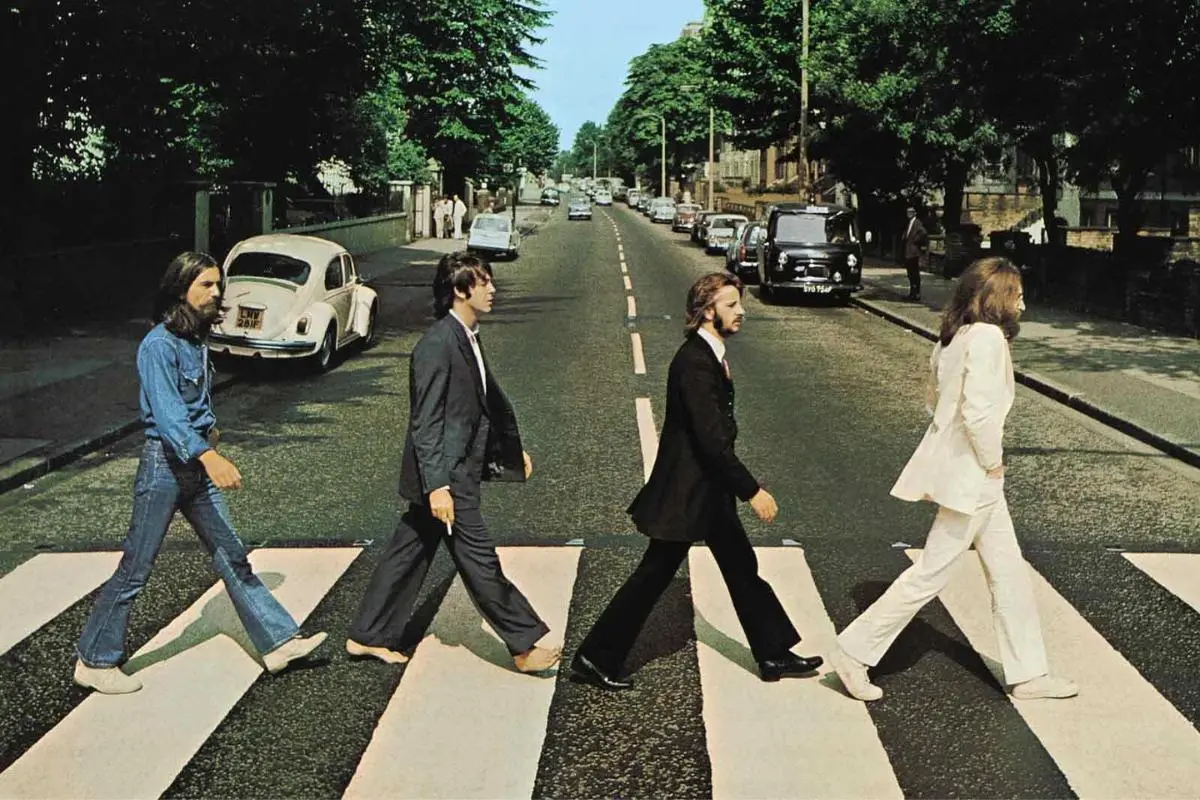
Using a Hasselblad with a 50 mm lens, he captured the band walking back and forth across the zebra crossing in the summer heat. In some frames Paul kept his sandals on; in others he kicked them off and walked barefoot, a minor comfort choice that would later fuel a global death hoax. Afterward, McCartney examined the transparencies and chose frame five, the only one where all four Beatles were in step and striding cleanly away from the studio.McCartney examined the transparencies and chose frame five, the only one where all four Beatles were in step and striding cleanly away from the studio.
John Lennon later summed up their mood with a dry aside: they were thinking they ought to be recording, not “posing for Beatle pictures.” The cover may look relaxed, but underneath it is the boredom of four men who had been turned into permanent public property.The cover may look relaxed, but underneath it is the boredom of four men who had been turned into permanent public property.

The moment before: boredom on the curb
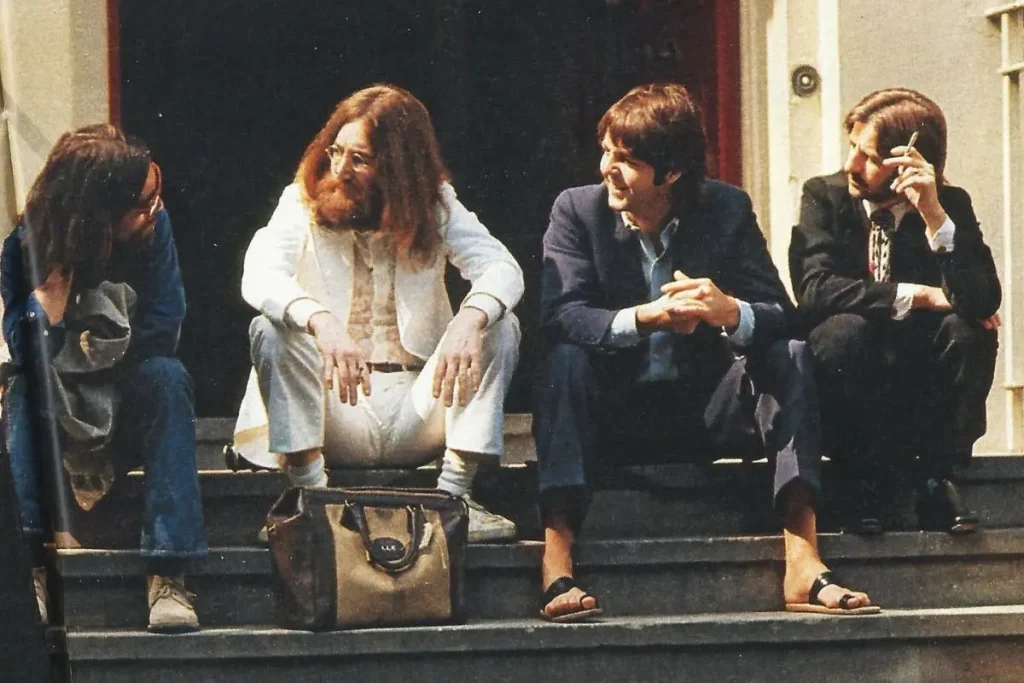
So what about the moment before they actually crossed? That exists too, caught not by Macmillan but by the people hanging around the shoot. Beatles assistant Mal Evans and Paul’s new wife Linda were both armed with cameras and documented the band loitering on the studio steps and at the curb while Macmillan set up his ladder and the policeman took position.Documented the band loitering on the studio steps and at the curb while Macmillan set up his ladder and the policeman took position.
In these candid shots the myth evaporates. You see Ringo picking his nose, John making Paul laugh, and George slouched on a low wall while Linda’s handbag and Paul’s discarded sandals sit beside him. One series taken from near the crossing shows the band literally “waiting to cross,” traffic building up as they smoke and chat like any other group of tired session musicians killing time between takes.One series taken from near the crossing shows the band literally “waiting to cross,” traffic building up as they smoke and chat like any other group of tired session musicians killing time between takes.
Linda’s own photos, later published in books and exhibitions, reinforce how thrown together the whole thing was: the Beatles milling outside the studio door, road crew hovering in the background, and the band looking more like four strangers than the tight unit fans imagined. She had been explicitly snapping away while they waited for Macmillan to begin.
Other outtakes from that morning show them standing around the steps of No. 3 Abbey Road, half in shadow, with the crossing still just another bit of street furniture in the background. Only when you see the contact sheets do you realise how thin the line is between a rock icon and four slightly grumpy men waiting to be told what to do next.
What happened after they crossed
Once Macmillan had his six frames, the policeman let the traffic flow again and the circus was over almost as quickly as it had begun. One detailed fan reconstruction, drawing on Mal Evans’ diary, has John and Paul walking round the corner to McCartney’s nearby Cavendish Avenue house, while George headed off to London Zoo with Evans and Ringo went shopping to kill time before the afternoon session.One detailed fan reconstruction, drawing on Mal Evans’ diary, has John and Paul walking round the corner to McCartney’s nearby Cavendish Avenue house, while George headed off to London Zoo with Evans and Ringo went shopping to kill time before the afternoon session.
They were not done working. That same afternoon the band was back inside EMI for two long sessions, overdubbing drums and bass onto The End, adding white noise from George’s Moog and extra drums to I Want You (She’s So Heavy), and allowing Paul to fuss endlessly over guitar and tambourine parts for Oh! Darling. In other words, the day of rock’s most famous stroll was also just another grinding day at the office.That same afternoon the band was back inside EMI for two long sessions, overdubbing drums and bass onto The End, adding white noise from George’s Moog and extra drums to I Want You (She’s So Heavy), and allowing Paul to fuss endlessly over guitar and tambourine parts for Oh! Darling.
A day in the life: how those hours unfolded
If you map out 8 August 1969, the contrast between the myth and the mundane becomes even starker.
| Time | What was happening |
|---|---|
| Morning | The Beatles arrive unusually early at EMI Studios; Mal Evans notes Ringo turning up first, the others closer to late morning. |
| Late morning | Macmillan sets up his stepladder; Linda and Mal shoot candid photos of the band on the steps and at the curb, waiting for traffic to be stopped. |
| Around 11:35 | Police briefly halt cars; the band walks back and forth across Abbey Road while Macmillan rattles off six frames from the middle of the street. |
| Midday | Session ends; the Beatles disperse for a few hours, some heading to Paul’s house, others shopping or visiting the zoo before returning to work. |
| Afternoon & evening | Recording and overdub sessions for The End, I Want You (She’s So Heavy) and Oh! Darling drag on into the night, far from the tourist cameras. |
Reading the picture like a crime scene
The bystanders and the Beetle
Decades of close scrutiny have turned the Abbey Road cover into a kind of rock forensics exercise. Fans have identified the decorators in white overalls on the left, traced the white Volkswagen Beetle’s later sale at auction, and argued about the identity of the man standing by the police van. One American tourist, Paul Cole, claimed it was him after spotting a resemblance on his copy of the LP, a story repeated in mainstream coverage even though researchers have poked serious holes in it.
Scrutinising the uncropped frames reveals a constantly shifting cast of extras: buses pausing while the band crosses, a mysterious tall man on the right pavement, and a young woman in a purple top appearing and disappearing between shots. None of them knew they were walking into history. They were simply people on their way to work, briefly inconvenienced by four musicians and a photographer.
The “Paul is dead” fantasies
Then there are the conspiracy clues. For believers in the long running “Paul is dead” hoax, the cover is a staged funeral: John in white as a priest, Ringo in black as undertaker, barefoot Paul as the corpse, George in denim as the gravedigger. Even the Volkswagen’s “28IF” plate and the letters “LMW” were seized on as hints that McCartney would have been 28 “if” he were alive and that his partner Linda was a widow, readings that crumble the moment you check the actual dates and biography.
The irony is sharp. The more you chase meaning in every cuff and shoelace, the more you miss the point that the image was supposed to be bluntly literal: four men leaving the building, walking away from the studio that had locked them inside for most of the decade.
Why those 10 minutes still haunt rock culture
So why does the moment before they crossed Abbey Road still fascinate us? Partly because it shows the fragile line between men and myth. In one set of frames you have Paul bumming a cigarette and George squinting into the sun; in the next you have a global symbol endlessly reproduced on posters, murals and tourist selfies.
The older you are, the more that gap hits home. Many fans first saw Abbey Road as teenagers and only later discovered the contact sheets and candid shots that reveal how quickly it was all thrown together. It is a reminder that some of the most enduring icons of the vinyl era were built on haste, compromise and a little bit of luck.
It is also a perfect example of how Beatles hysteria supercharged everything around them. A ten minute cover shoot on a sleepy London side street has been argued over for half a century, from camera settings to cloud patterns, precisely because the culture decided The Beatles were beyond ordinary criticism or indifference.
Look again at the “moment before” images and you see something more interesting than myth: four tired professionals on a hot morning, doing a job they no longer loved, still capable of snapping into perfect formation the instant the camera pointed their way. That tension between boredom and brilliance is the real story of Abbey Road, and it is all there in the seconds before they took that famous walk.
In the end the crossing is just paint on tarmac, but for a brief window in 1969 it was the stage for rock’s most analysed stroll. The magic is not that they crossed it. The magic is that we are still arguing about what they were thinking while they waited on the curb.