Most bands form, rehearse, and then play a gig. Siouxsie and the Banshees did it backwards: they booked the stage first, invented the band second, and figured out the music never. On September 20, 1976, at the 100 Club on Oxford Street, a 19-year-old Sex Pistols superfan with no songs, no rehearsals and no intention of faking either walked on stage — and accidentally began one of the great careers in British music.
The Bromley Contingent
Susan Ballion was, at that point, famous only for watching. She belonged to the Bromley Contingent — the flamboyantly dressed suburban clique who followed the Sex Pistols from gig to gig and functioned as punk’s first visual scene, photographed nearly as often as the bands. They were fans in the way that matters historically: not consumers but co-conspirators, dressing dangerously, colonising the front rows, willing the new world into being.
When Malcolm McLaren’s circle organised the two-night 100 Club Punk Special — the festival that effectively announced punk to London — a slot stood empty. Siouxsie and her friend Steven Severin volunteered to fill it, despite possessing, between them, no band, no material and no experience. That was rather the point. Punk’s founding dare was that the distance between audience and stage was imaginary. Somebody from the crowd had to actually test it.
Twenty minutes of the Lord’s Prayer
The band assembled for the occasion has become a pub-quiz legend in itself: Sid Vicious — pre-Pistols — on drums, and future Adam and the Ants architect Marco Pirroni on guitar, alongside Severin’s untutored bass. What they performed was a single improvised piece, roughly twenty minutes long, built around Siouxsie reciting the Lord’s Prayer and whatever other memorised text — fragments of pop songs, whatever surfaced — she could intone over the din.
It was, by conventional measures, not music. It was also, witnesses agreed, riveting — performance art with a rhythm section, fronted by someone whose stage presence arrived years before her craft. She didn’t know how to sing yet. She unmistakably knew how to command, and in September 1976 that was the entire syllabus.
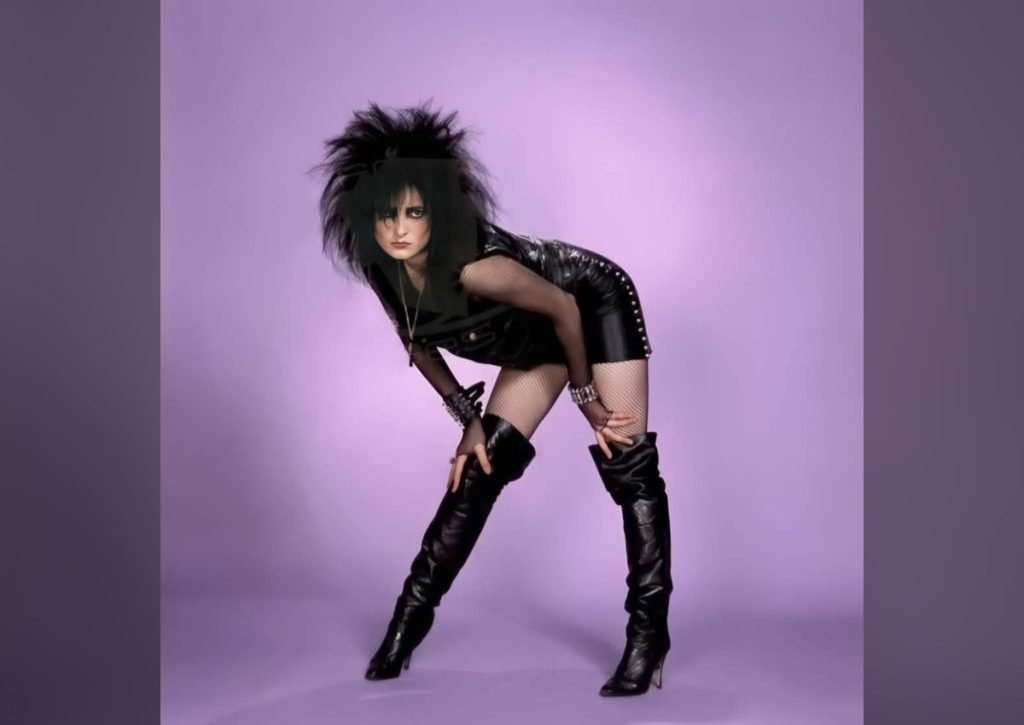
Accounts of the set differ on details — how long it truly ran, how much was prayer and how much collage — because almost nobody thought to document a filler act assembled forty-eight hours earlier. What survives consistently in every telling is the nerve: Severin thudding one note like a heartbeat, Vicious keeping something adjacent to time, Pirroni conjuring noise around them, and Siouxsie — cropped hair, one breast provocatively bared beneath fetish-shop styling — staring the room down as though the lack of songs were the room’s failing, not hers. Several people present went home and formed bands. That was the transaction punk ran on, and this set was its purest invoice.
The night’s other legacy was negative but formative: watching the scene’s chaos up close taught Siouxsie and Severin what they didn’t want. When they rebuilt the Banshees as a real group, they did it with un-punk discipline — serious rehearsal, ambitious arrangements, total visual control — which is precisely why they outlived the movement that birthed them.
The fans who lapped the field
Here’s what elevates the stunt into history: it stuck. While the Pistols detonated and burned out on schedule, the joke band from the audience went home, learned their instruments, wrote actual songs — and turned out to be built for the long war. By 1978 the Banshees were charting with “Hong Kong Garden”; across the following decade they became one of Britain’s most consistently inventive groups, laying down the sonic and visual blueprint for goth, influencing everyone from the Cure (who lent them a guitarist) to generations of art-rock bands, while their frontwoman matured into one of the great vocal stylists of her era.
The 100 Club improvisation thus became the ultimate proof of punk’s core proposition. The movement claimed anyone could get up and do it; Siouxsie got up, did it with literally nothing prepared, and then out-lasted, out-wrote and out-grew nearly everyone on the bill. The audience member became one of the most imitated frontwomen in rock, her painted-eye glare stencilled onto four decades of bedroom walls.
The permission slip
Every scene has its sacred first gigs, and most improve in the retelling. This one doesn’t need to. The facts as documented — no songs, borrowed drummer, the Lord’s Prayer, twenty minutes, September 1976 — already constitute the perfect parable of punk’s whole promise: that authority on a stage is seized, not conferred; that taste and nerve outrank training; and that the person watching you tonight may be your successor by Christmas.
Siouxsie walked off that stage with no material and every important thing already in place. The songs came later, and they came brilliant. But the career began with the walk on — the moment a fan called the movement’s bluff and found out it wasn’t bluffing.