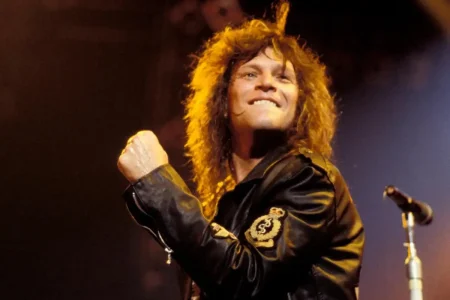

In the pop-culture Venn diagram of 1985, there’s a sweet spot where MTV hair, tabloid flashbulbs, and young-stardom chaos overlap. Jon Bon Jovi and Diane Lane landed right in it for a brief, high-profile relationship that reportedly lasted only about five months. It’s the kind of romance that feels bigger than its runtime: a rock frontman on the launchpad and an actress who had already grown up in public.
Because both stars have kept the details fairly private, the relationship is best understood as a snapshot of timing: who they were in 1985, what their careers demanded, and why “normal dating” is basically a myth when you’re famous at 20-something. What follows is the clearest, most responsible version of the story: how it likely started, why it probably ended, and what the whole thing reveals about fame’s attention economy.
Who they were in 1985: the context that made it combustible
By 1985, Jon Bon Jovi (born John Francis Bongiovi Jr.) was no longer a local Jersey hopeful. Bon Jovi had already released Bon Jovi (1984) and 7800° Fahrenheit (1985), and the band was pushing toward the stadium-era identity that would fully detonate with Slippery When Wet a year later—after the early rise outlined in his biography and the band’s eventual Hall of Fame profile.
Diane Lane, meanwhile, was a working actress with a rare kind of early fame: she was on magazine covers as a teenager and had major film credits before most people finish high school. Her breakout period in the late 1970s and early 1980s meant she’d already experienced the “young star in a fishbowl” phenomenon firsthand, as reflected in her filmography profile.
“They are young, famous, and in a hurry.”
– A standard tabloid framing of the era
That cliché wasn’t always wrong. In an entertainment culture trained to treat celebrities as storylines, any pairing between rock and Hollywood was automatically a headline, whether the couple asked for it or not.
How it started: why these two made sense on paper
Most credible summaries of the relationship describe it as a 1985 romance that flared fast and ended quickly, placing it in the middle of Bon Jovi’s early ascent and Lane’s already-established visibility. The “how did they meet?” piece is fuzzier, and that’s worth saying out loud: neither has publicly provided a detailed, definitive origin story.
Still, the likely mechanics are easy to map. In the mid-1980s, musicians and actors mixed constantly through the same promotional circuits: record-release parties, label events, benefit nights, premiere after-parties, and the gravitational pull of Los Angeles and New York celebrity nightlife. If you were famous and under 30, you were probably two handshakes away from everyone else famous and under 30.
There’s also a deeper “why” behind the attraction. Bon Jovi’s image in that era was all forward motion: ambition, charm, and a carefully calibrated everyguy appeal. Lane’s appeal was different but equally potent: she projected maturity beyond her years, a quality that often reads as steadiness to people living inside a career hurricane.
The 1985 chemistry formula
- Mutual heat: both were young and highly photogenic in an image-driven decade.
- Shared pressure: both worked in industries that monetize attention, especially romantic attention.
- Opposites that attract: rock-tour chaos vs. film-set discipline can feel exciting at first.
It’s also possible that the relationship’s profile was amplified simply because it fit a narrative. The 1980s loved a “rock star + actress” story, and the press didn’t need much encouragement.

How high-profile was it, really?
“High-profile” can mean two things: high visibility to fans and media, or high importance to the people involved. The first was definitely true. Bon Jovi’s fame was accelerating fast, and Lane was already familiar to celebrity press.
The second is harder to measure, because both stars generally avoid oversharing. The relationship is often mentioned in biographical write-ups and career retrospectives as a notable early romance, but not as a defining life chapter.
That contrast is the whole point: celebrity culture can turn five months into “legend” if the story is convenient, photogenic, and easy to repeat.
Why it ended: five months is a clue, not a mystery
Most accounts that reference the relationship describe it as brief, commonly around five months, with no dramatic public postmortem. In other words, it ended the way many intense early-twenties romances end, just with more cameras.
Here are the most defensible reasons, grounded in what we know about their careers and patterns of celebrity relationships rather than gossip-fuel invention:
1) Logistics: touring vs. filming is relationship kryptonite
Even the healthiest couples struggle with distance. Now add: a rock band’s travel schedule (soundchecks, radio stops, late-night promo) versus an actor’s schedule (location shoots, long days, early calls). The overlap in free time can shrink to nothing. For a young relationship, that can be fatal.
2) Fame acceleration changes the power dynamics
Bon Jovi in 1985 was climbing, not cruising. When fame is rising, everything in life becomes provisional: friends, routines, even personality. The version of you who starts dating in January can look different by June if your band suddenly feels like “the next big thing.” Bon Jovi’s career trajectory in the mid-1980s supports this kind of instability.
3) The “image tax”: when the relationship becomes content
It’s one thing to date privately. It’s another when your dating life becomes part of the marketing weather. Young celebrities often discover that romance can get weaponized by publicity cycles: one outlet hints at an engagement, another implies cheating, and suddenly you’re doing reputational cleanup instead of having dinner.
Lane had already experienced what it means to be watched, assessed, and discussed as a public figure from a young age. A relationship that feeds the machine can start to feel like a job you never applied for.
4) Timing and values: Bon Jovi’s long-game relationship was waiting in the wings
One of the most interesting “edgy but true” angles here is that Bon Jovi’s famous love story isn’t with Lane at all. It’s with Dorothea Hurley, his longtime partner and eventual wife. Many credible biographies note their longstanding connection and the eventual marriage that followed years later.
This doesn’t require melodrama. It suggests that even if the Lane romance was real and exciting, Bon Jovi’s emotional anchor may have been elsewhere, or at least his long-term values were pulling him toward a different kind of life than a Hollywood power-couple sprint.
“I got away with murder.”
– Jon Bon Jovi, referring to his long marriage and life on the road (as quoted in an interview with Men’s Health)
That kind of reflection, offered years later, implies he knows exactly how hard it is for fame-era relationships to survive. (It also hints that survival is less about romance and more about boundaries.)
What the relationship says about 1980s celebrity culture
The Lane-Bon Jovi relationship reads like a case study in 1980s celebrity mechanics: a culture where a person could be both a private human and a public product, sometimes in the same hour. Fans felt ownership. Media monetized speculation. Publicists tried to steer the narrative without admitting a narrative existed.
And for music fans, it’s a reminder that rock history isn’t only written in riffs and choruses. It’s also written in the personal turbulence that happens offstage, especially before an artist learns how to protect their life from their career.

Quick timeline table (high-level and cautious)
| Year | What’s happening for Jon Bon Jovi | What’s happening for Diane Lane |
|---|---|---|
| 1984 | Debut album Bon Jovi establishes the band. | Already well-known from earlier film work. |
| 1985 | 7800° Fahrenheit era; touring and rising visibility. | Career continues; strong public profile. |
| 1986 | Slippery When Wet era begins, global superstardom follows. | Moves forward into later career phases. |
Why music fans still care (and what’s not worth obsessing over)
If you love rock history, the appeal of this romance isn’t “who dumped who.” It’s what it reveals about the moment right before megafame hits. In 1985, Bon Jovi wasn’t yet a legacy act or a Hall of Fame chapter. He was a young frontman in a loud decade, moving fast enough that a five-month relationship could feel like a lifetime.
The responsible takeaway is also the simplest: without detailed firsthand accounts from the people involved, the best story is the one that sticks to what’s knowable. Anything else turns real humans into fan fiction.
Conclusion: a flashbulb romance that makes sense in hindsight
Jon Bon Jovi and Diane Lane’s 1985 romance remains memorable because it was perfectly timed for maximum visibility: two young stars, two different fame-machines, and a culture eager to turn attraction into a headline. The relationship appears to have started through the usual celebrity-world proximity and ended for the least glamorous reasons: distance, pressure, and diverging trajectories that fit their publicly documented career arcs—including Bon Jovi’s onscreen credits profile.
In a decade obsessed with “forever,” their five months might be the most honest part of the story: sometimes the most famous romances are simply the ones that happened at the loudest moment.