Before the internet learned to shout, London already had a comment section: brick walls, club toilets, and Underground corridors. In the British blues boom, somebody wrote three words that turned a young guitarist into scripture: “Clapton Is God.”
It reads like overkill now, the kind of praise you’d expect on a T-shirt. But this wasn’t a modern, ironic meme – it was public devotion to Eric Clapton’s playing, at a moment when electric guitar suddenly felt like the most important voice in the room.
A meme with fumes: where “Clapton Is God” came from
A Guardian review of Clapton’s autobiography says an anonymous fan spray-painted the slogan in a London Underground station in 1965. The reviewer notes that the same act would look like label street marketing today, but back then it helped cement Clapton’s reputation while he was rising with John Mayall’s Bluesbreakers.
The genius of the line is its simplicity: three words, no explanation. It flatters the musician, signals you’re in the know, and dares the reader to disagree.
Graffiti also turns fandom into risk. You’re leaving evidence in daylight – and anyone with paint and nerve can copy it.
London’s blues boom: why the timing was perfect
Mid-60s Britain was obsessed with “authentic” American blues, even when that authenticity was filtered through teenage Londoners in sharp suits. Records were studied like holy texts, and clubs became laboratories where players competed to sound tougher, rawer, and more real than the next band.
Clapton arrived like the missing link: not just a great rhythm player, but a lead guitarist people came specifically to watch. The Guardian later argued that no one did more to create rock’s cult of the lead guitarist, and that the “Clapton is God” graffito captured how fans were already ranking musicians like saints.
Once the guitar became the main event, everything else shifted. Singers still got the spotlight, but the future belonged to whoever could make six strings sound like a confession and a threat at the same time.
Was it a fan, or a stunt? Clapton’s own conspiracy theory
Clapton has even suggested the slogan might not have been “organic” fandom at all. In a Classic Rock interview, he called it a “put-up job,” suspected hype man Hamish Grimes, and said the label became a “cross to bear” even as it helped him push blues, country, and gospel under the pop radar.
If it began as a stunt, it was still the rare stunt that hit a cultural nerve so hard it turned into truth. Once the line existed, fans could keep rewriting it until it stopped being paint and started being folklore.

Why Clapton was treated like a “God”
Some of the “god” energy came straight from Clapton’s own intensity. Guitar World recalls him saying the graffiti felt “quite justified” at the time because he’d put so much seriousness into the mission, even claiming he was “in it to save the fucking world.”
So why did fans reach for religious language? It wasn’t just speed – it was a rare alignment of attitude, tone, and timing that made him feel bigger than human.
| What fans heard and saw | Why it hit so hard |
|---|---|
| Blues phrasing that felt “spoken,” not recited | It sounded like he meant every note, not like he was showing off. |
| Thick, loud overdrive with real sustain | For many listeners, this was a new kind of electric guitar authority. |
| Vibrato and bends that stayed vocal and in-tune | The guitar stopped sounding like strings and started sounding like a voice. |
| Public “purism” in a pop marketplace | Refusing compromise becomes mythology fast, especially in a youth scene. |
Listen like a fan in 1966 (and steal the useful parts)
If you want to understand the hype, don’t start with the fastest lick. Start with the things you can’t fake for long.
- Intonation under pressure: bends that land on pitch, even when the amp is screaming.
- Vibrato that has shape: wide, controlled, and timed to the groove (not random shaking).
- Call-and-response phrasing: a “question” line, a pause, then an “answer” that raises the stakes.
- Space as a weapon: leaving holes so the next note feels inevitable.
The sound that rewired rock guitar
Clapton’s reputation also had a practical basis: he helped normalize a bigger, louder guitar sound. A Classic Rock feature on the ‘Beano’ album describes Decca engineers panicking at the volume of a 20-year-old Clapton driving a Gibson Les Paul into a new Marshall amp, until producer Jimmy Page told them to keep rolling and said he’d take responsibility.
That shift is huge for players. It’s where distortion stops being an accident and becomes a musical color you can control, shape, and aim like a spotlight.
To chase that vibe today, aim for a clean tone that’s right on the edge of breakup, then use your hands for dynamics. The “god” part isn’t the gear list – it’s the confidence to let one note hang there until the room believes you.

How three words became a template for modern fandom
Seen through a modern lens, “Clapton Is God” is a perfect proto-meme: short, repeatable, and built to travel by imitation. It turned taste into identity – you weren’t just a listener, you were a believer.
It spread for the same reasons internet catchphrases spread: it was definitive, portable, and provocative. And it was easy to repeat without needing to explain yourself.
- Definitive: no nuance, no “one of the best.” Just God.
- Portable: easy to copy anywhere, from a wall to a notebook.
- Provocative: people repeated it to agree with it, mock it, or argue with it.
The hangover after the hallelujah
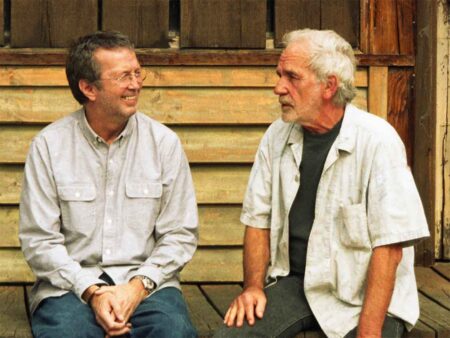
The punchline is that Clapton didn’t spend the rest of his life trying to live up to a spray-painted halo. Later he gravitated toward J.J. Cale precisely because the music resisted showmanship, and he spoke openly about getting weary of the “guitar hero” label and the trappings around it.
That’s the real lesson hidden inside the graffiti: deification is flattering, but it freezes art into a statue. If you want to honor Clapton’s best era, don’t worship it – study it, then go make your own noise.
“Clapton Is God” survived because it captured a real shock people felt in mid-60s London: the sense that a guitar could speak with authority, not just accompaniment. Whether it began as pure fandom or clever hype, it helped invent the language of guitar-hero worship – and it reminds us how quickly great playing can turn into mythology.