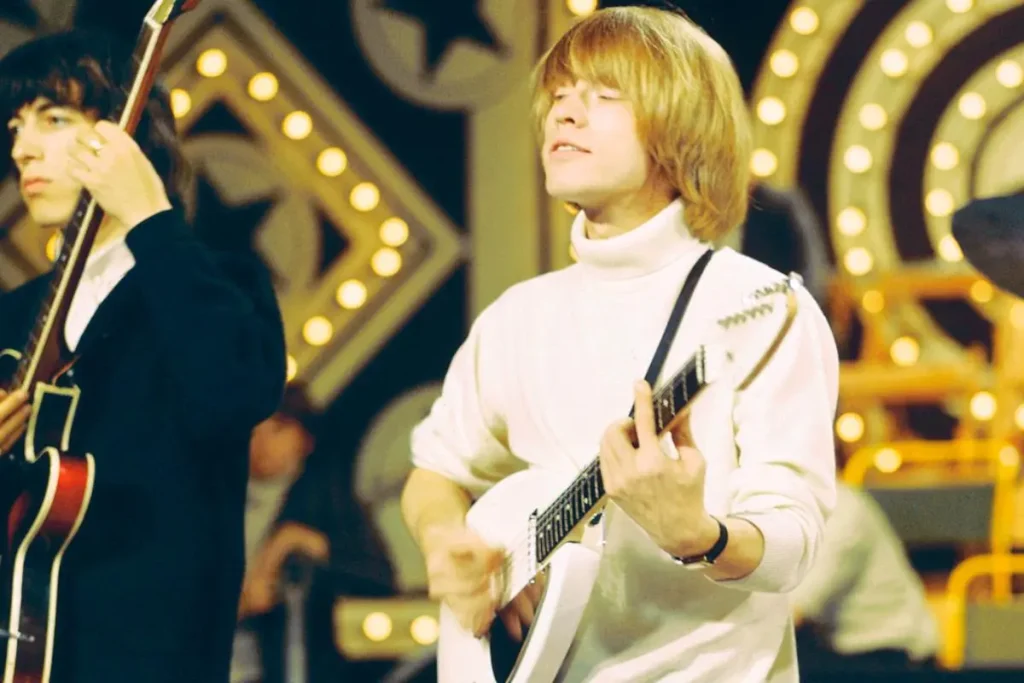
Before Mick Jagger strutted across stadium stages or Jim Morrison turned self-destruction into theatre, there was a pale, sharp-cheekboned kid from Cheltenham already living the script: sex, drugs and rock and roll, years before the phrase existed.
That kid was Brian Jones, founding guitarist and sonic wizard of the Rolling Stones. Bassist Bill Wyman later described him as the inventor and inspiration of the band and insisted it would never have existed without him, effectively casting Jones as the first true rock star in the music business.
Brian Jones, the man who invented the Rolling Stones
Born Lewis Brian Hopkin Jones in 1942 to musical parents, he moved easily from clarinet to guitar to harmonica as a teenager. After drifting through early bands and the London R&B circuit, he placed a small ad in Jazz News in 1962 looking for musicians for a new rhythm and blues group, lifted the name “The Rolling Stones” from a Muddy Waters song, and initially led the band onstage and off.
The young Stones were blues obsessives before they were rock icons. They devoured Muddy Waters, Howlin’ Wolf and Slim Harpo, then flew to Chicago to record at Chess Records, cutting tracks like “It’s All Over Now” and “2120 South Michigan Avenue” in the same rooms their heroes had used, helping to drive the 1960s British blues revival.
Out of that covers band grew what the Rock & Roll Hall of Fame calls a raucous blend of rock and blues spread across more than thirty studio albums and decades of touring, with Brian Jones listed alongside Jagger, Richards, Wyman, Watts and the later guitarists on the official inductee roll.
Yet the man who assembled the Stones, named them and gave them their original musical identity is also the first of them to be erased in casual conversation. To see why Wyman calls him the first rock star, you have to look at how completely Brian Jones embodied that role before most people even knew what it was.
Blueprint of a rock star: sex, drugs and ego
In the early photos, Jones is the one your eye goes to first: the asymmetrical blond bob, dandy jackets, fur collars, striped trousers and androgynous pout. Before Jagger perfected the frontman strut, Brian was often the group’s visual focus, a mod rebel whose look and attitude were copied by other bands desperate for some of that danger.
Offstage he pushed excess to cartoon levels. By his early twenties he had fathered several children with different women, drifted between flats and girlfriends, and cultivated a reputation for pills, brandy and late-night chaos that even fellow musicians considered dangerous rather than merely naughty.
What makes this more than tabloid fodder is how directly it fed the Rolling Stones’ emerging mythology. Where the Beatles played cheeky charm, Brian leaned into menace and decadence, helping fix the Stones as the band your parents feared, long before Jagger and Richards fully grew into that role.
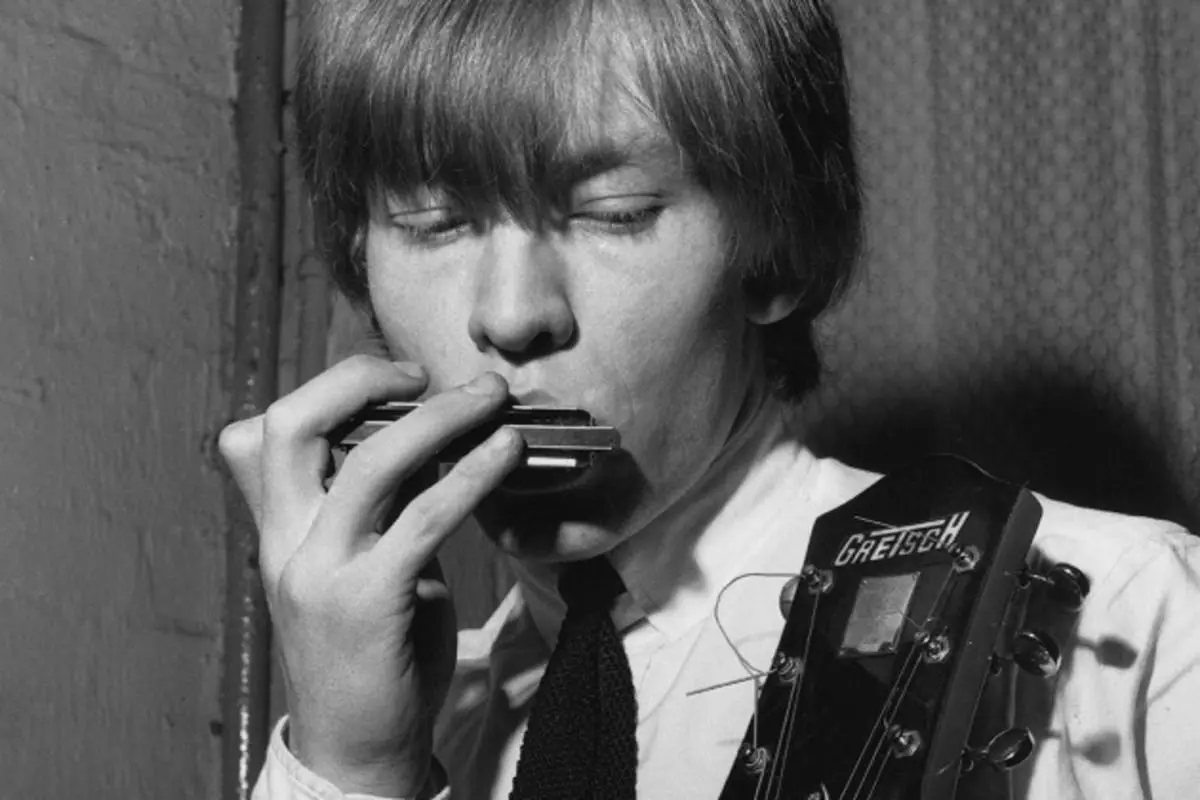
Sound alchemist: the multi-instrumentalist at the heart of the Stones
Jones was not just a good guitarist who partied too hard. He was the band’s resident sound alchemist, constantly turning up at sessions with a new instrument and a new obsession. One detailed reassessment notes how his sitar drives “Paint It Black”, his marimba makes “Under My Thumb” slink, his harpsichord transforms “Lady Jane”, and his Mellotron turns “We Love You” into a swirling ritual.
Listen closely to “Paint It Black” and you can hear how radical that approach was. A reconstruction of the session credits Jones on sitar alongside acoustic guitar, with Jack Nitzsche on piano, Bill Wyman on organ pedals, and Jagger on hand percussion, creating a raga-tinged dirge that pushed the Stones straight toward psychedelia.
Across the mid-60s albums he bounced between slide guitar, dulcimer, harmonica, flutes, organs, saxophone and more, often abandoning standard rhythm guitar altogether. Keith Richards has recalled how the two of them developed a “guitar weaving” style, trading rhythm and lead so fluidly that it sounded like several instruments at once, a texture that defined the early Stones.
For players, a handful of Jones moments are a masterclass in how one unexpected timbre can change a song:
| Track | Year | Jones’s role | Why it matters |
|---|---|---|---|
| Paint It Black | 1966 | Sitar patterns over rock rhythm | Turned a straightforward song into a dark, modal raga-rock landmark. |
| Under My Thumb | 1966 | Marimba hook | Showed how a percussion instrument could carry the main riff in a rock song. |
| Lady Jane | 1966 | Dulcimer and keyboard textures | Wrapped Jagger’s vocal in faux-Renaissance chamber pop instead of blues grit. |
| No Expectations | 1968 | Slide guitar | One of his last great parts, a mournful slide line that feels like his own elegy. |
Fall from the throne and a death that rewrote rock mythology
As the Jagger/Richards songwriting team caught fire, the power balance inside the band flipped. Manager Andrew Loog Oldham wanted charismatic, photogenic songwriters he could sell to the world, and Brian, who never found confidence as a composer, watched his leadership of the band evaporate while his addictions deepened.
By 1968 he was increasingly absent from sessions, missing shows and arriving at the studio too high or too fragile to play. In June 1969, Jagger, Richards and Charlie Watts drove down to his Sussex farmhouse and told him bluntly that the group he had founded would carry on without him; within weeks, Mick Taylor was announced as his replacement.
Less than a month after that meeting, in the early hours of 3 July 1969, Brian Jones was found motionless at the bottom of his swimming pool at Cotchford Farm. A coroner’s inquest recorded a verdict of “death by misadventure”, ruling that he had drowned while under the influence of alcohol and drugs, and noted that his heart and liver were already dangerously enlarged.
He was 27. Within two years Jimi Hendrix, Janis Joplin and Jim Morrison would all die at the same age, and fans began to talk about a sinister “27 Club”, with Brian’s death as the opening chapter. The doomed, beautiful, burnt-out rock star suddenly had a disturbingly clear archetype.
The official story has never silenced rumours. Biographers, journalists and ex-girlfriends have argued that a builder working on the house, Frank Thorogood, may have held Jones under in a drunken fight or that the original investigation was simply botched. What matters for rock history, though, is that his end felt less like a random accident and more like the grimly logical result of the life he was determined to live.
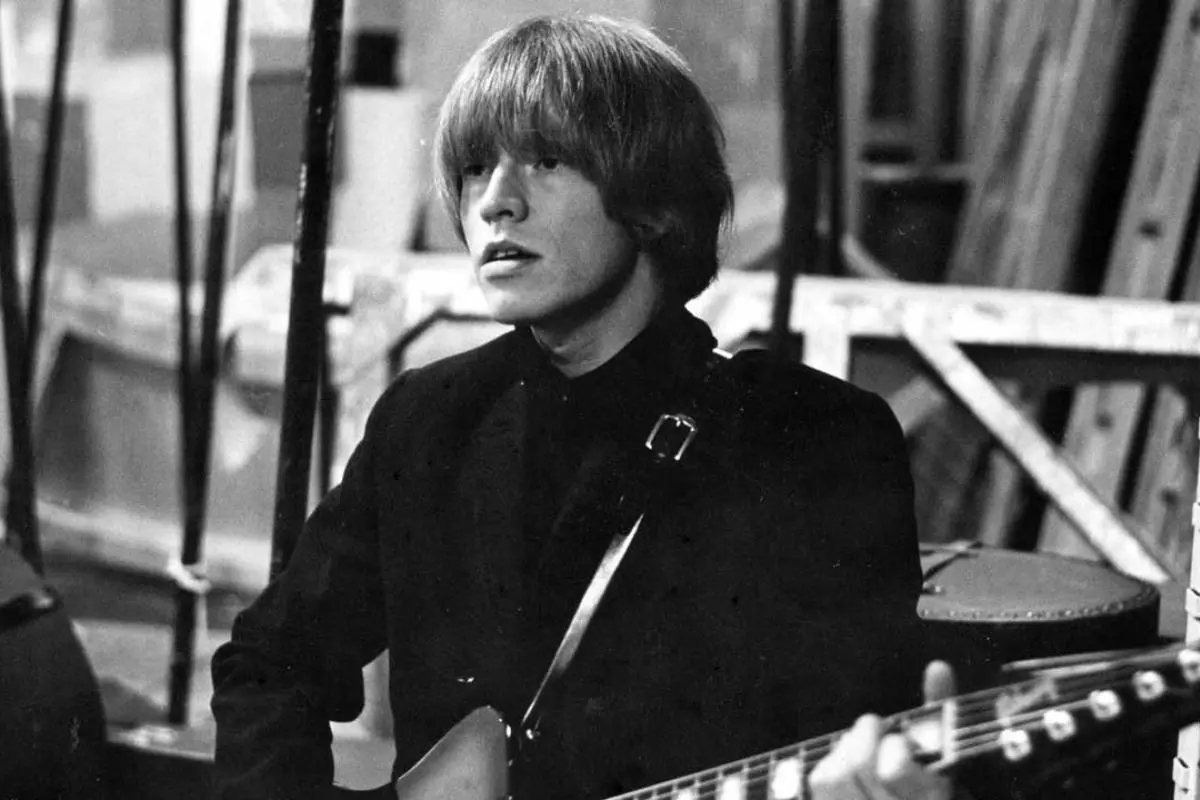
So was Brian Jones really the first rock star?
Of course, there were rock and roll icons before Brian Jones. Elvis had already weaponised sexuality on TV; Little Richard and Jerry Lee Lewis had torched pianos and decency standards; Buddy Holly had shown how a shy kid with glasses could lead a band. But none of them combined image, musical experimentalism and all-consuming self-destruction quite the way Jones did.
Jones looked like a pop star, played like a cutting-edge jazz-blues obsessive and behaved like a man determined to test every boundary of fame and indulgence. Long before stadium tours and private jets, he was cultivating fashion photographers, chasing avant-garde collaborations, collecting exotic instruments and living a lifestyle that made “sex, drugs and rock and roll” feel less like a slogan than a diary entry.
Seen from that angle, Wyman’s claim that Brian was the first rock star is less hyperbole than a reminder of how the template was forged. If Elvis invented the brand of rock and roll, Brian Jones may have been the first person to treat “rock star” as a full-time, all-consuming identity, one that created a band capable of conquering the world and then killed its creator in the process.
Why Brian Jones still matters
For listeners who grew up with the Stones as a riff machine fronted by Jagger and Richards, going back to the Brian Jones era is like hearing a different band. Follow the marimba line instead of the vocal, or the sitar drone instead of the guitar riff, and you realise how much of their early danger came from the quiet blond figure half-hidden at stage left.
He did not live long enough to reap the rewards or rewrite the narrative. But if we take Wyman at his word, Brian Jones was not just the first casualty of the Rolling Stones; he was their inventor, their muse and the prototype for the rock star as we now understand it. The least we can do is turn those records up again and hear his fingerprints all over them.