
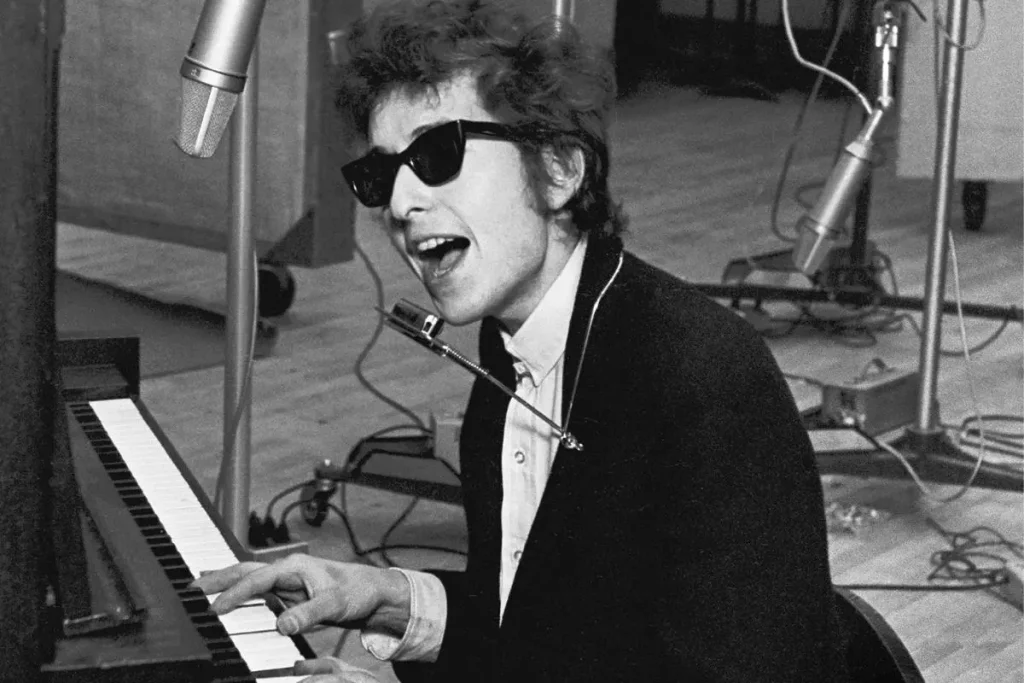
Bob Dylan in 1965 was not “transitioning.” He was detonating. In a matter of months he went from the acoustic oracle of the folk circuit to the guy who showed up with an amp, a band, and a grin that seemed to say: I’m not asking permission.
When photojournalist W. Eugene Smith photographed Dylan at a New York recording session that year, he didn’t just document a celebrity at work. He captured the feeling of a culture mid-argument, right before it got loud.
Smith’s series, often titled Bob Dylan, Recording Session. New York City, 1965, sits at a delicious intersection: a legendary musician redefining the rules, and a legendary photographer obsessed with truth, craft, and control. The images have become shorthand for Dylan’s electric leap: smoke, stare, shadows, and the sense that something irreversible is being committed to tape.
Why this photo session matters more than “cool rock star pictures”
Dylan’s 1965 studio work produced songs and sounds that still define what “rock lyricism” is allowed to be. Around this period, Dylan’s catalog pivots hard into electric arrangements and surreal narrative density, as reflected in the mid-60s release arc on his official site.
Smith, meanwhile, was not a casual visitor with a camera. His reputation was built on immersion, technical rigor, and a willingness to push editors, subjects, and himself until the story felt honest. PBS’s biography of Smith’s work and working methods notes how his approach became iconic in documentary photography.
Put those personalities in one room and you get friction you can practically hear. Dylan is chasing velocity. Smith is chasing the definitive frame. Neither man is known for “just going with the flow,” which is precisely why the photographs feel charged rather than posed.
W. Eugene Smith: the perfectionist who made chaos look inevitable
Smith’s best-known projects are obsessive: he returned to subjects repeatedly, shot in depth, and shaped narrative through sequencing and printing choices. The International Center of Photography’s entry on Smith’s stature and legacy emphasizes his importance as a major figure in photojournalism.
That matters because the Dylan session photographs are not merely “behind the scenes.” They are Smith doing what Smith did: turning a real environment into a tight visual argument. The darkness isn’t accidental. The proximity isn’t accidental. The tension between candid and composed is the whole point.
I was a magician.
Mike Bloomfield (describing Dylan’s impact, as quoted by New England Public Radio)
Bloomfield’s quote (circulating via public radio reporting) is useful here because it underlines how musicians experienced Dylan then: not just as a songwriter, but as a force that changed the rules of the room. Smith’s camera turns that “magician” energy into something you can hang on a wall.
What’s happening in New York in 1965: Dylan’s electric point of no return
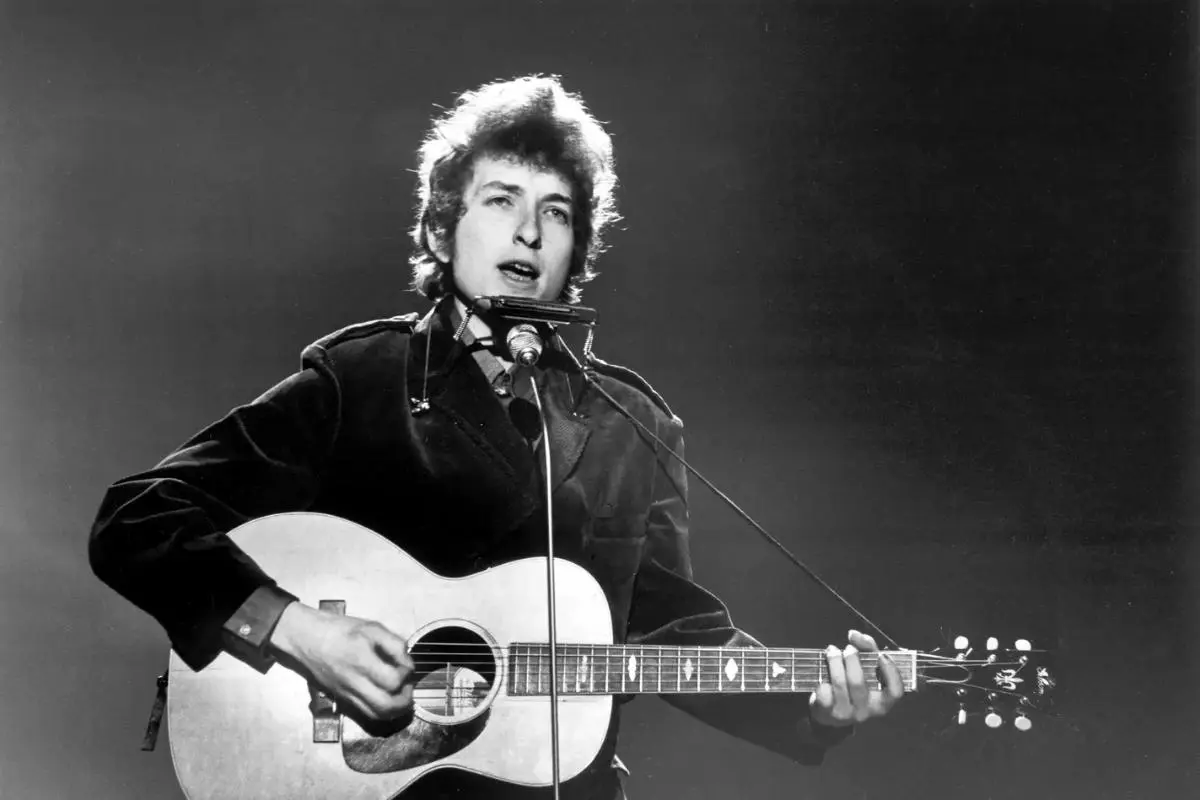
1965 is the year Dylan’s arguments with “folk orthodoxy” turn into sound. The folk world loved him as a principled acoustic messenger. Rock audiences were ready to crown him as something else entirely. That public identity crisis becomes part of the art.
His official album pages make the shift easy to track: Bringing It All Back Home is the headline moment where electric and acoustic coexist on the same record, a statement in sequencing as much as in tone, and Dylan’s broader mid-60s label-era arc reflects how quickly that pivot solidified.
Then Highway 61 Revisited arrives as an electric mission statement, with “Like a Rolling Stone” as the cultural battering ram. Even if you know the song, it’s worth remembering how radical its scale and attitude felt against the tighter pop forms of the time.
Newport isn’t a footnote – it’s the flashpoint
The user-provided passage highlights a key idea: Dylan didn’t necessarily show up at Newport planning to “go electric,” but momentum, audience reaction, and his own impatience with purity tests made the switch feel inevitable. Whether or not that specific causal chain is interpreted the same way by every historian, the broader truth stands: the mid-1965 period is when Dylan publicly stopped negotiating with the folk movement and started moving past it.
Here’s the part people miss: Newport wasn’t just “boos vs cheers.” It was a referendum on what authenticity meant, who got to police it, and whether volume itself was a betrayal. That argument still shows up today whenever a scene claims it owns an artist’s identity.
Reading the Eugene Smith Dylan photos like a musician
If you look at Smith’s Dylan session images as a guitarist or recording nerd (not only as an art viewer), they start to read like a session diagram. You can see decision-making. You can see fatigue. You can see the quiet violence of concentration.
These photographs are widely collected and cataloged as fine art objects, not just editorial ephemera. For example, the Metropolitan Museum of Art’s catalog entry for a Smith print from this period helps confirm their museum-level status.
Three visual “tells” that scream 1965 studio reality
- Isolation in a crowded room – Dylan appears alone even when others are nearby, which mirrors how a band can orbit a songwriter’s decisions in the studio.
- Smoke, shadow, and compression – visually similar to tape saturation: details thicken, highlights bloom, and edges feel like they’re vibrating.
- The half-performance face – not quite stage persona, not quite private self. It’s the look people get when the red light is on and they’re pretending it doesn’t matter.
The Getty’s collection cataloging of a Smith print as an object underscores that this is not merely a “Dylan moment,” but a significant Smith work in the history of photography.
The provocative take: these images aren’t about Newport – they’re about control
It’s tempting to pin everything on Newport because it’s dramatic and easy to summarize. But Smith’s session photographs point to a deeper 1965 storyline: Dylan’s move electric was also Dylan trying to control the conditions of his own work.
Acoustic folk performance can be intimate, but it’s also exposed. Electric studio work gives you architecture: arrangement, amplification, edits, takes, and the ability to weaponize sound. Dylan’s mid-60s records feel like he’s building a room around his lyrics so nobody can reduce them to slogans.
And Smith? Smith was famously controlling about his prints and sequencing. The photographer and the musician share a trait: both wanted to be the final editor of what the public thought was “real.” An overview of Smith’s intensely driven working life and output fits the pattern of a maker who refuses to be casual about presentation.
Gear-and-room reality: what an ad hoc electric band changes
The user-provided passage names key players tied to Dylan’s electric turn, including Mike Bloomfield and Al Kooper. The details matter because electric Dylan is not just Dylan plugging in – it’s Dylan choosing collaborators who speak fluent Chicago blues and R&B.
When you recruit players who learned timekeeping from blues clubs rather than coffeehouses, the whole rhythmic ethic changes. The backbeat becomes a statement. The organ becomes a weapon. The electric guitar stops being decoration and becomes the argument itself.
Quick table: acoustic Dylan vs electric Dylan (from a player’s perspective)
| Element | Acoustic folk setup | Electric band setup |
|---|---|---|
| Dynamics | Voice-led, subtle shifts | Drums and amps define the ceiling |
| Authority | Lyrics carry the whole load | Arrangement shares the message |
| Risk | Every mistake is naked | Mistakes can become texture |
| Audience contract | “Listen closely” | “Hold on” |
Where the Dylan session photos live now (and why that’s telling)
One reason these photographs keep resurfacing is that they are distributed and discussed through institutions that treat them as cultural artifacts. A major documentary photography cooperative’s platform and archives continue to contextualize Smith’s legacy and work.
Likewise, major museums have cataloged individual prints from Smith’s body of work, including entries at The Met that fix the work into the permanent record of art history rather than music trivia.
That institutional afterlife changes how we read the images. They stop being “a day in the studio” and become evidence of a turning point: when rock became a serious subject for serious photographers, and when a songwriter became a modern myth while still sweating through takes.

What musicians can steal from this moment (without copying the costume)
Dylan’s 1965 lesson is not “go electric.” It’s “stop auditioning for your own audience.” If your scene demands you stay pure, ask who benefits from your purity: you, or the people selling tickets to your predictability.
Practical takeaways
- Write past the format – if a song wants six minutes, let it. The arrangement can justify the length.
- Choose collaborators who challenge your default – an “outside” rhythm section can expose lazy phrasing and force stronger choices.
- Document your process – not for nostalgia, but to learn what your face and body do when you’re actually creating.
- Control the final artifact – mixes, masters, photos, liner notes. Your work is a chain, and weak links become your public identity.
Conclusion: one room, two legends, and a future being recorded
W. Eugene Smith’s Dylan session photographs matter because they show transformation without the usual cartoon narration. No lightning bolts, no “before and after,” just a man in the act of committing to a sound, and a photographer skilled enough to make that commitment visible.
In 1965, Dylan didn’t just turn up the volume. He turned up the stakes. Smith caught the moment when the argument became music, and the music became history.


