Keith Richards likes to pretend it was all a bit of a joke: a slow, dirty blues about a lazy barnyard rooster, shoved into the pop charts at the height of Beatlemania. Under the swagger, it was something closer to a holy war.
Put that together with Ronnie Spector feeding a broke Mick and Keith bacon and eggs in Spanish Harlem, then marching them into James Brown’s Apollo, and you get the real story of how the Rolling Stones stopped chasing pop and started hijacking it.
The most subversive No. 1 single of the 60s
Before the Stones ever touched it, Little Red Rooster was a Willie Dixon composition cut by Howlin’ Wolf at Chess Records in 1961, a slow Chicago blues built around Wolf’s own slide guitar and a tangle of animal imagery and sexual innuendo.
The Stones recorded their version in 1964, keeping the tempo glacial and the mood menacing. Brian Jones’ bottleneck slide circles Mick Jagger’s vocal, while Bill Wyman and Charlie Watts hold a stubbornly undanceable groove that sounded like everything pop radio was trying to avoid.
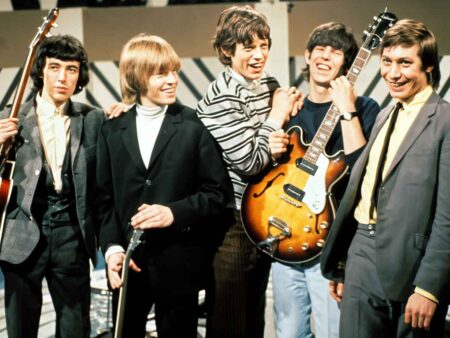
On 13 November 1964, Decca released Little Red Rooster as the band’s fifth UK single. Three weeks later it hit No. 1, the first blues record ever to top the UK singles chart and still the only straight blues song to reach the summit there. Their American label refused to issue it as a single, spooked by the innuendo and the tempo.
In other words: five scruffy kids put a slow, sexually loaded blues about a rooster at the very top of a pop market built on bouncy teen romance.
| Year | Key moment |
|---|---|
| 1961 | Howlin’ Wolf records The Red Rooster at Chess Records in Chicago. |
| 1963 | Sam Cooke scores a US hit with a sleeker Little Red Rooster. |
| 1964 | The Rolling Stones cut their slow, Wolf-inspired version in London. |
| 1964 | On 5 December, the song becomes the first blues No. 1 in the UK. |
Keith Richards’ ‘song about a chicken’ manifesto
Managers, label, even friends told the Stones not to do it. A dirge-like Willie Dixon cover was the exact opposite of what a hungry beat group was supposed to release in late 1964. They were meant to chase the Beatles, not Howlin’ Wolf.
Richards later summed up their attitude in one obscene dare: they were the little red rooster, and, as he put it, ‘See if you can get that to the top of the charts, motherfucker. Song about a chicken.’ In his memoir he describes the single as an act of arrogance and open defiance of pop convention, a way of saying: this is what we are really about.
He also insists it worked not just for them but for the music they loved. Richards recalls that once Little Red Rooster charted, bookings for Muddy Waters, Howlin’ Wolf and Buddy Guy surged, and he is convinced that seeing British kids score hits with hard blues helped Berry Gordy feel bolder about pushing Motown deeper into the mainstream.
You can argue with the scale of that claim, but you cannot miss the point: to Keith, that freak No. 1 was a weapon aimed at the complacency of pop and at America’s amnesia about its own black music.

Spanish Harlem, a living room floor and the Apollo
Rewind a little, to the first time Mick Jagger and Keith Richards set foot in the United States. They were not stars; they were broke tourists with guitars. According to Ronnie Spector, the future icons slept on her mother’s living room floor in Spanish Harlem, living on her family’s hospitality and her mother’s bacon and eggs.
Then Ronnie did something far more important than giving them a bed. She took the two skinny English blues fans to the Apollo Theater to see James Brown. She remembered leading them backstage, introducing them to the rhythm and blues royalty who prowled those halls, and seeing Mick literally shaking when they passed Brown’s dressing room door.
Decades later, Jagger told Time that before they ever came to America, the Stones wore out copies of Brown’s Live at the Apollo, studying the way he turned a show into a ritual. When they finally met him backstage at that same theater, Brown let the young singer watch multiple shows a day. Jagger is blunt about the result: ‘Of course. I copied all his moves.’
What James Brown drilled into the band
For a guitarist, Little Red Rooster is all space and restraint: slide lines that answer the vocal, tiny rhythmic pushes from the rhythm guitar, bass notes placed just late enough to sting. That sense of drama is exactly what Brown’s shows embodied, only at a much higher temperature.
At the Apollo, Jagger saw a band that could hit on a dime and stop like a machine being unplugged. He took that idea home. The Stones’ live shows soon leaned on sudden breaks, vamping codas and vamp-and-stop grooves that owe as much to the Famous Flames as to Muddy Waters. The guitars stayed blues; the way they worked the crowd got a lot more James Brown.
From Chess to Shindig: opening the Chicago floodgates
By the time Little Red Rooster topped the UK charts, the Stones had already made their pilgrimage to 2120 South Michigan Avenue, the address of Chess Records. There they cut sides like 2120 South Michigan Avenue itself, standing where their heroes Muddy Waters and Willie Dixon had stood, and meeting those men in the flesh.
Know Your Instrument’s history of that period notes that songs like Little Red Rooster hitting No. 1 proved blues could sell, and that Richards’ five-string open G language grew directly out of those encounters with American blues players. In other words, the rooster that crowed in Britain was hatched in a very specific Chicago coop.
The payoff for Chicago came on American television. In 1965, the Stones agreed to appear on ABC’s Shindig! only if Howlin’ Wolf was booked too. The network balked; the band held the line. The result is one of the great clips in music TV: Brian Jones quietly telling the host that Wolf is their idol, then snapping ‘now it is about time you shut up and we had Howlin’ Wolf on stage’, before the huge man tears into How Many More Years in front of screaming white teenagers.
That is the loop completed. Chicago blues inspires British kids; those kids become stars; they use prime-time US television to fling their idol back into America’s living rooms. Whatever you call that – appropriation, evangelism, or both – it is not passive.

Appropriation, payback and the uncomfortable middle
It would be naive to pretend the Stones did not profit massively from music born out of black poverty and Southern trauma. Little Red Rooster earned them a hit and cool points that Howlin’ Wolf never enjoyed in his own lifetime. That imbalance is built into the entire history of rock.
At the same time, they insisted on crediting their sources, recording at Chess, putting Wolf on Shindig, and talking endlessly in interviews about Muddy Waters, Buddy Guy and the rest. The truth sits in a messy middle: they took the blues and sold it back to the world, and they also helped pull a lot of blues elders out of the shadows in the process.
What musicians today can steal from this story
1. Trust the ‘wrong’ song
On paper, releasing Little Red Rooster as a single was idiotic. It is slow, bleak and impossible to dance to in any conventional way. Precisely because of that, it told the public what the Stones really were, instead of what the market research said they should be.
If you are an artist, that is the takeaway: one unapologetically honest track can define you more powerfully than ten calculated crowd-pleasers. The dangerous move is often the one that cuts through.
2. Put your heroes on stage, not just in your playlists
The Stones did not just steal licks from Howlin’ Wolf; they dragged him onto network TV and into their touring bills. Ronnie Spector did not just talk about James Brown; she physically took two terrified British kids down the hallway to meet him.
In an era of algorithmic playlists and anonymous influences, there is something radical about that level of visibility. If a player or singer changed your life, say their name, cover their songs onstage, invite them to open for you, and make sure your audience knows where the magic really comes from.
3. Study groove like a fanatic
Richards admits he spent years with a guitar strapped on, playing until he forgot there was a world outside the fretboard. Jagger stood in the wings at the Apollo, absorbing Brown’s sideways glides, microphone tricks and command over the band.
Great feel does not arrive by accident. Whether your church is Chess Studios, the Apollo, a tiny bar or a playlist on your phone, you get that authority by treating your heroes’ records like textbooks and your instrument like an extra limb.

From a Harlem floor to the top of the charts
Picture the arc. Two unknown English musicians sleep on a girl group’s living room floor in Spanish Harlem, say polite thanks to Mrs Bennett, and are dragged into the blazing, disciplined chaos of James Brown’s Apollo show.
A year later they are arrogant enough to bet their careers on a slow Willie Dixon blues about a rooster, and plugged in enough to force Howlin’ Wolf onto national television. In between those points is the moment when the Rolling Stones stopped trying to be a pop band and became what Keith later called, with a crooked smile, ‘what we are really about’. Little Red Rooster was not just a hit; it was a line in the sand.