
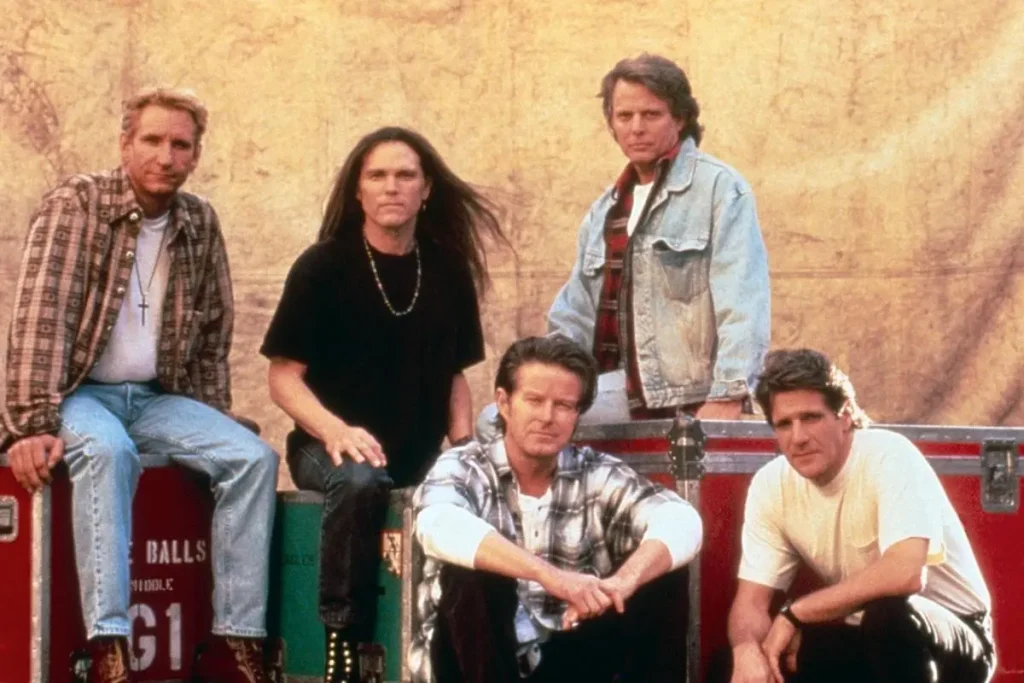
The Eagles didn’t reunite in 1994 like a humble old band looking for closure. They came back like a corporation re-opening a wildly successful product line, with the confidence of artists who knew their catalog was basically a public utility.
After 14 years of internal fractures, lawsuits, and solo detours, the group returned for an MTV Unplugged special and the album Hell Freezes Over, then hit the road with the kind of box-office muscle most younger bands would never touch. The cynics called it cash-grab. The fans called it salvation. The charts and arenas called it a takeover.
The 1994 reunion: from “never again” to “watch this”
By the time the Eagles split in 1980, they were already a legend and a headache. The breakup became myth, complete with barbed quotes and enough resentment to power Los Angeles for a decade.
Then 1994 arrives, and the band executes a return that feels less like a reunion and more like a brand relaunch. The album Hell Freezes Over combines live recordings with a handful of new tracks, and the title basically mocks everyone who ever said the Eagles were done for good.
“For the record, we never broke up, we just took a 14-year vacation.”
Don Henley, introduced during the Hell Freezes Over era (widely repeated line)
Whether you love or hate that line, it’s the perfect summary of how the Eagles framed the comeback: not as an apology, but as a flex.
Why MTV Unplugged mattered (even if it wasn’t really “unplugged”)
The Eagles’ special is often remembered as MTV Unplugged, but it aired under the title Eagles: Hell Freezes Over. Either way, the point wasn’t purity. The point was control: a carefully curated, camera-friendly reset that made the band feel both intimate and unstoppable.
And yes, the show used instrumentation that drifted beyond the strictest “unplugged” rules, but that’s also the Eagles’ whole story: they were never a punk band trying to prove authenticity. They were craftspeople aiming for the best possible sound in the room.
Hell Freezes Over: the record that turned reunion into a new era
Hell Freezes Over worked because it didn’t pretend the past was enough. The live cuts hit the nostalgia button hard, but the new songs signaled that the Eagles weren’t only polishing trophies.
The album included “Get Over It,” a sharp, cranky single that sounded like Henley and Frey reading the cultural room and deciding to punch back. It’s not a peace offering. It’s a sneer with a hook.
| What made the reunion album click | Why it mattered |
|---|---|
| Live versions with big dynamics and tight harmony | Re-established the Eagles as elite performers, not just a greatest-hits memory |
| New material (including “Get Over It”) | Helped the comeback feel current rather than purely archival |
| High production standards | Matched the band’s reputation for perfectionism and radio-ready polish |
| Mass-market appeal | Turned a reunion into a mainstream event, not a niche rock story |
For the hard numbers crowd, the album’s commercial impact is part of its legend. It became one of the key 1990s examples of how a legacy act could still move huge units and sell out huge rooms, a scale that’s echoed throughout Glenn Frey’s long post-reunion career arc.
The tours: nostalgia as a weapon, not a crutch
Many reunions fade after the first lap around the world. The Eagles turned touring into the engine of their modern identity. The shows weren’t framed as a one-time victory lap; they became an ongoing promise: pay the ticket price, and we’ll play it like it matters.
That “it matters” part is crucial. Fans didn’t just want “Hotel California” for the thousandth time. They wanted it executed with the precision and drama that made it iconic in the first place.
Why the Eagles stayed relevant while other legacy acts felt stuck
Here’s the provocative truth: the Eagles kept winning because they were willing to treat their classic material like a living product, not a sacred relic. That means consistent arrangements, high-level musicianship, and an almost ruthless focus on sound quality.
It also helps that their signature blend of rock, country, and folk never really went out of style. Modern Americana, country-rock radio, and harmony-heavy pop all owe something to the Eagles’ template, even when artists don’t say it out loud.
2016: Glenn Frey’s death and the end of the original engine
In 2016, Glenn Frey died, and it wasn’t just a band losing a co-founder. It was the Eagles losing one of their key voices, writers, and stage personalities.
Reports on Frey’s death cited complications involving rheumatoid arthritis, acute ulcerative colitis, and pneumonia. That combination of diagnoses also sparked discussion about how chronic illness can cascade, especially when the immune system is under stress.
For plain-language context on one of those conditions, the National Health Service definition of ulcerative colitis describes it as a form of inflammatory bowel disease that causes inflammation and ulcers in the colon.
After Frey: the ethical question and the practical reality
When a giant band continues after a foundational member dies, there are always two reactions. One group says it’s disrespectful. The other says the music belongs to everyone who made it and everyone who loves it.
The Eagles kept touring, and they did it in a way that made the subtext obvious: this is a tribute, but it’s also the business. That’s not automatically cynical. It’s honest.
The band’s modern era and ongoing touring footprint underline the scale of what changed – and what didn’t – after Frey’s passing.
The new lineup: Vince Gill and Deacon Frey
Replacing Glenn Frey is impossible, so the band didn’t try to “replace” him in the emotional sense. Instead, it brought in players who could carry the vocal and guitar load while keeping the show respectful.
Vince Gill’s reputation as a world-class singer, guitarist, and songwriter made him a credible choice for a band that lives and dies by harmony and tone.
Deacon Frey’s role added a different layer: continuity, family, and a direct line to Glenn’s presence without resorting to hologram theatrics.
The sound that refuses to die: why Eagles songs still land
The Eagles’ influence isn’t just “they sold a lot of records.” It’s structural. They helped mainstream a hybrid of rock drive, country narrative, and folk harmony that became a roadmap for decades of radio-friendly songwriting.
Even their best-known tracks show the formula: singable melodies, layered vocals, and lyrics that feel like short films. “Hotel California” works because it’s both a groove and a story you can argue about for the rest of your life.
On the production side, “Hotel California” is also a benchmark recording, frequently dissected by musicians and engineers because the arrangement, tones, and dual-lead interplay are so tightly engineered.
Timeless doesn’t mean harmless
It’s tempting to treat the Eagles as comfort food: warm harmonies, desert highways, a little melancholy. But a lot of their most enduring work has teeth. “Life in the Fast Lane” is basically a warning shot. “Desperado” romanticizes loneliness while quietly indicting it. “Get Over It” is a grumpy manifesto.
That edge is part of why the band still clicks with new listeners. They weren’t writing greeting cards. They were writing adult pop that understood compromises, ego, and consequences.
How to hear the reunion era like a musician (not just a fan)
If you want to get more out of the 1994 performances and the tours that followed, listen like a builder studying architecture. The Eagles’ “secret” is rarely virtuoso flash; it’s systems.
Quick listening checklist
- Harmony stack: Notice how the vocal blend stays clean even when the band pushes volume.
- Guitar roles: One part carries rhythm, another paints lines, and the leads converse instead of competing.
- Dynamics: Choruses lift without just getting louder; the arrangements open up.
- Time feel: The groove is steady, but not robotic. That’s veteran pocket.
If you’re a guitarist, the Eagles are a masterclass in parts that are playable, memorable, and strategically placed. That’s why cover bands live on their catalog, and why the songs survive every format shift from vinyl to streaming.
Conclusion: the Eagles proved reunions can be dangerous and still be great
The Eagles’ 1994 reunion didn’t just revive a band. It rewrote the playbook for what a legacy act could be: a touring juggernaut, a premium live experience, and a catalog that stays culturally loud even when rock supposedly “dies.”
Glenn Frey’s death changed the story forever, but it didn’t erase the music or the demand. If anything, it sharpened what the Eagles always were: a band built on craft, friction, and the stubborn belief that a great song can outlive the people who wrote it.
Check the video below:


