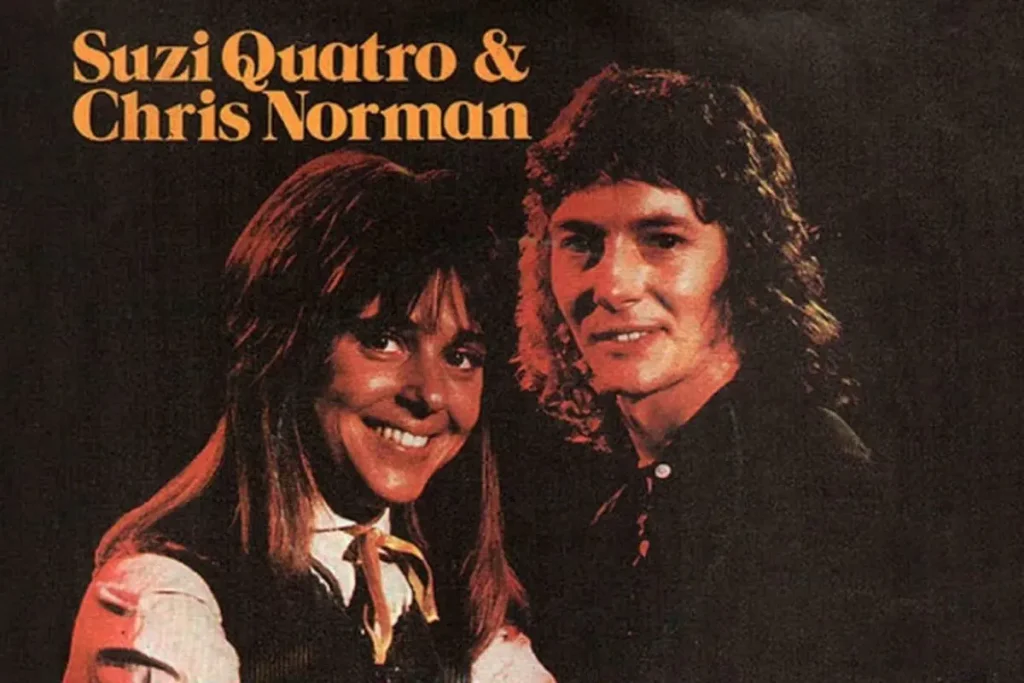
Some hit singles sound inevitable – like the universe was always going to arrange the exact chorus, the exact snare sound, the exact radio timing. “Stumblin’ In” does not feel like that kind of record.
On paper, Suzi Quatro and Chris Norman were an odd match: she was the leather-clad rock trailblazer with serious TV visibility, he was best known as the voice of Smokie, a band with a much stronger European footprint than an American one. And yet their duet became one of the era’s stickiest soft-rock crossovers, climbing high on U.S. radio and staying lodged in pop culture ever since – something you can still trace in Suzi Quatro’s chart history.
“It’s one of those songs that just… people love it.”
– Suzi Quatro, via The Current interview feature
The late-70s moment that made this duet possible
To understand why “Stumblin’ In” landed, you have to remember how weird the musical ecosystem was in the late 1970s. Rock had splintered into arena bombast, punk backlash, disco dominance, and a growing appetite for gentler adult pop that still felt “real.”
Soft rock wasn’t about being harmless. The Hot 100 climate of 1979 shows how much room there was for emotionally direct, radio-friendly records. It was about being accessible – emotionally direct, radio-friendly, and often sung like the vocalist was confiding in you from the passenger seat. The format rewarded duets because they created instant narrative tension: two voices, two viewpoints, one hook.
The “total opposites” mythology – true, but incomplete
Suzi Quatro: a rock identity that refused to ask permission
Suzi Quatro’s image was not built for easy-listening radio. Her reputation came from hard-edged glam rock and a tough, self-directed persona that influenced generations of women in rock, including major artists who have credited her impact – an arc Quatro reflects on in her discussion of “Stumblin’ In”.
That’s what makes “Stumblin’ In” provocative. It’s not a “sellout” pivot so much as proof that a rock artist can switch emotional gears without surrendering credibility. If anything, her voice gives the song its backbone – the grit under the gloss.
Chris Norman and Smokie: bigger than many Americans realized
The common American framing is that Smokie “barely made a mark.” In the U.S., that’s partly fair. But globally, Smokie had serious chart traction, and Norman’s voice was already radio-ready: warm, slightly husky, built for melodic hooks – traits that fit the band’s broader profile on Smokie’s Billboard artist page.
So the duet isn’t “superstar meets nobody.” It’s closer to “two different lanes of pop-rock professionalism collide and accidentally make a classic.”

What the charts say: this wasn’t a minor hit
“Stumblin’ In” wasn’t just a charming footnote. It performed strongly in the United States, reaching the upper tier of the Billboard Hot 100. It also connected with adult-leaning listeners on Billboard’s Adult Contemporary chart, which is exactly where soft rock became a long-term lifestyle rather than a trend.
| Metric | What it tells you |
|---|---|
| Billboard Hot 100 peak | A mainstream pop breakthrough, not just a niche rock success. |
| Adult Contemporary presence | Proof it lived on “soft” radio formats that repeat songs for decades. |
| UK award database listing | Shows the single’s life in certification culture and catalog tracking. |
For readers who like receipts, Billboard’s own artist pages also document Suzi Quatro’s U.S. chart performance, keeping “Stumblin’ In” anchored in verifiable chart data rather than nostalgia fog via her Billboard artist profile.
The songwriting chemistry: why two voices beat one
The magic of “Stumblin’ In” is structural. It’s built like a conversation that keeps turning into a confession. Each singer sounds slightly surprised by what they’re admitting, and the harmony makes it feel like the two characters are learning the same lesson at different speeds – something that’s easier to place when you look at Chris Norman’s broader recording footprint.
Musically, it leans on classic soft-rock tactics: mid-tempo pulse, clean chord movement, and a chorus that resolves with comfort instead of drama. The production doesn’t try to “rock up” the track to match Suzi’s tougher brand, and it doesn’t water Chris down into faceless pop either. It splits the difference – which is exactly why it works.
The hook is disarmingly simple (and that’s the point)
Some songs impress you. “Stumblin’ In” seduces you. The melodic line is easy enough to remember after one play, but the performance keeps it from becoming wallpaper.
That’s the paradox: soft rock survives by being replayable without becoming invisible. When people call it “easy listening” as an insult, they miss the craft involved in making something feel effortless.
Why the pairing feels “wrong” – and why that’s exactly why it hits
There’s a psychological thrill in hearing artists step outside their expected roles. With Quatro, you anticipate swagger; with Norman, you anticipate smoothness. “Stumblin’ In” plays that expectation like a card trick.
Quatro doesn’t soften her identity so much as reframe it: toughness becomes tenderness. Norman doesn’t become a rock frontman; he becomes the steady emotional counterweight. Together, they create a believable romance that’s not flashy, not poetic, just real enough to sting.
“I was a rock ’n’ roll artist, and then suddenly I had this huge soft hit in America.”
– Suzi Quatro, as discussed in The Current feature
The TV factor: Suzi Quatro’s mainstream visibility mattered
One reason the “opposites” narrative persists is that many listeners first encountered Suzi as a TV personality as much as a recording artist. Her acting run as Leather Tuscadero on Happy Days amplified her mainstream profile in the U.S., creating a rare bridge between rock credibility and family-living-room familiarity.
That matters because “Stumblin’ In” is the kind of song that spreads when different audiences agree to like the same thing. TV recognition can lower the barrier to entry: even skeptical listeners will give the song a chance because they already “know” one of the faces, and her wider screen work is captured in Quatro’s filmography listing.
“Soft rock” doesn’t mean “soft impact”
Here’s the edgy claim that holds up: soft rock is often more emotionally manipulative than hard rock because it’s designed to bypass your defenses. A big guitar riff signals “performance.” A gentle duet signals “truth.”
“Stumblin’ In” isn’t cynical, but it is expertly engineered to feel intimate. The lyrical stance is humble – two people admitting they didn’t plan this, can’t fully control it, and might get hurt. That’s relatable in a way that power anthems rarely are.
Still a vibe: why the song keeps returning
When a record keeps resurfacing across decades, it usually has at least one of these traits: a singable chorus, a distinctive vocal blend, or a narrative you can map onto your own life. “Stumblin’ In” has all three.
It also benefits from the ongoing re-evaluation of Suzi Quatro’s legacy. As more critics and musicians publicly frame her as a foundational figure for women in rock, her catalog gets re-heard with fresh respect – and the “surprise soft hit” becomes part of the story rather than a detour.

How to listen to it like a musician (quick checklist)
- Focus on the vocal phrasing: notice how they don’t sing like two soloists fighting for space.
- Listen for restraint: the track avoids huge dynamic swings, which keeps it replayable.
- Track the harmony choices: the blend is warm, but not sugary – the slight rasp is the secret sauce.
- Pay attention to the emotional arc: it’s not “love conquers all,” it’s “love happens anyway.”
What “Stumblin’ In” reveals about both artists
For Suzi Quatro, the song proves she could dominate a softer format without losing the core of her voice or persona. Chart documentation shows that this duet sits among her most recognized U.S. entries, which is no small thing for an artist so closely associated with glam-rock attitude.
For Chris Norman, it’s a reminder that great pop singing is a skill, not a genre. You can come from band success and still deliver a duet that feels personal, not like a contractual team-up.
Conclusion: the hit nobody “should” have made
“Stumblin’ In” endures because it’s a musical contradiction that resolves in real time: glam-rock toughness meets soft-rock vulnerability, and instead of canceling each other out, they create a new center. It’s not just a late-70s slow dance staple. It’s a case study in how opposites can sound believable when the performance is honest and the hook is bulletproof.
Check the music video below: