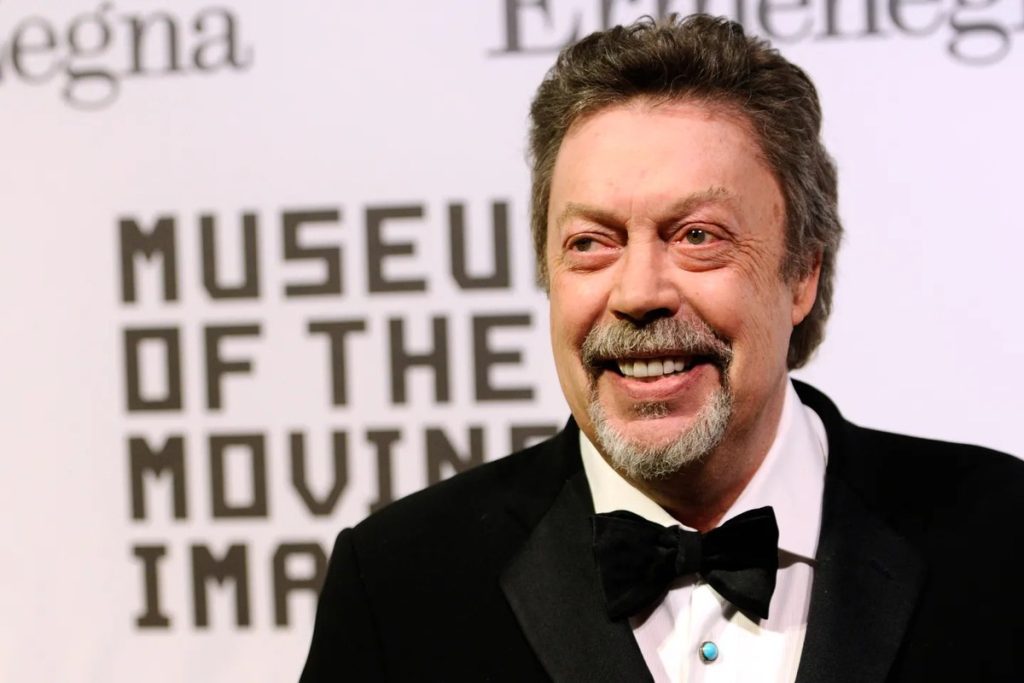
Tim Curry died on Tuesday night at his home in Los Angeles. He was 80. His longtime manager and friend Marcia Hurwitz confirmed the death to the Associated Press; no cause has been disclosed.
The obituaries have led, inevitably, on Dr. Frank-N-Furter, on Pennywise, on the butler in Clue and the concierge in Home Alone 2. All fair. But there is a version of Tim Curry that gets left out of the film write-ups, and it is the one that belongs on a music site: before he was anybody’s favorite villain, he was a singer who made three rock records with some of the most serious producers of the era.
He sang before he acted
Curry was born in Grappenhall, Cheshire, the son of a Methodist naval chaplain and a school secretary. His father died when he was 12. Acting did not occur to him until his mid-teens; singing came first and came early.
“There was a lot of theater, and I sang, too; I had been singing in church from the age of 7,” he told the AP of the school he attended for the sons of Methodist ministers. “I had enormous opportunities to express myself in that way. I just got hooked, really.”
He went to the University of Birmingham in 1965 — one of only three English universities then running a drama department — and by his own account “took an academic course, which I largely ignored, I’m afraid, and just acted all the time.” Then he went to London and talked his way into his first professional job. That job was Hair.
Curry’s entry into the business was not Shakespeare; it was the West End production of the era’s defining rock musical. From there he went to the Royal Shakespeare Company and the Royal Court Theatre, where in 1973 Richard O’Brien’s The Rocky Horror Show opened with Curry as Frank-N-Furter.
Rocky Horror is a rock musical, and Curry played it as one. He took it to Broadway and then into the 1975 film alongside Barry Bostwick, Susan Sarandon and Meat Loaf — which is to say his most famous role put him on screen singing next to one of the biggest-selling rock vocalists of the following decade.
The three albums
Between 1978 and 1981, off the back of Rocky Horror, Curry made a genuine run at a recording career. The personnel tell you how seriously it was taken.
Read My Lips (1978) was produced by Bob Ezrin — the man behind Alice Cooper’s run of classics, Lou Reed’s Berlin, Kiss’s Destroyer and, two years later, Pink Floyd’s The Wall. The record was built largely from covers.
Fearless followed in 1979 and was the commercial high point. Unlike its predecessor it was almost entirely original material), mostly written by Curry with his producers Michael Kamen and Dick Wagner — Kamen, the arranger and composer who would later work with Pink Floyd, Queen and Metallica; Wagner, the guitarist whose playing runs through Alice Cooper’s and Lou Reed’s best-known records. The single “I Do the Rock” became Curry’s only US chart entry, reaching No. 91 on the Billboard Hot 100 late that year.
Simplicity arrived in 1981 and closed the chapter. Nobody would argue Curry was a great rock singer in the way Meat Loaf was. But these were not vanity records: Ezrin, Kamen and Wagner did not take on passengers.
The voice was always the instrument
What the music career makes obvious is the thing that ran through everything else: Curry’s asset was his voice.
He earned three Tony nominations — for Spamalot, My Favorite Year and Amadeus, where he played Mozart opposite Ian McKellen’s Salieri — plus an Emmy nod in 1994. The New York Times described his King Arthur in Spamalot as “stalwart, plummy-voiced.” In later years he built a second career entirely out of that baritone, voicing roles across Star Wars: The Clone Wars, The Wild Thornberrys and The Adventures of Jimmy Neutron.
Luke Evans, who finished a seven-month run as Frank-N-Furter in Broadway’s 2026 revival only recently, put it in exactly those terms on Instagram: “He was a force, a bright fierce flame, an exquisite charm and that rich vocal tone.” Carol Burnett, his co-star in Annie, wrote that “nobody could play lovable villains better than he could.” Michael McKean, from Clue, remembered a last conversation “about life and love and laughter.”
What is and isn’t known
Curry suffered a major stroke in 2012 that left him using a wheelchair, and he lived with significant health problems for more than a decade afterward. He kept working, lending his voice to animation and returning to live-action in 2024 for a cameo in the horror film Stream. His memoir, Vagabond, was published in 2025.
On the death itself, the confirmed facts are thin and worth stating plainly. Hurwitz confirmed he died Tuesday night at home. Newsweek reported, citing law enforcement sources via TMZ, that police responded to the residence at 11:23 p.m. and that no foul play is suspected. No cause of death has been given by his family or his representative. A number of outlets are running detailed accounts of his medical history that have not been confirmed by anyone speaking on the record, and readers should treat those accordingly.
Curry never married and had no children, and was famously private. He wrote in Vagabond that he agreed to tell his story only because of what fans kept telling him it had meant — “that older queen, hopefully still in his fishnets, who saw Rocky Horror upstairs at the Royal Court,” among others. For a man who spent fifty years playing people he insisted were nothing like him, it is a rare glimpse of the actual person, and a good note to leave him on.