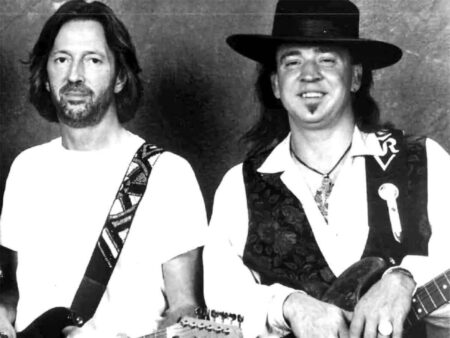
Eric Clapton once had “Clapton is God” sprayed on London walls. Yet when he talked about Stevie Ray Vaughan’s last performance, he sounded less like a deity and more like a man who had just seen something he could not match.
In the final days before Vaughan’s death at Alpine Valley, Clapton watched a newly sober, utterly fearless guitarist playing like he had been given a second life and intended to use every second of it. What Clapton thought in those moments is one of the most revealing crossroads in modern guitar history.
The comeback: Stevie, clean and terrifyingly good
By 1990 Stevie Ray Vaughan was not the reckless prodigy from the early Texas Flood years. He was a survivor who had gone to the brink with drugs and alcohol, nearly died on tour in Europe in 1986, then dragged himself through rehab and back onstage sober and sharper than ever. His playing after that period was more focused, more controlled, and somehow even more dangerous.
That reborn version of Vaughan powered the In Step era and put electric blues back in serious circulation at a time when glossy 80s rock was running out of gas. Critics and players alike began treating him not as a novelty or a throwback, but as one of the defining guitar voices of the late 20th century.
Setting the scene: Alpine Valley, August 26, 1990
Stevie’s last show took place at Alpine Valley Music Theatre near East Troy, Wisconsin, on August 26, 1990. He had spent those final days opening for Eric Clapton, with a bill that read like a blues summit: Robert Cray, Buddy Guy, Jimmie Vaughan, and Clapton himself.
After Vaughan’s own set, an all-star encore jam on “Sweet Home Chicago” closed the night, with Stevie trading licks alongside Clapton and the others. Fans later pointed to that show as one of the most electrifying performances of his life, not because anyone knew it was the end, but because he played like a man who had finally outrun his demons and was flooring it.

Clapton watching from the wings
Clapton was not hearing Stevie like a casual fan. Backstage, he sat in his dressing room with the door open, watching the stage feed on a monitor and listening as that massive Texas tone rolled in from outside. Later he admitted he was “so bowled over and so in love with this guy” onstage that he started to feel ashamed about walking out afterward to play his own Cream-era material.
What shook Clapton was not just Vaughan’s speed or power, but that he was “playing from the heart completely,” locked into one kind of music with total conviction. Coming from a player who had reinvented himself multiple times since the 60s, that kind of single-minded purity hit hard.
“No one better on this planet”: Clapton’s blunt verdict
In a later interview, Clapton talked specifically about Stevie’s Alpine Valley performance and did not resort to polite rock-star compliments. Instead he went for the jugular:
“The worst thing for me was that Stevie Ray had been sober for three years and was at his peak. When he played that night, he had all of us standing there with our jaws dropped. I mean, Robert Cray and Jimmie Vaughan and Buddy Guy were just watching in awe. There was no one better than him on this planet. Really unbelievable.”
That comment surfaced in a Rolling Stone conversation and has since been quoted in auction notes and retrospectives on Clapton’s career. Coming from a man who once scared London with his own virtuosity, the phrase “no one better than him on this planet” is not casual flattery. It is Clapton essentially conceding the crown.
Why Stevie hit Clapton so hard
Part of the impact was personal. Clapton knew the cost of addiction and the fragility of sobriety, and here was a younger guitarist who had done exactly what doctors once doubted Clapton himself could do: get clean and come back stronger. Stevie’s playing in those final years was the sound of someone who had decided that every chorus might be his last and should be played that way.
Part of it was historical. Vaughan had dragged plugged-in blues back into the mainstream in the 80s, at a time when the genre was treated like museum music. His hybrid of Albert King bends, Hendrix ferocity and Texas shuffle swing convinced an entire generation that blues could still feel lethal, not academic or nostalgic, earning him a place among the greatest guitarists of all time.

Clapton, tone, and the problem of Stevie’s fire
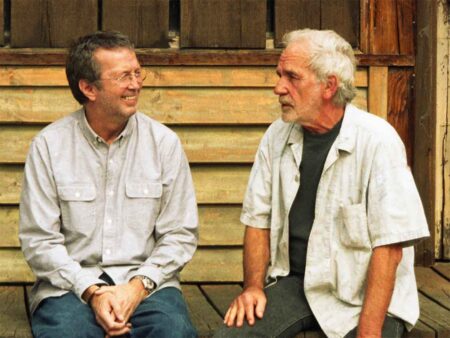
By the late 80s, Clapton himself was searching for a less showy way to make music. He was gravitating toward understated players like J.J. Cale, whose whole aesthetic was the opposite of trying to blow the roof off every solo. Cale’s quiet, restrained approach gave Clapton a way out of the “guitar hero” circus he had helped create.
That makes his awe of Stevie even more striking. Clapton was publicly rejecting flash, but in private he was mesmerized by a guy who could walk onstage with a battered Strat, heavy strings, and ridiculous vibrato and simply overpower a stadium by sheer conviction. He was not just impressed. He was threatened, in the best musical sense.
The radio moment that stopped Clapton’s car
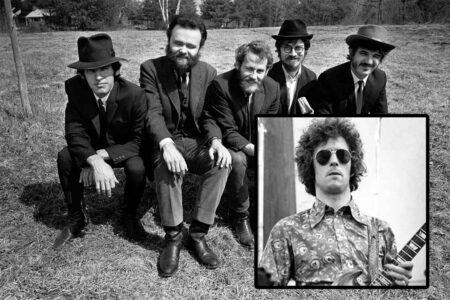
Clapton has recalled first really hearing Vaughan on the radio and being so stunned he had to pull his car over. What he heard was someone taking the same blues vocabulary he had mined in the Yardbirds, John Mayall’s Bluesbreakers and Cream, but delivered with the ferocity and precision of a street fighter half his age, a moment later described in detail as the performance that made him pull over his car.
He later admitted that Vaughan’s example helped drag him back toward deeper blues projects, from full-album collaborations with B.B. King to his obsessive Robert Johnson tribute. In other words, the student he was praising as unbeatable ended up nudging the supposed master back to the source.
Last flight out of Alpine Valley
After the jam at Alpine Valley, plans were already being floated backstage for a series of Royal Albert Hall shows in London, where Stevie would join Clapton for a Jimi Hendrix tribute run. It was one of those fantasy-lineup ideas fans dream about and rarely get, and it was later documented in accounts of the Alpine Valley shows.
Instead, four helicopters were waiting to shuttle musicians and crew to Chicago. In thick fog, Vaughan took the last open seat in a chopper filled with members of Clapton’s entourage. Minutes later it slammed into a ski slope near the venue, killing everyone on board, with investigators later ruling that the pilot flew into terrain in near-zero visibility, as detailed in the official investigation of the crash.
Clapton’s survivor’s guilt
Clapton came brutally close to stepping into that same helicopter. He has talked about how the crash shook him, not only because he lost a friend and musical ally, but because he knew that by simple logistics it could have been him. In later interviews he said the experience changed his outlook, making him treat every day afterward as a “bonus” he had no right to waste, a reaction he described when recalling how Vaughan’s playing had once stopped him in his tracks.
For a man already haunted by losses like Jimi Hendrix and Duane Allman, Stevie’s death was a particularly sharp twist of the knife. This time, the fallen guitar genius was a recovered addict, three years sober and finally at full power, and the randomness of losing him in a low-visibility hop to the next gig was almost too much to process, a cruelty later echoed in Clapton-related memorabilia and tributes.
What Clapton really respected in Stevie’s playing
Strip away the mythology and you are left with some very concrete things Clapton admired. Vaughan’s tone was brutal but controlled, helped by down-tuned strings, thick gauges, and a right hand that could snap a note out of the amp like a rifle shot. He could shift from a Texas shuffle to jazz-inflected chord work without losing that street-level bite, a versatility often highlighted in profiles of his playing style.
More importantly, he did all of this without hiding behind effects or studio polish. Live, it was essentially Strat, cable, cranked amp, and raw touch. That lack of a safety net is exactly what older players like Clapton recognized. If you missed, there was nowhere to run. Stevie almost never missed.
What today’s players can steal from that night
| What Clapton saw | What it means for you |
|---|---|
| One style, played with total commitment | Stop trying to cover everything. Go deep on one voice and make it undeniable. |
| Raw tone, minimal gear | Chase touch and dynamics before pedals. If it does not sound good dry, it will not sound good with effects. |
| Sober, focused performance | Your playing will never outrun your lifestyle. Clarity offstage turns into clarity onstage. |
| Respect between giants | Use other players’ greatness as fuel, not as an excuse to quit. |
Conclusion: the night the “guitar god” bowed his head
On paper, Alpine Valley was Clapton’s show. In reality, it became the night Eric Clapton quietly admitted that someone else had pushed electric blues further than he could take it. His description of Stevie Ray Vaughan as the best guitarist on the planet was not hyperbole. It was a stunned field report from a man who knew exactly what that title meant, a sentiment he would echo when saying there was “no one better” than Vaughan.
If you are a guitarist who grew up on 50s rock, 60s British blues, or 70s hard rock, it is worth watching that final footage with Clapton’s comments in mind. You are seeing the moment the kid who idolized the British blues boom took that whole tradition, cleaned up his life, and threw it back at the original hero so hard that even Clapton could only stand there, jaw dropped, and say: there is no one better.