For more than fifty years, rock fans stared at the bent figure on the cover of Led Zeppelin’s untitled fourth album and saw a mystery. An old man, hunched under a bundle of sticks, became a blank screen for every theory from folk magic to occult symbolism. Only recently did we learn his real name: Lot Long, a Victorian thatcher from Wiltshire, who never knew he would be conscripted into rock mythology.
The album cover that turned a stranger into a symbol
Led Zeppelin’s fourth studio record is one of rock’s great shape-shifters. It has no printed title, only four cryptic symbols, yet it contains arena staples like Black Dog and Stairway to Heaven and has been treated as a kind of hard-rock scripture since its release in 1971.
The front cover shows a framed image of an elderly man carrying a heavy load of cut branches on his back, hung on a wall of faded floral paper inside a crumbling house. Flip the sleeve and you get a modern high-rise block, widely believed to be Salisbury Tower in Birmingham, completing a stark rural-versus-urban diptych.
The band refused to print its name or the album title, and the art department offered little explanation. The effect was deliberate confusion: a massive rock statement that looked like a battered picture in a condemned living room. To fans raised on glossy band photos, it felt almost confrontational.
Painting, photograph, or occult relic?
For decades, most listeners assumed the old man was a painted figure, not a real person. Bootleg lore claimed he was a hermit, a druid, even a stand-in for Crowleyan magicians that guitarist Jimmy Page admired. Others simply called him the stick man and left it at that.
As the occult reputation of Zeppelin grew, so did the speculation. In fan circles and music press, the figure was variously said to be Henry Brusher Mills, a New Forest snake catcher who lived like a hermit, or Old George Pickingill, a folk magician some writers dubiously linked to early witchcraft traditions.
It all fit a seductive narrative: the runes on the inner sleeve, the tarot-style Hermit on the gatefold, and an album that seemed to shimmer with half-buried folk horror. Rock culture wanted a wizard on that wall, not a poor laborer hauling fuel.
From anonymous stick man to Lot Long of Mere
The truth that has finally emerged is both less mystical and more human. The man on the cover was a Wiltshire thatcher named Lot Long, sometimes recorded as Lot Longyear, born in the market town of Mere in 1823.
By the early 1890s, Long was a widower living in a small cottage on Shaftesbury Road in Mere, near the borders of Wiltshire, Dorset and Somerset. When the photograph was taken he was around 69 years old, still working, his livelihood literally resting on his shoulders in that bundle of sticks.
For half a century of record-store browsing, he was nobody, a prop. In reality he was a skilled manual worker at the end of a hard life, captured in a single moment that would outlive him by well over a century.
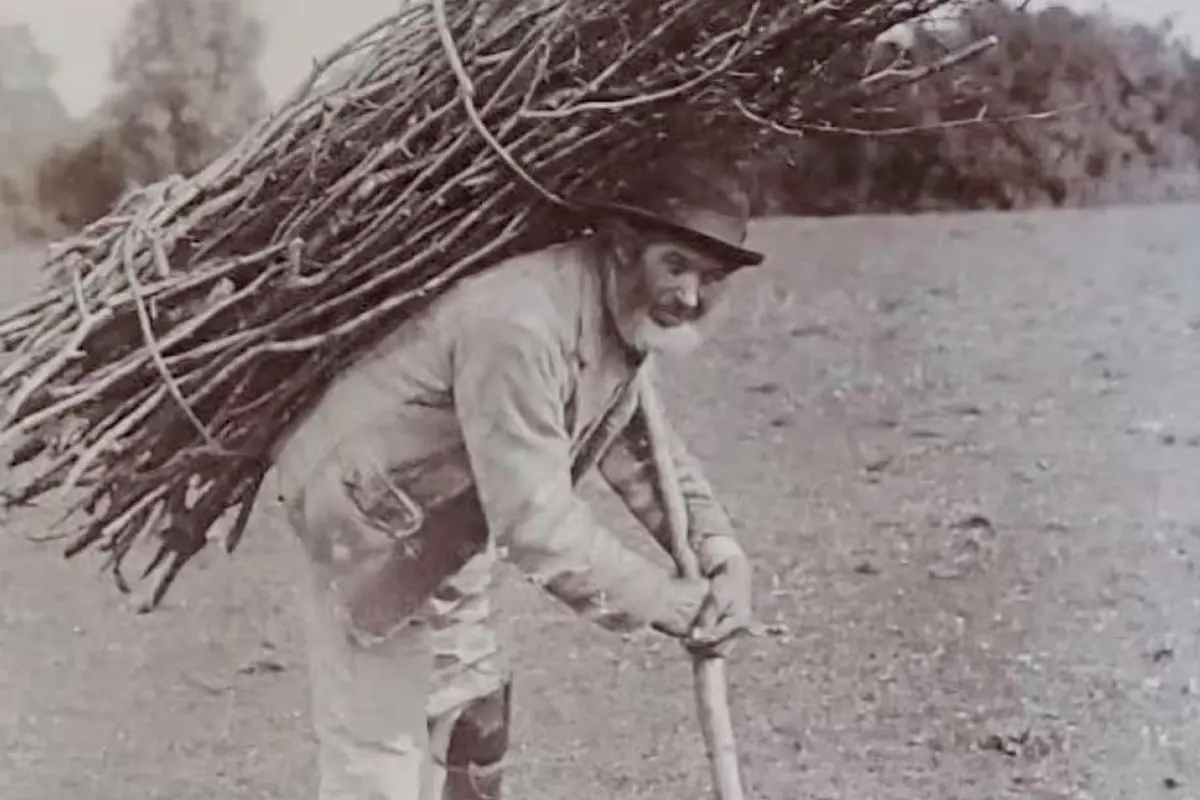
The Victorian photograph behind the cover
The source of the image is not a painting at all but a late Victorian photograph titled A Wiltshire Thatcher. It appears in a carefully assembled album of photographs labeled Reminiscences of a visit to Shaftesbury. Whitsuntide 1892. A present to Auntie from Ernest, with the thatcher’s portrait captioned in the photographer’s hand.
Handwriting in the album matches the signature of Ernest Howard Farmer, a key early figure in British art photography and the first head of the School of Photography at Regent Street Polytechnic, now part of the University of Westminster. The Led Zeppelin cover uses a hand-coloured version of Farmer’s black and white image, framed and then photographed again against that peeling interior wall.
| Detail | What we know |
|---|---|
| Full name | Lot Long (sometimes Longyear) |
| Birth | Born in Mere, Wiltshire, 1823 |
| Occupation | Thatcher – a specialist in roofing with straw or reeds |
| Status at time of photo | Widower, still working into old age |
| Home | Cottage on Shaftesbury Road, Mere |
| Approximate age in image | About 69 years old |
| Death | Died in 1893 |
How the photo resurfaced after 130 years
The key to the mystery was not a Zeppelin insider but a local historian. Brian Edwards, a visiting research fellow at the University of the West of England and a lifelong Zeppelin fan, was working with Wiltshire Museum on an exhibition about the region when he opened the Victorian album and froze. He instantly recognised the stooped figure with the sticks from his record collection, a moment later described in detail in Artnet’s account of the discovery.
Edwards later described scrolling through an online auction catalogue in 2023, flipping an image of the album pages upright and feeling his jaw hit the floor as he realised what he was seeing. He called his wife for a sanity check, then alerted Wiltshire Museum, whose staff confirmed the likeness.
The museum moved quickly, acquiring the album at auction for a few hundred pounds, a tiny sum given that it effectively bought the negative history of one of rock’s most famous pieces of cover art. Conservators are now working to preserve and digitise the photographs so that the thatcher and his neighbours can finally be seen clearly, away from worn cardboard sleeves and ring wear.
Wiltshire Museum’s statements describe the picture as a late Victorian coloured photograph of a Wiltshire thatcher and note that research strongly suggests the sitter is Lot Long, born in Mere in 1823 and a widower by the time he was photographed, who died in 1893.
Robert Plant, junk shops and a quiet act of appropriation
So how did a rural working man from the 1890s end up on a 1971 rock album? Most accounts agree that Robert Plant spotted a colourised print of Farmer’s photograph in an antique or junk shop near Jimmy Page’s home in Pangbourne, Berkshire, on the way to or from the Headley Grange recording sessions, as reported in coverage of the original photo’s rediscovery.
The band then had the picture framed and photographed against the decaying interior wall that appears on the sleeve. From there, the design team built the entire package around that collision of worlds: battered cottage wall on the front, stark modern tower block on the back.
In purely visual terms, it is brilliant. In ethical terms, it is quietly ruthless. A real man with a hard, anonymous life had his image plucked from obscurity and turned into a logo for a band on the cusp of rock aristocracy. His name, family and circumstances were stripped away, leaving only an aesthetic of burden and authenticity.
Seen alongside Zeppelin’s repeated borrowing from American bluesmen who were rarely credited or properly paid, the cover feels of a piece with the band’s larger pattern: astonishing art anchored, sometimes rather casually, to the backs of working people who never shared in the rewards.
Myth versus reality: what Lot Long changes
Knowing the man’s name does not kill the magic of the cover. If anything, it makes the image more unsettling. That is not a mythical hermit or invented archetype; it is a specific old labourer, probably exhausted, still working because Victorian England offered him little choice.
The bundle on his back may be thatching material, firewood, or both. Either way it reads as weight – the literal and symbolic load of rural poverty. The colourist who tinted the original photograph drew out the earthy browns and muted greens, tones that sit uneasily against the gaudy floral wallpaper behind him.
When that framed scene is then pasted onto a ruined interior and backed with a brutal apartment block, the album becomes a kind of silent editorial. It pits the pre-industrial world, embodied by Long, against the concrete age that produced Led Zeppelin and their audience. The band claimed no grand concept, but the visual politics are sharp whether or not they were fully conscious of them.
It also punctures some of the more grandiose occult readings of the record. The inside gatefold still offers listeners their tarot Hermit, glowing staff held aloft on a mountain. The front cover, by contrast, now reads like a hard fact: here is the kind of man whose world your amplifiers are about to drown out.
Conclusion: giving the man on the cover his name back
For years, fans argued about who the stick man might be and what secret Zeppelin encoded in his bent frame. The real story is stranger and more grounded. A provincial photographer with artistic ambitions documented a local thatcher in 1892. Eight decades later, a singer hunting through junk shops grabbed the picture as raw texture for a record sleeve.
Lot Long never heard Led Zeppelin and never consented to be their mascot. Yet his image helped sell millions of copies and defined the look of one of rock’s most revered albums. Now that historians and museum staff have given him his name back, the cover snaps into a different focus.
The loudest band of the 1970s built its most iconic visual on the quiet suffering of a Victorian worker. Knowing that does not make the album any less powerful. It just reminds us that behind even the most mysterious piece of rock iconography, there is usually a very real human spine bearing the weight.