
September 30, 1977: AC/DC release “Let There Be Rock” as a single in Australia, taking a track that already felt like a mission statement and turning it into a hard, shiny 7-inch calling card. Depending on your tolerance for volume, it’s either a celebration of rock’s origins or an argument that rock ‘n’ roll is the closest thing we have to scripture.
And the lyric hook is deliciously nerdy: the song plays as a mythical history lesson where classical music gets the memo and then loses the room. It riffs on Chuck Berry’s famous jab in “Roll Over Beethoven” and runs with it as if Bon Scott is writing fan fiction with a Marshall stack.
OTD: What exactly happened on Sept 30, 1977?
“Let There Be Rock” was issued as a single in Australia in 1977, separate from the album campaign, during the band’s scorching pre-international-breakthrough run with Bon Scott on vocals. The track appears on the Let There Be Rock album, credited to Angus Young, Malcolm Young, and Bon Scott.
Chart-wise, the single’s Australian performance is often described as modest rather than dominant, which is part of its mystique: it wasn’t a polite, radio-friendly hit, it was an escalation. In other words, AC/DC weren’t trying to win everyone; they were trying to find their people through its Australian chart run.
The lyric that hijacks a Chuck Berry line
Chuck Berry’s “Roll Over Beethoven” famously tells the old guard to move aside, name-checking both Beethoven and Tchaikovsky as rock arrives like a cultural bulldozer. That “tell Tchaikovsky the news” line is basically a mission statement for rock’s teenage revolt, echoed in Berry’s original lyric.
AC/DC’s twist is cheeky and bigger than it first appears: in “Let There Be Rock,” the message actually reaches Tchaikovsky, who then spreads it and sets off a chain reaction that turns into rock ‘n’ roll. It’s comic-book storytelling, except the superheroes are guitar amps and a backbeat.
“Roll over Beethoven and tell Tchaikovsky the news.” – Chuck Berry, “Roll Over Beethoven”
“Let There Be Rock” as a creation myth
The title alone is biblical, and AC/DC lean into that language without pretending they’re a thoughtful prog band. The song stages rock’s beginning like the Book of Genesis rewritten by a pub singer with a wicked grin: there was nothing, then there was rock, and suddenly everyone had to deal with it.
This is why the track still feels larger than its era. It’s not a diary entry, and it’s not subtle social commentary. It’s the kind of song that tries to explain rock ‘n’ roll as an unstoppable force of nature, and then proves its point by being seven-ish minutes of relentless drive.
The “history lesson” is propaganda (in the best way)
There’s a reason fans call it an anthem: the story is exaggerated on purpose. It’s propaganda for the church of loud guitars, built to recruit, not to inform. The band’s “truth” is emotional: rock ‘n’ roll arrives, electrifies the world, and the faithful are never the same.
That makes the single release an interesting moment: putting this track on a 7-inch isn’t just distribution, it’s a dare. If you dropped the needle on this in 1977, you weren’t background-listening. You were choosing sides.
The sound: why it hits like a brick
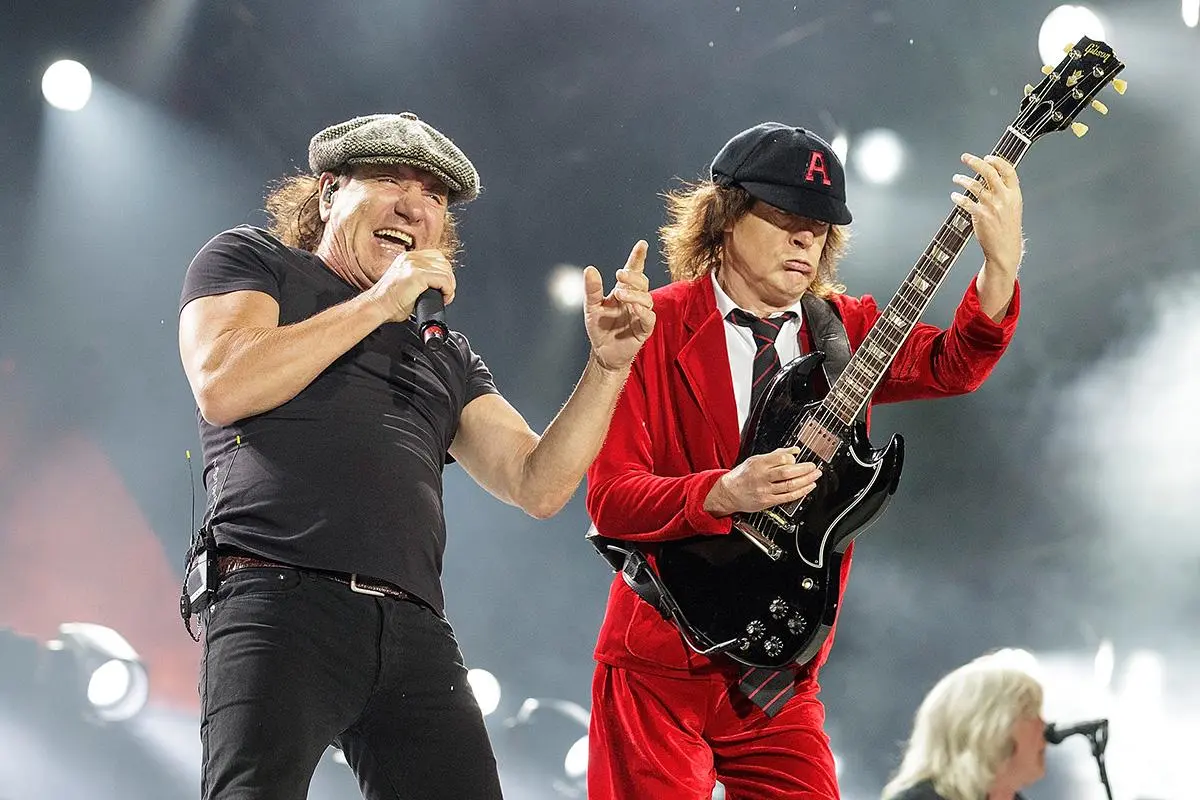
For players, “Let There Be Rock” is a masterclass in AC/DC’s core language: tight rhythm guitars, a bassline that locks to the kick drum, and lead work that sounds like it’s trying to set the fretboard on fire. It’s not complicated music, but it’s disciplined music.
If you want the track’s secret sauce in one line: the groove never apologizes. The tempo and pulse are steady enough to feel inevitable, which makes the eruptions of lead guitar feel like sparks off an industrial grinder.
Gear and tone, without the mythology
It’s easy to talk about AC/DC tone like it’s magic, but the “magic” is mostly execution. The guitars are bright, the overdrive is firm rather than fuzzy, and the rhythm parts are played with the kind of consistency that most bands only achieve in the studio. If your band can play this song cleanly at volume, congratulations: you have a real rhythm section.
Why this single mattered even if it wasn’t a massive chart-smash
Not every legendary single is a chart monster. Sometimes the important releases are the ones that clarify identity: this is who we are, this is how we sound, and we’re not sanding down the edges to fit anyone’s playlist.
In that sense, “Let There Be Rock” is a pivot into the version of AC/DC the wider world would eventually understand. The band’s official discography treats Let There Be Rock as a core pillar of the catalog for a reason: it’s one of the cleanest statements of intent in hard rock.
Listen like a musician: 5 moments to focus on
- The opening groove: tight, no wasted motion. Treat it like a lesson in right-hand control.
- Bon Scott’s phrasing: he sings like he’s telling a story across a bar table, not performing “vocals.”
- Dynamic patience: the band doesn’t “peak” early. They let the tension build.
- The solo sections: Angus Young’s lead lines stay melodic even when they’re aggressive.
- The ending: controlled chaos. It feels like it’s falling apart, but it’s actually steering the whole way.
Quick facts: song vs single vs album (so you don’t mix them up)
| Item | What it is | Why it matters |
|---|---|---|
| “Let There Be Rock” (song) | A long-form anthem and rock origin story | Defines AC/DC’s worldview in one track |
| Australian single (Sept 30, 1977) | The 7-inch release that pushed the track as a standalone statement | Captures AC/DC’s take-no-prisoners era in a portable format |
| Let There Be Rock (album) | The 1977 studio album built for maximum impact | Where the song lives as part of a broader escalation |
But did Tchaikovsky “really” get the message?
No, obviously. The point is the audacity: AC/DC treat rock history like a tall tale, not a museum exhibit. It’s a reminder that rock ‘n’ roll has always been half music, half mythology, and the mythology is part of the fun.
It also hints at something older listeners know in their bones: rock didn’t just replace earlier music, it stole their drama and scale. Classical has storms and fireworks. Early rock had the nerve to say, “We’ll take that energy, add a backbeat, and call it Saturday night.”
How to celebrate the anniversary (without being cringe)
- Spin it loud, preferably on a system that can handle real transients. The song is built for speakers that move air.
- Play along (guitar, bass, drums). If your timing is sloppy, this track will expose you fast.
- Do the Berry-to-AC/DC double feature: listen to “Roll Over Beethoven,” then “Let There Be Rock,” and notice how the “news” evolves into a full-blown religion via a blistering live take.
- Watch a live performance to see how the song becomes an endurance test and a crowd-binding ritual – especially when you trace its appearances through UK chart listings and reissues.
A provocative take: “Let There Be Rock” is AC/DC’s manifesto, not “Highway to Hell”
“Highway to Hell” is the crossover door-kicker, sure. But “Let There Be Rock” is the philosophical core: it tells you what the band thinks rock is for. It’s not about being dangerous for marketing reasons; it’s about rock as liberation, as noise, as community, as a thing that spreads.
If you’re building a “how rock works” playlist for someone who thinks it’s just three chords and dumb lyrics, this is the track that proves three chords can still carry a whole mythology.

Conclusion
Released as an Australian single on September 30, 1977, “Let There Be Rock” is AC/DC turning rock history into a legend you can sing, sweat, and stomp to. It borrows Chuck Berry’s famous cultural taunt and expands it into a full origin story, delivered with all the subtlety of a kicked-in door.
Put it on, turn it up, and remember: not every “important” record is important because it topped charts. Some are important because they made rock ‘n’ roll feel inevitable.