
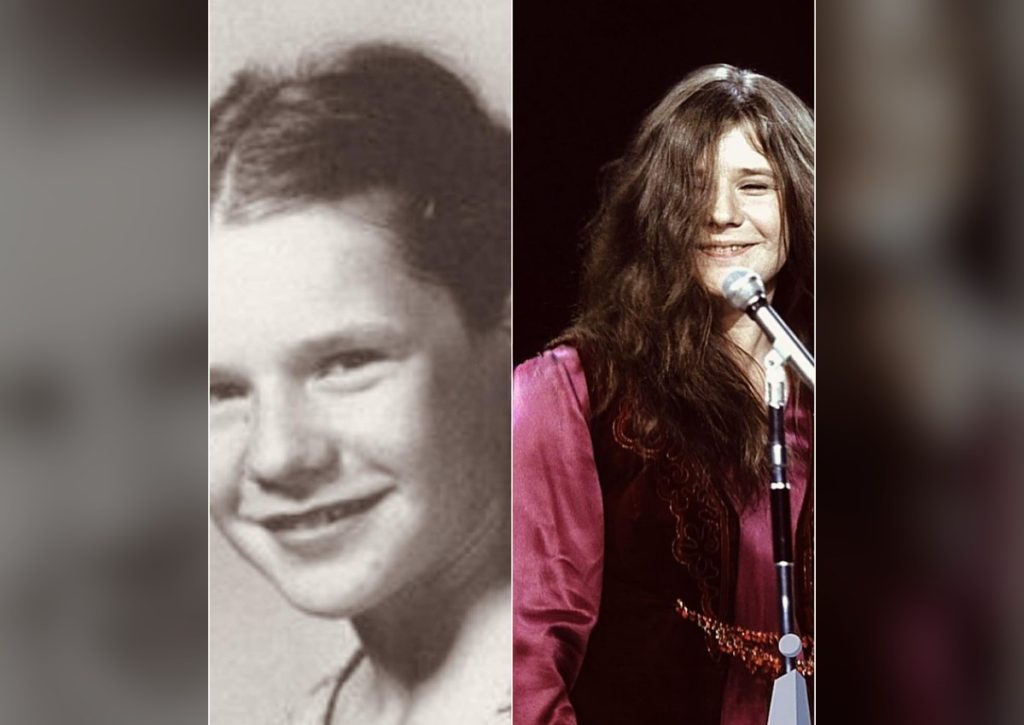
The Janis Joplin the world remembers — feathers, Southern Comfort, the voice like a building on fire — was made in San Francisco. But the person was made in Texas, and made the hard way. Before the Avalon Ballroom and Monterey, there was Port Arthur and Austin: a decade of small-town mockery so relentless that it functioned, in the end, as training.
Port Arthur’s odd girl out
Port Arthur was an oil-refinery town with oil-refinery values, and Janis broke every one of them without especially trying. She read books, painted, said what she thought, and — the unforgivable part — refused to pretend otherwise. Classmates at Thomas Jefferson High threw things at her and called her names whose cruelty she recited, verbatim, in interviews for the rest of her life. The wound never really closed; her infamous return to the ten-year high-school reunion in 1970, celebrity in full plumage, was revenge dressed as homecoming.
What Port Arthur also gave her, almost by accident, was the blues. Late-night radio and a handful of records — Bessie Smith, Lead Belly, Odetta — reached the unhappiest girl in town and told her there was an entire tradition built from exactly this feeling. She taught herself to sing by imitating them, discovering a voice nobody in Texas had any category for.
Austin: sanctuary, then ambush
The University of Texas at Austin, where she enrolled in 1962, was supposed to be the escape. In some ways it was: she found the folknik crowd at a ramshackle student venue called Threadgill’s, where owner and yodeller Kenneth Threadgill adored her, and for the first time she sang for rooms that listened. The student paper noticed too — a profile that summer headlined “She Dares to Be Different” opened with the barefoot girl in Levi’s who carried her Autoharp everywhere in case the urge to sing struck. It reads today like the first document of Janis Joplin, rock star.
Then Austin showed its other face. That winter a fraternity ran its annual charity stunt, an “Ugliest Man on Campus” contest, and a write-in campaign put Janis on the ballot. The prank was exactly as vicious as it sounds, and though she hadn’t “won” — a bar owner took the title — the distinction meant nothing. The people she’d finally relaxed around had voted on her face. Friends from the period describe her devastation, and Texas accounts of those years treat the episode as the moment the state effectively handed her to California. Within weeks, in January 1963, she and Chet Helms thumbed out of Austin toward San Francisco.
What the cruelty built
It would be tidy to say she left the pain behind. The truth is more useful: she industrialised it. The voice that flattened audiences at Monterey was the Port Arthur wound with a PA system — total abandonment as a vocal technique, every song sung as if acceptance depended on it, because in her formative experience it had. Interviewers found her disarmingly frank about the mechanism. She wanted to be loved by crowds because individuals had been unreliable; the math was that simple and that sad.
Texas kept its fingerprints on the music, too. The blues she’d absorbed off records in her bedroom stayed the foundation under everything, and the Threadgill’s repertoire — country, folk, Bessie Smith — kept surfacing in her phrasing long after the San Francisco scene made her its first female superstar. She returned to sing at Threadgill’s birthday party in 1970, weeks before her death, flying in mid-tour to honour the one Austin room that had been kind.
There’s a detail from the Threadgill’s era that deserves more circulation than it gets. The regulars there were not bohemians; they were truck drivers and country pickers, the exact demographic that had made her life miserable elsewhere. And they loved her — because in that room the only currency was whether you could sing, and she could sing like nobody in the state. It was Janis’s first proof that the problem had never been her. It was the rooms.
The reckoning that came too late
Port Arthur eventually built its statue and its museum exhibit, the way hometowns do once the danger of the living person has passed. The university crowd that ran the contest grew up into people who tell the story sheepishly, when they tell it at all. Janis didn’t live to see any of the apology. She died at 27 in Hollywood, a story the myth machine got to first.
But the Texas years deserve to be told straight, because they answer the question every new listener asks: where did that voice come from? It came from a decade of being the joke in rooms she couldn’t leave — and from the discovery, somewhere between a refinery town and a folk bar, that the only way out was to sing louder than the laughter. San Francisco gave Janis Joplin her stage. Texas, God help it, gave her the reason.


