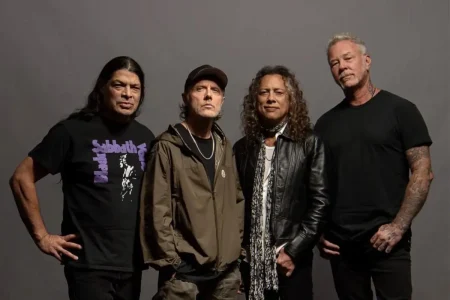
James Hetfield has spent decades as heavy metal’s most recognizable rhythm guitarist and one of its most scrutinized frontmen. Yet the story that keeps repeating behind Metallica’s volume is quieter and more personal: a kid shaped by loss, a man wrestling with addiction and control, and an artist learning (sometimes painfully) that strength is not the same thing as silence.
This is a look at Hetfield’s personal life through the lens of his well-documented highs and lows: family trauma, fame’s pressure cooker, rehab, relapse, and the ongoing work of staying emotionally present. Some of it is uncomfortable, because the “tough guy” myth is exactly what nearly broke him.
Early life: when “hold it in” becomes a lifestyle
Hetfield’s childhood is often summarized as “strict” and “tragic,” but the combination matters: discipline without emotional oxygen can teach a person to survive by shutting down. Public biographical details note he grew up in Downey, California, and experienced major losses young, including the death of his mother and later his father, events that have been linked repeatedly to themes in his songwriting and worldview.
One of the most provocative (and useful) ways to frame his early life is this: his future addiction did not begin with alcohol. It began with emotional self-reliance, the belief that needing help is weakness, and that pain can be “handled” by refusing to feel it.
What that created in adult Hetfield
- Control as a coping skill – when life feels unsafe, controlling the environment can feel like the only safety.
- Anger as armor – rage is energizing; grief is exhausting.
- Work as escape – perfectionism can look like professionalism until it becomes compulsion.
Metallica fame: success that amplifies every crack
Metallica’s rise turned private wounds into public fuel: touring, recording pressure, and the constant need to “deliver” a persona that looks invincible. Fame does not create problems from scratch; it makes existing ones louder. The band’s official updates when shows pause for health reasons have repeatedly shown how seriously they treat disruptions when a member needs to focus on recovery, which matters because it signals the scale of the problem when plans get halted.
For older fans, it is tempting to romanticize the 80s and 90s as the era of iron-stomached rock stars. But the truth is less glamorous: the same environment that makes legendary records also normalizes unhealthy coping, especially for leaders who think they are carrying the whole machine.

The “Some Kind of Monster” era: the myth of the unbreakable band dies on camera
There is no way to discuss Hetfield’s ups and downs without addressing the period documented around Some Kind of Monster. Even if you love Metallica, the film is a rough watch because it punctures the fantasy: the band in therapy, tensions exploding, and Hetfield stepping away for treatment. It is culturally notable enough to have broad critical documentation and aggregation.
What makes this era important is not the gossip. It is the lesson: if a man whose job is literally to be loud cannot talk about fear, that fear will find another outlet. The documentary’s most uncomfortable moments are basically a case study in emotional illiteracy meeting adult responsibility.
A quote that reframes “strength”
“I’m not the kind of person that’s going to go, ‘Oh, poor me.’”
James Hetfield, in the documentary Metallica: Some Kind of Monster (as widely quoted and discussed in the film’s coverage)
That line is not inherently “bad.” The danger is when it becomes a vow: never be vulnerable, never be needy, never be messy. In real life, that vow can turn into drinking, isolating, and detonating relationships to avoid feeling dependent.
Addiction and recovery: the public timeline and the private grind
Hetfield has spoken and acted publicly enough that the broad arc is clear: serious substance issues, treatment and recovery efforts, and long stretches of improved stability. The most widely reported modern inflection point came when Metallica postponed tour plans as Hetfield re-entered treatment, forcing the band to adjust schedules in a very public way.
Recovery is not a single redemption scene. It is routine. It is the boring choice made again and again, sometimes while you still feel angry, raw, or embarrassed. It is also, in a way most fans underestimate, a creative challenge: learning to write and perform without the chemical rituals that once numbed the nerves.
Relapse: the part nobody wants in the legend
Relapse is the most stigmatized chapter in any recovery story, because people treat it like a moral betrayal instead of a clinical risk. In 2019, multiple reports confirmed Hetfield returned to rehab, forcing the band to rework plans and publicly acknowledge the situation in major coverage of the rehab return and tour changes.
Edgy but true: if you want a rock icon who never falls, you are asking for a fictional character. Hetfield’s “downs” are part of why his later stability matters. They show the cost of untreated pain and the value of choosing help before the wreckage becomes irreversible.
Marriage, fatherhood, and the pressure of being “present”
Hetfield has been open at different times about the collision between family life and the demands of Metallica. Even without prying into private details, the shape of the conflict is familiar: touring pulls you away, fame complicates intimacy, and addiction makes emotional availability unreliable.
In the broader rock world, it is common to hear some version of “I did it for my family” used to justify absence. The harder truth is that providing is not the same as being there. Hetfield’s most meaningful growth has often looked like learning to stay in uncomfortable conversations rather than escaping into work, control, or substances.
Mental health: the quieter battle behind the loudest riffs
Metallica’s recent years have included more open discussion of anxiety, shame, and the psychological toll of performance. The band has also used its platform to point fans toward mental health support, reinforcing that struggle is not rare or disqualifying in broader coverage of mental health and recovery topics.
For older listeners who grew up when mental health was not discussed, Hetfield’s story can feel like a cultural shift happening in real time: a tough, masculine archetype admitting the inner world exists. Not as a brand move, but as survival.

The ups: what “winning” looks like in Hetfield’s world
It is easy to define a rock star’s “ups” as albums sold and stadiums filled. But in Hetfield’s case, the real wins are more human and less photogenic.
Signs of real stability (not just good PR)
- Choosing treatment when needed – even when it disrupts huge plans.
- Working with structure – routines, accountability, and boundaries.
- Continuing to create – proving he can work without self-destruction as the engine.
- Staying connected – bandmates, family, and professional support networks.
There is also a long-game artistic “up”: late-career honesty. The older Hetfield gets, the less he seems interested in pretending everything is fine. That does not make the music softer; it makes the emotion sharper.
The downs: patterns worth noticing (and learning from)
Hetfield’s low points do not read like random bad luck. They follow recognizable patterns that many fans will see in their own lives: isolation, rigidity, and self-medication when vulnerability feels impossible.
| Pattern | How it shows up | What it costs |
|---|---|---|
| Control | Needing things “right” to feel safe | Conflict, burnout, resentment |
| Shame | Hiding pain and avoiding help | Relapse risk, emotional distance |
| Escape | Work, alcohol, withdrawal | Family strain, band instability |
There is a reason Some Kind of Monster still resonates: it shows how success can become a cage. When your identity is “the strong one,” you may delay help until the collapse becomes unavoidable.
Practical takeaways for musicians and fans
This is Know Your Instrument, so let’s translate celebrity biography into usable lessons. If Hetfield’s story teaches anything, it is that your instrument will not save you from your inner life. But it can be a bridge if you build the right supports around it.
If you tour or gig regularly
- Build a “post-show plan” that is not alcohol-centered: food, a walk, a call home, a book, sleep.
- Normalize check-ins with bandmates like you would with gear maintenance.
- Put guardrails on perfectionism: define “good enough” before rehearsal starts.
If you are supporting someone in recovery
- Respect treatment as health care, not scandal.
- Watch for isolation – it often arrives before relapse.
- Encourage professional help rather than trying to be the therapist.
For anyone seeking a structured framework used by many people in recovery, Alcoholics Anonymous’ Twelve Steps outline how the program is commonly approached.
Why Hetfield’s story still matters
Hetfield is not compelling because he is flawless. He is compelling because he is publicly learning what many people learn privately: toughness without tenderness turns into self-destruction. His ups and downs are a reminder that the bravest thing a “strong” person can do is ask for help early.
The riffs will always be there. The more radical achievement is staying alive, staying connected, and making music without needing to bleed for it.
If you or someone you know is struggling with addiction or mental health, reach out to qualified local services or a medical professional.