
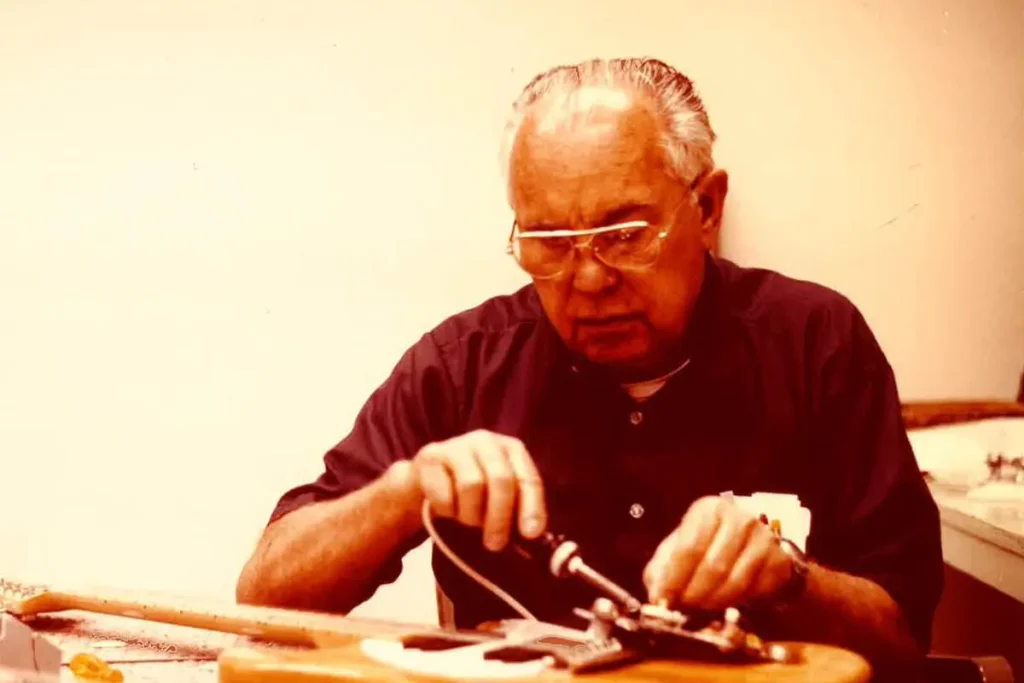
The Telecaster’s origin story is less “artist’s muse” and more “shop problem that refused to go away.” In the late 1940s, working musicians were wrestling hollow-body electrics that could howl with feedback, crack under travel, and demand repairs that cost time and money. Leo Fender, a self-taught electronics guy with a repairman’s obsession for repeatable fixes, approached the guitar like an appliance: build it tough, build it simple, and make it serviceable on a workbench, not a violin maker’s altar.
“I don’t care if it’s a guitar or a vacuum cleaner, the principle is the same.”
Leo Fender, quoted in the Library of Congress interview “Leo Fender: A Legend in His Own Time” in the Telecaster’s documented history
That attitude is why the Telecaster still feels a little punk. It’s blunt, practical, and unapologetically engineered. And for a huge slice of popular music, it was the first solid-body electric guitar that truly went mainstream, changing what “live electric guitar” could be.
Before the Telecaster: why hollow-body electrics hit a wall
By the late 1940s, amplified guitar was no longer a novelty. Bands were louder, venues were bigger, and the guitar was fighting for space with drums and horns. Hollow bodies, even with pickups, were still resonant acoustic boxes, which meant volume could trigger runaway feedback and wolf tones under stage conditions.
Musicians also needed instruments that could survive car trunks, smoky bars, and weekend tours. A carved archtop is a beautiful object, but it is not a forgiving one. Fender’s “solid slab” idea was essentially a refusal to keep treating the electric guitar like a delicate acoustic.
The late-1940s leap: “make it like a machine”
Fender’s core insight was manufacturing, not mysticism. A flat body and a bolt-on neck meant the instrument could be produced consistently and serviced fast. If a neck warped, you didn’t “reset” it like a traditional luthier job; you swapped it or adjusted it. That sounds mundane until you realize it’s the business model of modern electric guitars.
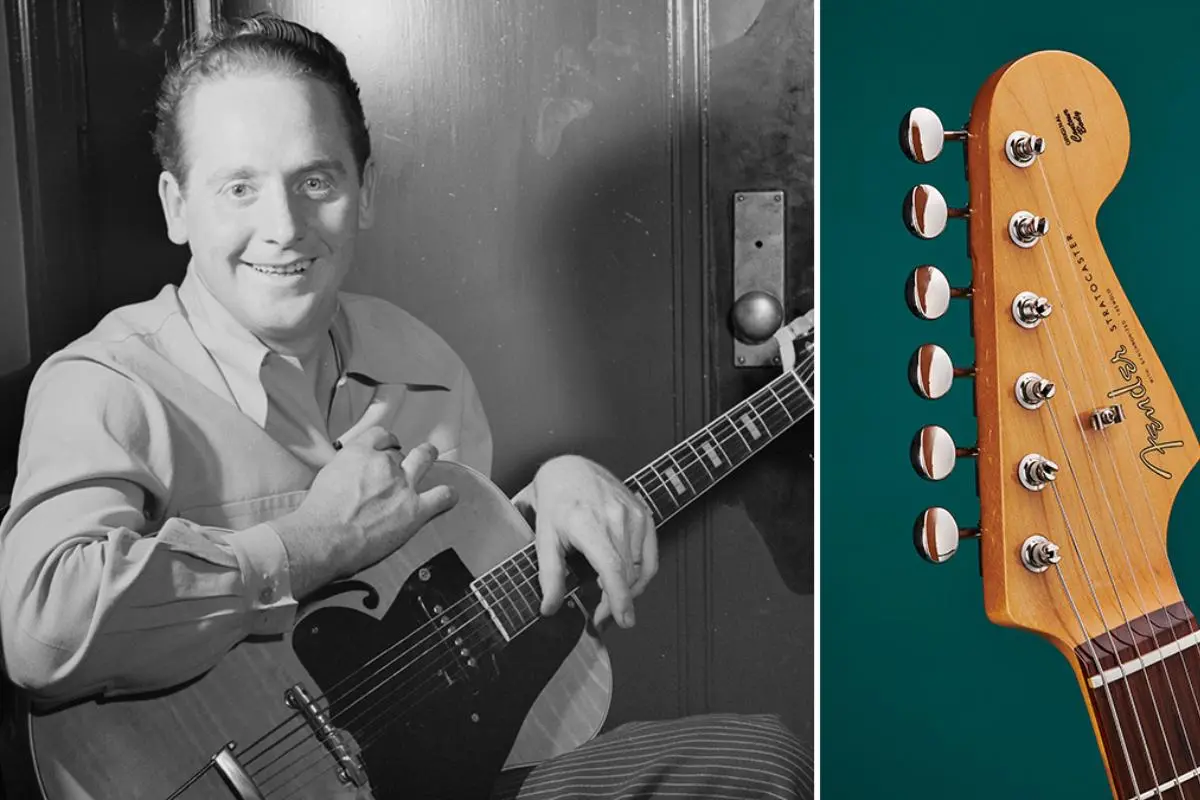
Bolt-on neck: the most radical “boring” idea in guitar history
Traditionalists mocked bolt-ons as cheap, but players discovered the upside: stability, replaceability, and modularity. The electric guitar became a platform you could maintain like a tool. Decades later, even Fender’s competitor Gibson would embrace a different kind of production logic, but the Tele’s bolt-on concept remains one of the great efficiency hacks in instrument design.
1949: the Esquire – the prototype that wasn’t shy about being simple
In 1949 Fender introduced the Esquire, essentially the blueprint: solid body, bolt-on neck, and a deliberately straightforward layout that prioritized durability and manufacturing repeatability. The Esquire’s single-pickup concept also revealed something important: the new solid-body format didn’t need acoustic resonance to sound alive, it needed a good pickup and a rigid structure.
In the Telecaster family tree, the Esquire is the “proof of concept” that made investors, dealers, and working players pay attention. Even if you prefer later two-pickup versions, the Esquire is where the philosophy shows up unfiltered: minimum parts, maximum job-done.
1950: the Broadcaster – two pickups and a bigger target on Fender’s back
Fender quickly expanded the idea into a dual-pickup version, released as the Broadcaster. This is the moment the design stops being a clever experiment and becomes the modern template: two single-coils for contrast, a simple control scheme, and a body shape that sat comfortably against a player for long sets.
Two pickups mattered because it made the instrument adaptable. A bright bridge pickup could cut through a band mix like a knife, while a warmer neck pickup could cover smoother rhythms and melody lines. That “cover the gig” versatility is a huge part of why the Telecaster didn’t just exist, it sold.
The name problem: when marketing meets trademark reality
“Broadcaster” ran into a trademark dispute because Gretsch had used “Broadkaster” for drums, forcing Fender to change course. The lore includes the brief “no-name” transition period when decals were altered, but the key point is simple: Fender needed a new name, fast, for a guitar that was already becoming a working musician’s standard.
Evidence of Fender Telecaster-related artifacts in museum collections helps situate this era as more than mythology: these were real, circulating objects in a rapidly professionalizing music economy.
1951: Telecaster – a name that sounded like the future
Fender’s rename to “Telecaster” was more than a legal fix; it was a cultural statement. Television was the new miracle box in American living rooms, and “Tele” sounded modern, technical, and just a little sci-fi. The guitar’s look matched the name: clean lines, bright finishes, and a no-nonsense control plate that made it feel like industrial design, not old-world craftsmanship.
Even today, the Telecaster’s basic visual language reads instantly: single-cut solid body, pickguard, chrome bridge plate, and a straight-ahead headstock silhouette. It’s as recognizable as a stop sign, and arguably more influential.
The Telecaster recipe: why the parts work together
Telecaster mythology often gets stuck on “it’s simple,” but the real story is how the simple choices interact. Fender made a system where each component supports the whole: rigid neck joint, strong bridge assembly, and pickups voiced to exploit the instrument’s fast attack.
Two single-coils: clarity that can be sweet or savage
Tele pickups are famous for clear, cutting tone, but that’s not the whole picture. The neck pickup can be round and vocal, and the in-between position became a studio staple for clean rhythm parts. What players call “twang” is really a mix of transient attack, pickup voicing, and bridge design.
The bridge: where the bite lives
The Telecaster bridge design is not merely hardware – it’s tone architecture. The metal bridge plate and the way the bridge pickup mounts contribute to the sharp, immediate response that lets the Tele sit on top of a loud band without needing huge amounts of gain. Love it or hate it, it’s hard to ignore.
Serviceability: the anti-diva guitar
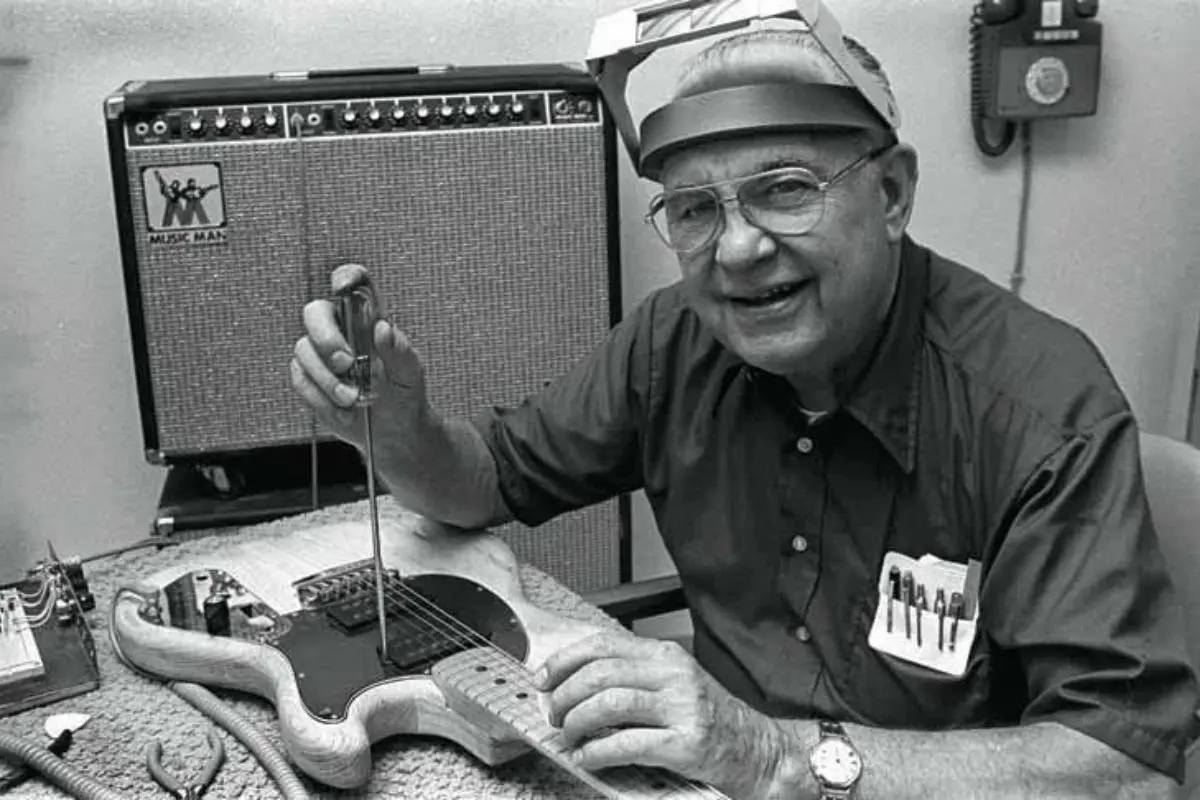
The Telecaster is famous among techs for being straightforward to work on. Electronics are accessible, the neck can be removed quickly, and parts are standardized. In an era when a broken guitar could mean a lost paycheck, “easy to fix” was not a luxury feature – it was survival.
“First commercially successful solid-body”: true, with a footnote
The Telecaster is widely described as the first commercially successful solid-body electric guitar. The important nuance is the word “successful.” Other solid-body experiments and earlier electrics existed, but Fender’s design hit the manufacturing and market sweet spot: it was scalable, affordable enough for working players, and tough enough to gig hard.
One approachable account of the Telecaster’s mainstream breakthrough frames exactly why “success” (not merely invention) is the hinge point in the story.
Why the Telecaster “won”: a ruthless fit for real musicians
Here’s the provocative claim: the Telecaster didn’t become iconic because it was beautiful. It became iconic because it was honest. The guitar was designed around the ugliest realities of professional music: unreliable gear, loud stages, tight budgets, and constant transport.
That’s why the Telecaster keeps reappearing in genre after genre. If you can plug in and be heard, you get hired. If you can survive a tour, you keep the gig. The Telecaster is basically a labor-saving device for musicians.
Telecaster as a genre-hopper
- Country: articulate picking and clean snap that complements pedal steel and fiddles.
- Blues and R&B: dynamic response that rewards touch, from whisper-clean to nasty bite.
- Rock: midrange cut that stays defined under distortion, even at high stage volumes.
- Punk and indie: simple controls and aggressive attack that record well and survive abuse.
Telecaster timeline (quick and scannable)
| Year | Name | Why it matters |
|---|---|---|
| 1949 | Esquire | Single-pickup solid-body concept proves the build method and market. |
| 1950 | Broadcaster | Two pickups establish the familiar functional layout and wider versatility. |
| 1951 | Telecaster | Renamed after the trademark dispute; the model becomes a durable standard. |
What museums and institutions tell us: it’s cultural hardware now
When an object moves from “gear” to “artifact,” it’s usually because it changed behavior, not just sound. Major institutions catalog Fender instruments and the Telecaster lineage because it represents a turning point in industrialized music-making, where design and mass production directly reshaped art.
Seeing electric guitars treated as collection objects – via the curated electric-guitar records in major art museums – underscores how far this tool has traveled culturally.
The engineering mindset: Leo Fender’s real superpower
Fender didn’t need to be a virtuoso guitarist to transform the guitar. He needed to listen to players and treat their complaints as engineering requirements. Oral-history interviews from people who worked around the early Fender ecosystem repeatedly emphasize process: prototypes, tweaks, and the steady push toward manufacturable consistency.
Firsthand recollections from early Fender collaborator George Fullerton help explain how iterative problem-solving (not romance) powered the early designs.
The same engineering zeitgeist shows up in early documentation of the electric solid-body idea, including the electric stringed musical instrument patent record that reflects the era’s push toward practical, manufacturable electrics.
A small legal dispute, a huge branding win
The Gretsch name conflict could have been a disaster. Instead, it handed Fender a cleaner, sharper identity. “Telecaster” didn’t just avoid a lawsuit; it sounded like modern America. The name helped the guitar leap from a niche tool to a cultural object that matched the optimism (and consumer electronics fetish) of the early 1950s.
And in the background, the broader market context matters: Gretsch’s long-running brand presence is a reminder that Fender wasn’t competing in a vacuum – naming, identity, and legacy were already valuable territory.
Practical takeaway: what the Telecaster design still teaches builders and players
The Telecaster is a reminder that reliability can be a creative feature. If your instrument stays in tune, survives the gig, and cuts through a mix, you play differently – more confidently, more aggressively, and with fewer compromises.
If you’re a player
- Use the volume knob: Telecasters clean up beautifully, making “one guitar, many tones” realistic.
- Respect the bridge pickup: it can sound harsh alone, but it’s gold inside a band mix.
- Lean into dynamics: the platform rewards touch more than many higher-output designs.
If you’re a builder or modder
- Modularity matters: bolt-on thinking makes maintenance and iteration easier.
- Hardware is tone: bridges, plates, and mounting methods are not cosmetic decisions.
- Design for service: the Tele’s layout is practically a lesson in accessibility.
Conclusion: the Telecaster’s “boring” choices were the revolution
From the Esquire to the Broadcaster to the Telecaster, Leo Fender’s breakthrough wasn’t a secret tonewood or mystical geometry. It was a cold-eyed commitment to solving working musicians’ problems with a design that could be built, fixed, and played hard. The Telecaster endures because it’s not precious – it’s useful, and that usefulness turned into a sound the world learned to love.
And maybe that’s the most disruptive part: the Telecaster proved that mass-produced, industrial design could make art louder, tougher, and more free.


