
Disclosure: We are a professional review site that receives compensation from the companies whose products we review. The opinions here are our own. We earn a commission if you join Guitar Tricks through our links.
By the KYI Team. Updated 18 November 2026. The timeline below is built from the lesson plans of the main beginner courses (Guitar Tricks, Fender Play and JustinGuitar, which we have worked through) and from thousands of comments in which learners describe how long each step took them.
The short answer: with 20 to 30 minutes of practice a day, most beginners can play a simple song all the way through within 2 to 3 months, play barre chords and strum along to most pop and rock songs within 6 to 12 months, and reach a confident intermediate level, soloing and playing with other people, in 1 to 2 years. Nobody ever finishes learning guitar, but most people can play songs they love within their first year.
The biggest factor isn’t talent or age. It is how often you pick the guitar up. Twenty minutes every day beats two hours on a Sunday, because your fingers learn from repetition and rest, not from marathons.
The timeline at a glance
| When (20 to 30 minutes a day) | What you can usually do | What feels hard |
|---|---|---|
| Week 1 | Hold the guitar, tune it, play your first two chords (often E minor and G) | Sore fingertips; chords buzz |
| Weeks 2 to 6 | Five or six open chords, a simple strumming pattern, your first riffs | Changing chords without stopping |
| Months 2 to 3 | Change between open chords in time; play a simple song start to finish | Singing while strumming; the F chord |
| Months 3 to 6 | Several strumming patterns, power chords, simple riffs and fingerpicking | Barre chords; keeping time with a recording |
| Months 6 to 12 | Barre chords, the minor pentatonic scale, play along with most pop and rock songs | Lead playing that sounds musical |
| Years 1 to 2 | Solos, string bends, improvising in a key, playing with other people | Speed, and knowing what to practise next |
| Years 2 to 5 | Advanced technique, your own style, learning songs by ear | Whatever you choose to chase |
These are typical ranges, not deadlines. Learners commonly report the same milestones arriving months apart from one another, and both ends are normal.
Week 1: your first chords (and sore fingers)
The first week is about the basics: how to hold the guitar and the pick, tuning, the names of the strings, and your first chords. Good beginner courses get you playing something musical straight away. In Guitar Tricks’ Guitar Fundamentals 1, the second lesson has you playing E minor and G and finishing a first, very simple song.
Your fingertips will hurt. That is normal, and it passes. Most people find the soreness eases within two to four weeks as calluses form, though some learners say it took a couple of months before they could play comfortably for more than half an hour. Short, frequent sessions help far more than long ones while your fingers toughen up.
Weeks 2 to 6: open chords and chord changes
Over the next few weeks you add the other open chords (C, D, A, E, A minor, D minor) and a basic strumming pattern. Our basic guitar chords for beginners page shows each shape. Fender Play’s Rock path, for example, starts with tab reading, D, E minor and A minor, and riffs from “Smoke on the Water”, “Satisfaction” and “Another One Bites the Dust”.
This is where most beginners get frustrated: you know the chords, but switching between them takes a second or two, and the song falls apart. The fix is boring and works: practise switching between just two chords for a minute at a time, every day. One learner summed up the breakthrough simply: two months in, they could finally switch between chords without pausing.
Months 2 to 3: your first full song
Somewhere around two to three months, chord changes start to land in time and you can play a simple song from start to finish. Learners who describe their first complete song most often put it at about two to three months, from songs such as “Holiday” by Green Day or anything built on G, C, D and E minor.
That four-chord set is the guitar’s best shortcut, and the nearest thing to an “80/20 rule”: a handful of open chords and one or two strumming patterns cover thousands of songs. Learn those well before you chase anything harder. Our 16 easy guitar chord songs are a good place to start.
Two things usually still feel hard at this stage. Singing while you strum is a separate skill and takes weeks of its own; many people find it hard even at six months. And the F chord, your first barre chord, usually won’t ring cleanly yet.
Months 3 to 6: strumming, power chords and riffs
Between three and six months you build rhythm and variety: several strumming patterns, palm muting, power chords for rock songs, simple fingerpicking, and riffs. This is also when it pays to start playing along with real recordings, which is the best test of whether your timing is steady.
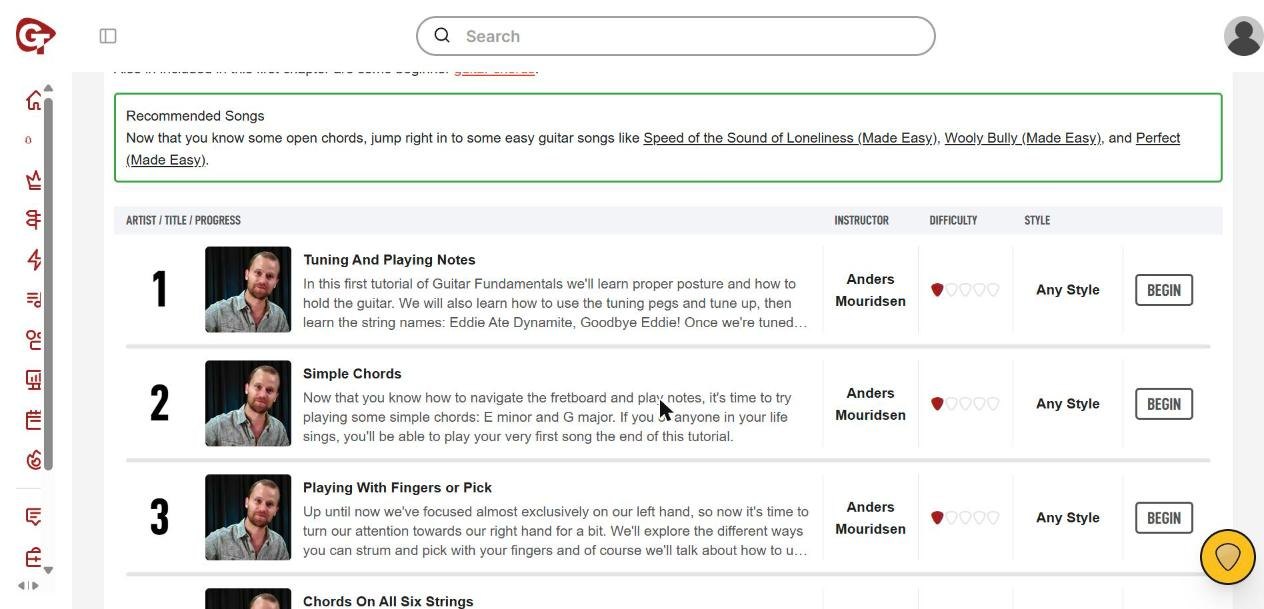
The first lessons of Guitar Tricks’ Guitar Fundamentals 1, from our account in November 2026. The course has 28 lessons, and Fundamentals 2 has 33.
If you are following a structured course, this is roughly where you finish the beginner stage. Guitar Tricks’ Guitar Fundamentals 1 and 2 have 28 and 33 lessons. Working through three or four lessons a week, with practice in between, most people complete both in four to six months, though that is our estimate rather than a figure Guitar Tricks gives.
Months 6 to 12: barre chords and playing along
Barre chords are the big milestone of the first year, and the one with the widest spread. Some learners report a usable F chord within a few weeks; others say they had practised every day for months and still couldn’t play one. Most land somewhere between three months and a year. A clean barre chord is mostly about thumb position, arm weight and a well set-up guitar with low action, not finger strength, so if you are stuck after months of trying, have the guitar checked before you blame your hands.
Once barre chords work, the whole neck opens up. Most pop and rock songs become playable, and you can start on the minor pentatonic scale, the basis of most rock and blues lead playing.
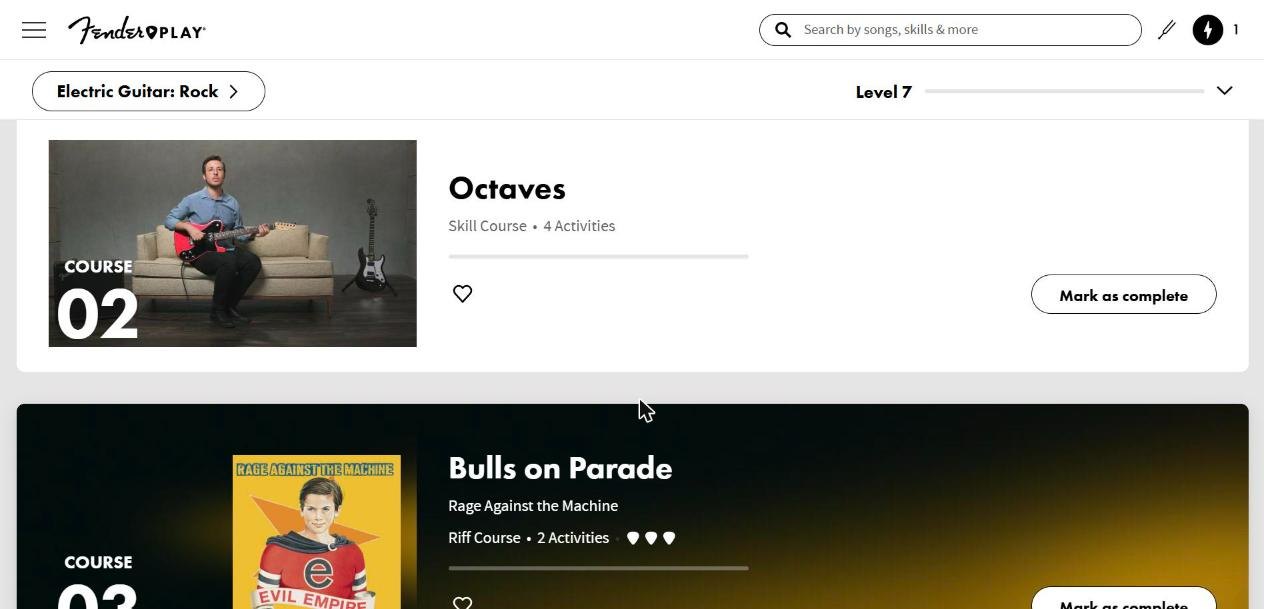
Level 7 of Fender Play’s Rock path, from our account: octaves, A-string barre chords, string bending and soloing, with songs such as “Comfortably Numb” and “Bulls on Parade”.
The end of Fender Play’s Rock path is a fair picture of where a dedicated learner is at about the one-year mark: octaves, A-string barre chords, triplets, double stops, string bending, simple soloing, and songs such as “Comfortably Numb” and “Hey Joe”.
Years 1 to 2: becoming an intermediate player
In the second year the work shifts from “can I play this?” to “can I make it sound good?”. You learn solos, string bends and vibrato, improvise over a backing track, learn some theory (which notes are in a key, and why chords fit together), and, ideally, play with other people. This is where many self-taught players stall, because there is no longer an obvious next lesson. A course with a defined path, or a teacher, helps most here.
Years 2 to 5 and beyond
After two years, progress depends on what you want: fast lead playing, jazz chords, fingerstyle arrangements, writing songs, or learning by ear. Players with five or more years behind them describe being able to pick up most songs they hear in an evening, and still finding new things to learn. Guitar has no finishing line, which is a big part of why people stay with it.
What makes you learn faster
- Practise daily, even briefly. 20 to 30 minutes a day adds up to over 120 hours a year. The same total in weekly bursts produces far less progress.
- Follow one structured path. Jumping between random videos is the most common reason beginners stall. Pick one course and finish the beginner stage before you browse. Our guide to learning guitar as a beginner has a 30-day plan to follow.
- Learn songs you love. Motivation is the real limit on progress. Use songs you want to play to practise each new skill.
- Get feedback on your hands. Most bad habits (a tense wrist, a flat finger muting the next string) are invisible from where you sit. Film yourself, take a few lessons, or use a course with instructor feedback.
- Use a metronome early. Timing is what makes playing sound like music. Start slow and speed up only when it is clean.
- Get your guitar set up. High strings make everything harder. A setup at a guitar shop is cheap and can make barre chords possible overnight. If you are still choosing a guitar, see our best acoustic guitars for beginners and best electric guitars for beginners.
How long with an online course or app?
The timeline above assumes you are learning from a structured course. Here is what the beginner stage of the main options looks like:
- Guitar Tricks: Guitar Fundamentals 1 (28 lessons) and 2 (33 lessons) take a complete beginner to strumming, power chords and simple songs, then four style courses carry you into the intermediate stage. Instructor feedback is included, which helps with the hand problems you can’t see. Our Guitar Tricks review has the details.
- Fender Play: seven levels per path, from your first chords to barre chords, bends and soloing. It is the gentlest structure, though songs are often simplified. See our Fender Play review.
- JustinGuitar: a free Beginner Course in three grades, then intermediate material. Excellent, but you have to supply the discipline yourself.
- Listening apps such as Yousician: great for building a daily habit, weaker on technique. Our best guitar learning apps guide compares them.
For a wider comparison, including courses for intermediate players, see our best online guitar lessons roundup.
Frequently asked questions
Can I learn guitar in 3 months?
You can learn the basics in 3 months: the open chords, a couple of strumming patterns and a handful of simple songs, played start to finish. Barre chords, lead playing and playing along with most songs usually take 6 to 12 months.
How long does it take to get good at guitar?
Most people who practise most days feel genuinely good, able to play the songs they like and to play with others, after 1 to 2 years. “Good” keeps moving, though: players with decades behind them still say they are learning.
How many hours a day should a beginner practise?
20 to 30 minutes a day is plenty for the first few months, while your fingertips toughen up. Consistency matters much more than length. If you have more time, split it into two short sessions.
Is it harder to learn guitar as an adult?
Not in any way that should stop you. Adults often progress faster at the start because they practise deliberately and understand what they are doing. Many learners start in their thirties, forties or later and are playing songs within months.
Is electric or acoustic guitar faster to learn?
Electric guitars have lighter strings and lower action, so they are easier on the fingers and make barre chords easier. The overall timeline is about the same; pick the instrument that plays the music you want to play. Our beginner electric guitars and beginner acoustic guitars guides can help you choose.
How long does it take to learn bass guitar?
Bass usually gets you playing along with songs a little sooner, because you play one note at a time. Expect simple bass lines within a few weeks and a solid grounding in 6 to 12 months of regular practice. See our best bass guitars for beginners.
Can you teach yourself guitar?
Yes. Most guitarists are at least partly self-taught. A structured course gives you the order to learn things in, and some form of feedback (a teacher, a course with instructor feedback, or filming yourself) stops bad habits setting in.
How long does it take to learn barre chords?
Usually between 3 and 12 months. Some learners manage a usable F chord within weeks; others take a year. Thumb position, arm weight and a guitar with low action matter more than finger strength.
The bottom line
Expect your first song in 2 to 3 months, barre chords and most pop and rock songs within a year, and confident intermediate playing in 1 to 2 years, if you practise 20 to 30 minutes most days. The fastest way through those milestones is a structured course, songs you love, and someone checking your hands now and then. If you want all three in one place, Guitar Tricks’ 14-day free trial covers your first two weeks.
Updated 18 November 2026 by the KYI Team. Screenshots are from our own Guitar Tricks and Fender Play accounts.
