
Disclosure: We are a professional review site that receives compensation from the companies whose products we review. The opinions here are our own. We earn a commission if you join Guitar Tricks through our links.
By the KYI Team. Updated 18 November 2026. This guide draws on the beginner courses we have worked through (Guitar Tricks, Fender Play and JustinGuitar) and on thousands of comments in which guitarists say what they wish they had known when they started.
The short version: get a guitar that is easy to play, pick one way to learn and stick with it, learn four chords and one strumming pattern, play a real song by the end of your first month, and practise 20 minutes a day. That is genuinely all it takes to get started. The rest of this page explains each step, with a 30-day plan you can follow from today.
Step 1: Get a guitar that is easy to play
Acoustic or electric? Choose the one that plays the music you love. You will practise more if what comes out sounds like the songs in your head. The old advice to start on acoustic is common but not necessary: electric guitars have lighter strings and lower action, so they are actually kinder to beginners’ fingers. With an electric you will also need a small practice amp or a headphone amp (see our best guitar amps). Our picks of the best acoustic guitars for beginners and the best electric guitars for beginners are good places to start.
For young children, a smaller guitar with nylon strings is the gentlest start: see our guides to the best acoustic guitars for kids, electric guitars for kids and nylon-string classical guitars. Adults with smaller hands should look at our guitars for small hands.
Have it set up. Many beginners struggle because their guitar is hard to play, not because they are doing anything wrong. If the strings sit high above the fretboard, every chord takes more pressure and barre chords feel impossible. A setup at a guitar shop is inexpensive and can make a cheap guitar play like a much better one. You don’t need to spend a lot: see our guides to the best acoustic guitars under $200, acoustics under $300, electric guitars under $200 and electrics under $300, and our tips for buying your first acoustic guitar.
Extras you need: a tuner (GuitarTuna and Fender Tune are free apps), a few medium-thin picks, and a free metronome app. Guitarists say again and again that the thing they most wish they had done from day one is practise with a metronome.
Step 2: Pick one way to learn
The most common reason beginners stall is jumping between random videos. Each one teaches things in a different order, and you end up knowing bits of ten songs and none of the basics. Choose one of these and follow it through the beginner stage:
| Way to learn | Cost (US) | Good for | Watch out for |
|---|---|---|---|
| Free course (JustinGuitar) | Free | Anyone on a budget who can keep themselves going | Nobody checks your playing |
| Online course (Guitar Tricks, Fender Play, Pickup Music) | About $150 to $180 a year | A set path, songs, tab on every lesson; Guitar Tricks and Pickup Music include feedback on your playing | You still have to practise |
| Listening app (Yousician, Simply Guitar) | About $120 to $150 a year | Building a daily habit; children | Weak on technique; easy to rely on the screen |
| In-person teacher | About $25 to $50 a lesson | Someone watching your hands every week | Cost; quality varies a lot between teachers |
For most adults, a structured online course is the best balance: it gives you the order to learn things in, it costs less than four private lessons a year, and you can replay every lesson. Our best online guitar lessons roundup compares the courses, and our best guitar learning apps guide covers the apps.
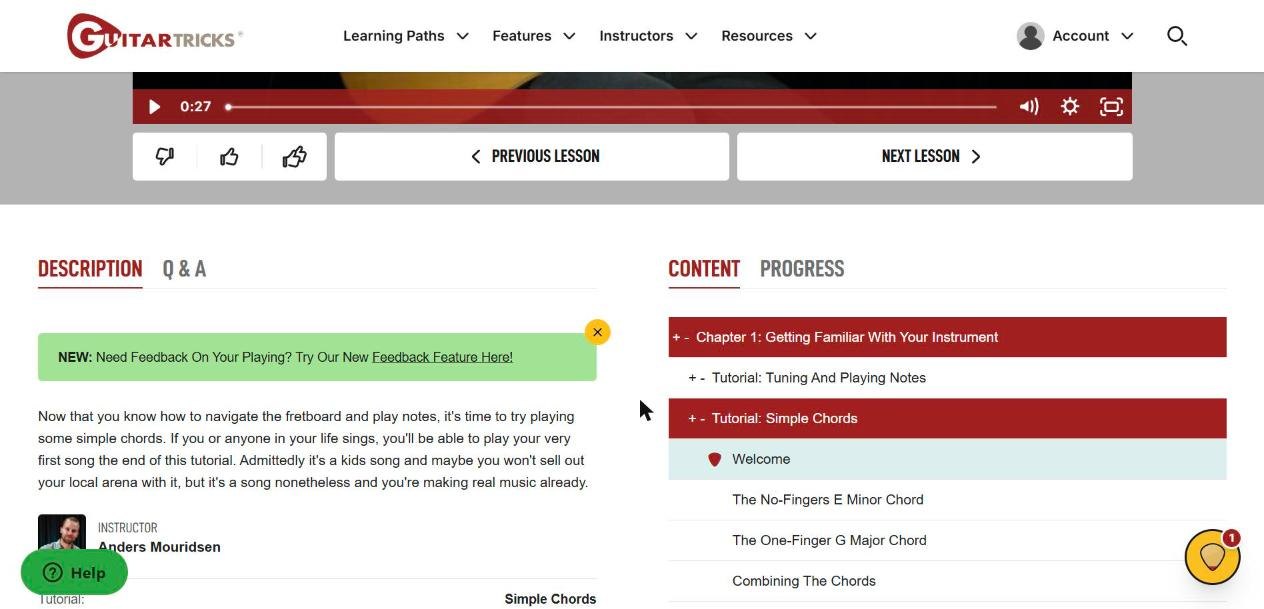
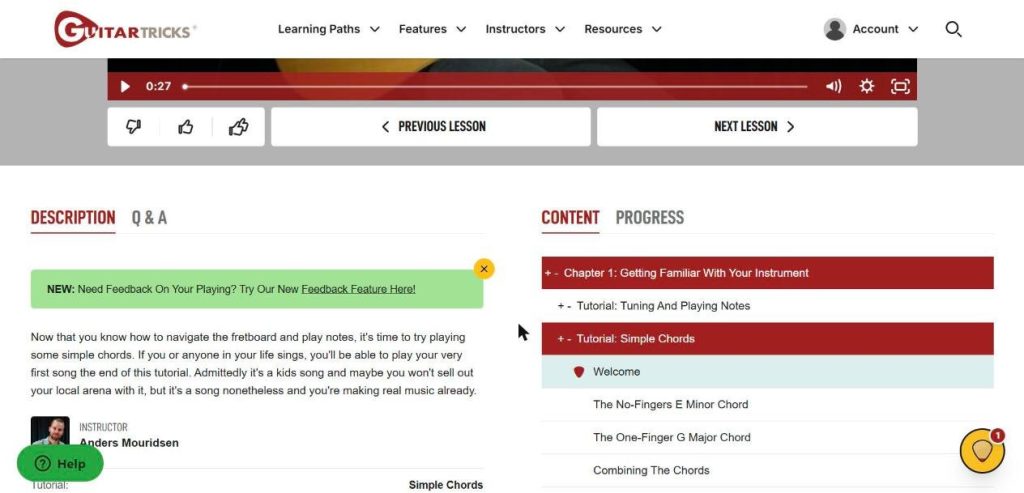
A Guitar Fundamentals 1 lesson in our Guitar Tricks account, November 2026: one short video, then the next lesson in order. A set path like this stops you jumping between random videos.
Step 3: Learn the right things first
Every good beginner course starts in roughly the same order, because it works:
- Posture and holding the pick. Sit with the guitar resting on your right leg (left if you play left-handed), the neck angled slightly up, and your fretting thumb behind the neck, not gripping it. Hold the pick between the pad of your thumb and the side of your index finger.
- Tuning and string names. From the thickest string to the thinnest: E, A, D, G, B, E. Tune before every session.
- Your first chords. E minor and A minor are the easiest; G, C and D come next. Press just behind the fret, on your fingertips, with only as much pressure as it takes to stop the buzzing. Our basic guitar chords for beginners page shows each shape.
- A simple strumming pattern. Start with four down strums per bar, then move to down, down-up, up-down-up, keeping your strumming hand moving steadily.
- Chord changes. This is the real skill of the first two months. Practise switching between two chords for one minute at a time and count how many clean changes you make.
You don’t need to read music. Guitar music is written in tab (a diagram of the six strings with fret numbers), and every course teaches it in a few minutes. A little theory, such as which chords belong together in a key, helps a lot later, but it can wait until you can play a few songs.
Step 4: Follow a 30-day plan
Twenty minutes a day is enough. Split each session into a warm-up, the new thing, and something fun, so you finish every day having played music.
| Week | Daily 20 minutes | By the end of the week |
|---|---|---|
| Week 1 | 5 min tuning and posture; 10 min E minor and G (or A minor); 5 min slow down strums | Two chords that ring cleanly, most of the time |
| Week 2 | 5 min warm-up on week 1’s chords; 10 min C and D; 5 min one-minute chord changes | Four chords; changes still slow, which is normal |
| Week 3 | 5 min chord changes; 10 min a strumming pattern with the metronome at a slow tempo; 5 min a riff such as “Smoke on the Water” | Strumming in time on one chord; your first riff |
| Week 4 | 5 min changes; 10 min one song with G, C and D, slowly; 5 min record yourself and listen back | A whole song, start to finish, even if slowly |
Your fingertips will be sore for the first two to four weeks. Short daily sessions let calluses build without making it worse; if it really hurts, stop for the day. On a structured course, the first month maps closely onto the opening lessons: in Guitar Tricks’ Guitar Fundamentals 1, for example, you are playing E minor and G and finishing a very simple first song by the second lesson.
Step 5: Play real songs early
Songs are what keep you going. Use them to practise every new skill, starting with ones that use only the chords you know:
- “Love Me Do” (The Beatles) and “Leaving on a Jet Plane” (John Denver): G, C and D.
- “Knockin’ on Heaven’s Door” (Bob Dylan): G, D, A minor and C.
- “Bad Moon Rising” (Creedence Clearwater Revival): D, A and G.
- “Three Little Birds” (Bob Marley): A, D and E.
- “Brown Eyed Girl” (Van Morrison): G, C, D and E minor.
- “A Horse with No Name” (America): two easy chord shapes for the whole song.
- Riffs: “Smoke on the Water”, “Seven Nation Army” and “Come As You Are” are single-note riffs most beginners can manage in their first weeks, and they are great fun on an electric.
For more, with chord charts, see our 16 easy guitar chord songs every beginner should know.
Slow everything down. A song played slowly and in time sounds like music; the same song rushed with stops between chords doesn’t. As one experienced player put it, the wrong notes in the right rhythm sound far better than the right notes in the wrong rhythm.
Mistakes that slow beginners down
- Too many sources. Ten teachers’ first lessons are not a course. Choose one path.
- No metronome. The most common regret among experienced players. Timing is what makes playing sound like music.
- Pressing too hard and tensing up. Squeezing the neck tires your hand and slows changes. Use the least pressure that stops the buzz, and keep your shoulders loose.
- Songs that are too hard too soon. Learn the songs you love, but choose ones at your level first, and save the hard ones as goals.
- Only playing what you can already play. Noodling feels good but doesn’t move you forward. Spend part of every session on something that is difficult.
- Quitting during the sore-finger weeks. The first month is the hardest physically. It gets much easier once calluses form.
- Never checking your hands. Film yourself now and then, or use a course or teacher that gives feedback. Bad habits are easy to fix early and hard to fix later.
How hard is it to learn guitar?
The first month is the hardest part: sore fingertips, buzzing chords and slow changes all happen at once, and that is when most people give up. Once you can change between a few chords in time, usually after two to three months, it becomes far more rewarding, because you are playing songs. Barre chords are the next hard step, typically somewhere in the first year. Our guitar learning timeline sets out what to expect month by month.
Guitar lessons for adult beginners
It is never too late. People start in their forties, fifties and beyond and are playing songs within months. Adults have real advantages: you can practise deliberately, follow an explanation of why something works, and choose your own songs. What adults usually lack is time, which is why short daily sessions and a course that tells you exactly what to do next work so well. Online courses suit adults particularly well because you can learn at any hour and repeat a lesson as often as you need without feeling self-conscious.
Where to start today
- No budget: start JustinGuitar’s free Beginner Course, Grade 1, and follow the 30-day plan above.
- Want a set path, songs and feedback on your playing: take the Guitar Tricks 14-day free trial and start Guitar Fundamentals 1. Our Guitar Tricks review explains what you get, and our free trial guide explains how the trial works.
- Want short, low-pressure lessons, or bass and ukulele too: try Fender Play. See our Fender Play review.
- Need a game to get you practising: try Yousician or Simply Guitar for a month, then move to a full course.
Frequently asked questions
Can I teach myself guitar?
Yes. Most guitarists are at least partly self-taught. Follow one structured course rather than random videos, practise most days, and get some feedback on your hands now and then, from a teacher, a course with instructor feedback, or by filming yourself.
Should I learn acoustic or electric first?
Whichever plays the music you love. Electric guitars are easier on the fingers because of their lighter strings; acoustics need no amp. The skills transfer either way.
What is the best age to start guitar?
Children can start from about 6 or 7 on a smaller, nylon-string guitar. There is no upper limit: adults of any age learn successfully with regular practice.
What should I learn first on guitar?
How to hold the guitar and pick, how to tune, and two easy chords (E minor and G or A minor). Then add C and D, a simple strumming pattern, and practise changing between chords.
How much should a beginner practise?
20 to 30 minutes a day. Short, daily sessions build skill and calluses faster than long sessions once or twice a week.
Do I need to read music to play guitar?
No. Guitarists mostly use chord diagrams and tab, which show you where to put your fingers. Every beginner course teaches tab in the first lessons.
How much do guitar lessons cost?
An in-person teacher typically costs $25 to $50 a lesson in the US. Online courses cost about $150 to $180 a year, and JustinGuitar’s beginner course is free.
Is it hard to learn guitar?
The first month is the hardest, while your fingers toughen up and chord changes are slow. After two to three months of regular practice, most beginners are playing simple songs and it becomes much more enjoyable.
Updated 18 November 2026 by the KYI Team. The screenshot is from our own Guitar Tricks account.