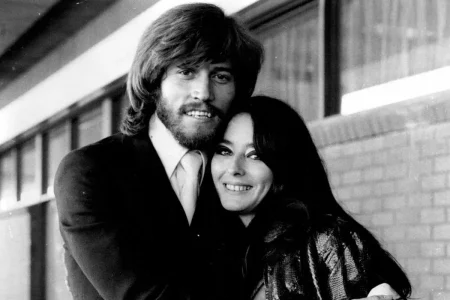
If you ever slow-danced to “How Deep Is Your Love” or tried to hit the high notes in “Stayin’ Alive,” you have Barry Gibb to thank – or blame. His voice is one of those sounds that can stop a room cold, as unmistakable as a siren and twice as insistent.
What is less obvious is how close that voice came to being written off. Before the disco boom, the Bee Gees were regarded by many in the UK industry as yesterday’s news. Barry’s answer was not to fade away, but to weaponise his own instrument and rewrite the rules of male pop singing.
The voice Britain almost threw away
Barry Gibb was born on the Isle of Man, raised in Manchester, and then hauled halfway around the world when the Gibb family emigrated to Redcliffe, near Brisbane. As kids, Barry, Robin and Maurice sang between races at a local speedway, hustling for coins and attention long before anyone thought of mirror balls and white suits. The Bee Gees’ early life and migration
Those early gigs mattered. They forced Barry to project over engines and crowd noise, to blend with his brothers in tight three-part harmony, and to learn what made a melody stick in the head of someone who was not really listening. The Bee Gees were a working band before they were a famous band, and Barry’s voice was a survival tool first, an artistic choice second.
By the late 1960s, they had become a serious chart act with orchestra-drenched ballads like “Massachusetts,” “Words” and “To Love Somebody.” Then fashion moved on. Rock got heavier, psychedelia curdled, and the Bee Gees suddenly looked like an old idea. Early 1970s albums stalled, and the group was dangerously close to becoming a trivia question: remember those sensitive brothers with the sad songs?
From has-beens to architects of disco
The turning point was not a nightclub in New York, but a studio in Miami. Acting on advice to change their environment, the Bee Gees decamped to Criteria Studios and cut the 1975 album “Main Course”. It fused R&B, funk and pop, delivered hits like “Jive Talkin'” and “Nights on Broadway,” and, crucially, was the first Bee Gees record where Barry’s falsetto sat right at the center of the sound.
“Main Course” did more than revive a faltering career. It turned the Bee Gees from balladeers into groove merchants, laying the groundwork for “Children of the World,” “Saturday Night Fever” and the entire late 70s dance-pop template. Suddenly that supposedly dated group was dictating what modern sounded like.
Older rock critics sneered at the tight trousers and helium highs, but the record-buying public did not care. If you were anywhere near a jukebox in that era, Barry’s voice was stalking you, from mall speakers to roller rinks.

How a single scream became a signature sound
Barry’s falsetto was not some childhood party trick. According to his own account, it crystallised during “Nights on Broadway” when producer Arif Mardin asked if any of the brothers could scream in tune over the chorus. Barry pushed his voice higher and higher, then later told Larry King that the idea “came to me in a dream” and evolved from a scream into a fully controlled singing register.
That accidental experiment became the Bee Gees’ calling card. The ragged, almost desperate shriek of “Stayin’ Alive,” the silky top notes of “Too Much Heaven,” the urgent yelps in “Tragedy” – all of it traces back to that one producer’s offhand request.
Technically, what Barry unlocked was the falsetto register: a lighter, airier production where the vocal folds thin out and only the edges vibrate. Vocal teachers describe it as a distinct register above the head voice, used to reach pitches that would otherwise be out of range, common in both pop and classical singing.
Barry did not use falsetto as a gimmick on the big choruses only. He layered it into harmonies, switched between chest voice and falsetto mid-phrase, and contrasted a smoky natural baritone with a laser-bright top. The result was a male pop voice that sounded simultaneously vulnerable and unstoppable.
More than disco glitter: a pen that would not quit
For all the attention on that high register, Barry Gibb’s most dangerous weapon was his songwriting. By conservative estimates he has written or co-written hundreds of released songs, with more than a dozen US number ones, and has been described as one of the most successful songwriters in history, second only to Paul McCartney in sheer chart impact. One assessment of his hitmaking record
Look at just a handful of titles: “How Deep Is Your Love,” “Stayin’ Alive,” “Too Much Heaven,” “How Can You Mend a Broken Heart,” “To Love Somebody.” These are not just hits; they are the emotional wallpaper of entire decades. Many listeners do not even realise how many of their favourite ballads and crossover smashes came from the same pen.
The hits you love that are really Barry Gibb songs
| Song | Artist most people know | Barry’s role |
|---|---|---|
| How Deep Is Your Love | Bee Gees | Co-writer, co-producer, lead vocal |
| To Love Somebody | Bee Gees (covered by everyone) | Writer, original lead vocal |
| Stayin’ Alive | Bee Gees | Co-writer, falsetto lead, vocal arranger |
| Woman in Love | Barbra Streisand | Co-writer, part of production team |
| Heartbreaker | Dionne Warwick | Co-writer, backing vocals, co-producer |
| Islands in the Stream | Kenny Rogers & Dolly Parton | Co-writer, behind-the-scenes producer mind |
Exporting the Bee Gees magic to other stars

After the disco backlash, radio programmers in some markets simply stopped playing new Bee Gees records. Instead of sulking, Barry pivoted. If stations did not want Bee Gees on the label, he would just move his sound into other people’s grooves.
A prime example is Barbra Streisand’s album “Guilty”. Streisand approached Barry to write and shape a full record; he wrote most of the material, co-produced the sessions, sang on the title duet and “What Kind of Fool,” and helped craft what her own camp now describes as her definitive pop statement.
Next came Dionne Warwick’s “Heartbreaker,” a song and album built around Bee Gees composition and production. The title track, with Barry’s unmistakable backing vocals floating around Dionne’s lead, became one of her biggest global hits and smuggled Gibb harmonies back onto adult contemporary radio without the Bee Gees’ name on the sleeve.
Then there is “Islands in the Stream”, written by Barry, Robin and Maurice for Kenny Rogers, only truly taking off once Dolly Parton walked into the studio. The duet topped both pop and country charts, with Barry and Maurice adding background vocals and production polish that made it a benchmark crossover ballad.
If you strip the logos off those records and listen only to the chord changes, the suspended harmonies and the way the melody climbs at the chorus, you can hear Barry’s fingerprints all over them. He turned himself into a stealth brand.
The falsetto that carried a generation
By the time the dust settled on the 70s and 80s, Barry Gibb’s high register had become synonymous with an era. Critics might have mocked it, but his falsetto-driven hits, as one modern profile noted, effectively carried a generation of pop listeners from lush 60s ballads into the age of dancefloors and synths.
The influence runs deeper than nostalgia. Male R&B and pop singers leaning heavily into head voice and falsetto – from disco revivalists to modern soul crooners – are operating in a world Barry helped make safe. He made it acceptable, even sexy, for a man to sing like that and still project power.
In a neat twist, “Stayin’ Alive” has become famous in medical training circles because its tempo, around 103 beats per minute, is almost perfect for teaching life-saving CPR compressions. Doctors literally tell students to hear Barry’s voice in their head while they push on a human chest.
What singers can steal from Barry Gibb
For vocalists and songwriters, Barry’s story is more than fan trivia. It is a masterclass in using your instrument ruthlessly well. A few takeaways are worth underlining.
- Treat range as color, not a stunt. Barry did not live in falsetto all night; he moved between registers for contrast. Try arranging your songs so the emotional peak coincides with a shift from chest to head to falsetto, instead of just belting higher.
- Write for your own voice first. Many of his greatest songs were demoed in his own register, then tailored for others. If you are a writer, stop chasing abstract hits and start writing what sits perfectly in your throat.
- Arrange harmonies like an orchestra. Listen to Bee Gees choruses as if they were string sections. Each brother occupies a lane, and Barry often doubles parts in different octaves. Think vertically, not just line by line.
- Reinvention beats respectability. The Bee Gees were already a respected 60s band. Trading that in for mirror balls was a gamble that many peers were too proud to make. Musically, it paid off in ways few acts ever experience.
One high note, a lifetime of echoes
Barry Gibb is not just the last Bee Gee standing; he is a reminder that the line between failure and reinvention is often one risky choice away. A producer asks for a scream, a singer pushes his voice past its comfort zone, and suddenly the sound of an entire decade shifts.
That is the real shock in Barry’s story. The voice that polite UK pop had more or less discarded ended up defining late 20th century pop, powering other people’s careers, and, in the strangest twist of all, giving the world a beat to save lives by. Not bad for a kid who started out singing over race cars.