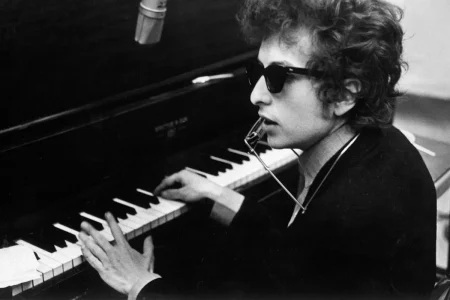
Bob Dylan has never pretended his songs came out of thin air. He has practically drawn a map to the vault he keeps stealing from: old hymns, Carter Family tunes, field hollers, and Scottish ballads. For anyone who writes songs, that map is worth more than any music theory book.
The Dylan quote that blows up the myth of originality
In a 2004 interview, Dylan said it is natural to pattern yourself after a hero, but the real trick is to be “exposed to everything that person has been exposed to.” He namechecked Van Gogh, Laurence Olivier and Frank Gehry as the kind of artists you might imitate at first, before realizing you have to go deeper into what shaped them. In that 2004 interview, Dylan said it is natural to pattern yourself after a hero, but the real trick is to be “exposed to everything that person has been exposed to.”
As MusicRadar recently pointed out, Dylan is really saying your favorite artist is a doorway, not a destination. If you love Dylan, you do not stop at Freewheelin’; you go back to Woody Guthrie, the Carter Family, field recordings, the Bible, blues 78s and Scottish murder ballads. You chase the same river of influences until you start to hear your own voice in that noise.
- Imitation is the training wheels phase, not the finish line.
- Your hero is already a collage of older sources, so copying them blindly just makes a bad photocopy.
- The serious work is tracing their roots and then adding your own layer of history.
The folk revival that taught Dylan how to steal properly
Dylan did that tracing work in the crucible of the 1960s urban folk revival. Coffeehouses like the Gaslight Cafe and Gerde’s Folk City in New York were swimming in Child ballads, union songs, Appalachian tunes and topical protest pieces. Know Your Instrument has written about how this scene, alongside Pete Seeger and Peter, Paul & Mary, turned folk from a regional style into a national force tied to civil rights and anti war movements.
In that world, nobody treated a melody like private property. Songs morphed from singer to singer, verses swapped in and out, tempos changed, refrains repurposed. Dylan walked into a culture where the question was not “Who owns this tune?” but “What can you do with it next?”
The folk process, in plain language
Scholars and old folk magazines call this constant reshaping of songs the “folk process.” Charles Seeger, father of Pete Seeger, used the term to describe how orally transmitted songs change as each new voice forgets a line, adds a verse or updates a reference, while the core tune and story stay recognizably the same. Charles Seeger used the term to describe how orally transmitted songs change as each new voice forgets a line, adds a verse or updates a reference, while the core tune and story stay recognizably the same.
Sing Out and other folk educators describe it less academically: you learn a song, you half forget it, you fix the gaps with your own ideas, and you pass that version on. Over decades, there is no single “original” left, only a family of related versions, all semi legitimate.

| In pop culture | In folk tradition |
|---|---|
| Borrowing a melody feels like a lawsuit risk. | Borrowing a melody is how you prove you belong. |
| Song is “owned” by one writer and one recording. | Song is a living object the whole community remakes. |
| Originality is a marketing hook. | Continuity with the past is the real badge of honor. |
Dylan’s blunt confession: “I’m not a melodist”
Dylan has been disarmingly honest about how this plays out in his own work. In one often cited interview he says, “You have to understand that I’m not a melodist. My songs are either based on old Protestant hymns, or Carter Family songs, or variations of the blues form.” He describes taking a familiar song, looping it in his head like a mantra, and letting the words slowly mutate until a new lyric appears. In that interview he describes taking a familiar song, looping it in his head like a mantra, and letting the words slowly mutate until a new lyric appears.
In the same breath he says he wrote “Blowin’ in the Wind” in about ten minutes by putting words to an old spiritual. This is not humble bragging about genius speed; it is a confession that the architecture of the song was already built by other, often anonymous, hands. His job was to wire that architecture into his own time and politics.
Decades later, when the Swedish Academy gave him the Nobel Prize for having “created new poetic expressions within the great American song tradition,” they were basically endorsing this method. Dylan did not invent new musical grammar; he wrote new, razor edged poetry on top of the oldest grammar America had.
“Blowin’ in the Wind”: from slave spiritual to coffeehouse anthem
Folk researchers and Dylan himself have long connected “Blowin’ in the Wind” to the spiritual “No More Auction Block.” Setlist.fm’s historical piece on the song notes that Dylan adapted the melody from that spiritual and later acknowledged that “Blowin’ in the Wind” had “always been a spiritual” in feel.
Rebeat Magazine traces “No More Auction Block” back to former slaves who made it to freedom in Canada, singing about the end of slave auctions and the “many thousand gone” who did not survive the journey. The tune moved through decades of Black history, into the civil rights repertoire of Paul Robeson and Odetta, and even fed into “We Shall Overcome” before Dylan ever pointed a microphone at it.
Sites like Dylanchords have laid the two melodies side by side and shown how closely Dylan’s guitar figure and vocal line follow the older tune, especially in the verse openings and cadences. In pop language, this would look like theft. In the folk frame Dylan was living in, it was obedience: you take what has been handed down and speak your own questions through it.
- The moral weight of “Blowin’ in the Wind” partly comes from that buried history of chains, escape and protest.
- Dylan did not “sanitize” the spiritual; he echoed its grief and turned its questions onto Vietnam, racism and hypocrisy.
- If he released the same degree of melodic borrowing from a 1990s hit today, his label’s first call would probably be to a lawyer.

“The Times They Are A-Changin'”: Irish ballad dressed as prophecy
Dylan has also been candid about the title track of his 1964 album. In later comments quoted by writer Cameron Crowe, he called it “a song with a purpose” and said it was influenced by Irish and Scottish ballads such as “Come All Ye Bold Highway Men” and “Come All Ye Tender Hearted Maidens.” Far Out Magazine notes that he set out to write a big, hypnotic song whose short verses piled up like warnings.
Listen to the contour of that melody and it sounds less like a brand new pop tune than a ballad that has been sung in pubs for two centuries. The radical move is not the tune, but the decision to stuff it with lines aimed at senators, parents and preachers while the civil rights movement and folk scene were heating up. Dylan is not pretending to be a prophet on a mountaintop; he is a young songwriter hijacking the sound of ancient authority to tell powerful people their time is up.
How to steal like Dylan without getting buried in lawsuits
So what does any of this mean for someone trying to write songs now, in a world where copyright bots scan every melody? Modern songwriting coaches freely tell students to start by imitating favorite tracks, then twist the result until it feels like their own work. Careers In Music, for instance, encourages writers to rewrite a beloved song and then bend the melody, lyric or structure so it becomes personal rather than a carbon copy.
Dylan’s method adds two hard rules to that advice: steal from older, traditional sources, and steal the framework, not the surface. You are not lifting a hook from last year’s radio hit; you are raiding hymnals, field recordings and public domain folk anthologies, then changing context, lyrics and details until the song feels like something only you could have written.
A practical Dylan style workflow
- Pick a root song that is safely old. Traditional ballads, hymns and pre copyright folk songs are your best hunting ground.
- Live with it. Play it for a week, on walks, in the car, until you can hum every contour without thinking.
- Change the subject. Keep the basic form and chord movement, but write a lyric about your town, your divorce, your war, not theirs.
- Bend the melody. Nudge key notes up or down, change where phrases land, stretch or compress lines until the tune no longer feels like a straight trace.
- Audit your theft. Record a rough demo, then listen back to the source. If it still sounds like karaoke with new words, keep reshaping.

The edgy truth is that every serious songwriter does some version of this. The difference between Dylan and a hack is that Dylan knows exactly which tradition he is raiding and why. He is not pretending to be original; he is trying to be consequential.
Conclusion: embrace the tradition, not the marketing myth
If you grew up on 50s rock and 60s folk, you already know most of your favorite records are built on older ghosts. Dylan simply said the quiet part aloud and built a Nobel winning career on honoring it. Follow his lead: obsess over the same deep sources your heroes drank from, reshape those forms for your own time, and stop worshipping originality for its own sake. In song, as in folk tales, the point is not to be the first to say something, but to say it so honestly that people still want to sing it after you are gone.