

Derek Trucks has never sounded like a museum exhibit. In a guitar culture that fetishizes “the tone” like it’s a birthright, Trucks’ most useful lesson is almost rude in its simplicity: change what needs changing until the instrument says what you hear in your head.
“I started in standard tuning, but a few years into it I switched to open E, and that’s what I use all the time now… [It] was easiest to express what I was hearing, and that came with getting rid of a pick, just playing with my hands.”
Derek Trucks
That quote is more than gear talk. It’s a philosophy of adult musicianship: you can love tradition without being chained to it. And in Trucks’ case, the “liberation” of open E and fingerstyle didn’t erase his roots – it sharpened them.
Why Trucks’ open E move is secretly radical
Plenty of players use open tunings. The radical part is committing. Trucks isn’t treating open E like a special-effect tuning for one song; he’s building a whole musical language on it, the way a saxophonist commits to a mouthpiece and learns every shade of articulation.
Open E is tuned (low to high) E-B-E-G#-B-E. Strum it open and you already have an E major chord. That single fact changes everything about how your hands think, especially with a slide.
Open E vs standard tuning (quick reality check)
| Topic | Standard (EADGBE) | Open E (EBEG#BE) |
|---|---|---|
| Basic chord shape | Multiple fingerings for one chord | One straight-bar chord with slide |
| Slide intonation demand | High, but notes often “boxed in” | Brutal, because chords are everywhere |
| Harmonic layout | Familiar to most players | Built for drones, triads, and voice-leading |
| Common pitfall | Overplaying licks | Leaning on one-fret “major chord” too much |
If you want to play melodically with a slide, open E lets you do it with less mechanical fuss and more vocal phrasing. That’s the point Trucks keeps circling: he wasn’t chasing novelty; he was chasing clarity.
Getting rid of the pick: not a gimmick, an upgrade
Trucks dropping the pick is often framed as “quirky.” In practice, it’s a control move. Fingers let you grab multiple strings with different dynamics, mute selectively, and snap accents without the same kind of transient “click” a pick can impose.
For slide, that matters even more because the left hand (with the slide) can’t do normal fretting pressure. Your right hand becomes your brake pedal. You decide which strings live, which strings die, and which harmonics shimmer on top.
Three right-hand habits that make slide sound “pro” fast
- Hybrid muting: thumb and fingers pick while the heel of the hand lightly dampens bass strings.
- String targeting: intentionally hit only two or three strings, not all six, unless you mean it.
- Dynamic swells: use your fingers like a volume fader – soft attack, then bloom into sustain.
Trucks’ tone often sounds “clean” even when it’s loud because the noise floor is controlled. That is technique first, gear second.
The listening clue: Trucks followed the slide tradition, not the guitar tradition
When Trucks says he was listening to music “geared towards slide,” he’s pointing to an important fork in the road. Slide guitar isn’t simply “guitar but with a tube.” It’s closer to a fretless singing instrument: phrasing, microtonal movement, and sustain-based harmony.
That’s why his playing often feels more like a human voice than a “lick bank.” It’s also why players who try to copy his notes without copying his articulation end up sounding flat. Slide is pronunciation.
Try this: the 60-second “sing it, then slide it” test
- Hum a three-note phrase (no guitar) and exaggerate the bends and scoops.
- Find those three notes on one string in open E.
- Match the movement between notes, not just the target pitches.
You’ll immediately hear what Trucks is chasing: the line between notes is the music, not the notes themselves.
“Don’t be chained down”: the anti-nostalgia argument guitarists need
Trucks’ quote takes a swing at a sacred cow: the idea that authenticity means staying loyal to one historic sound. He argues you can grow “and not be chained down to any one sound,” and that you don’t want to be stuck in something that happened “thirty years ago.”
That’s edgy because classic rock and blues communities often reward reenactment. But Trucks’ career suggests a sharper truth: repeating the past is not the same thing as honoring it.
His approach also dodges a trap older musicians can fall into: believing their best tone is behind them. Trucks treats tone as a moving target that should keep up with your ears.
Full circle with The Allman Brothers Band: roots as a power source
Trucks talks about things coming “full circle” when he got the chance to play with The Allman Brothers Band. That’s not just a resume line; it’s a musical feedback loop. You immerse in a tradition, leave it to find your voice, then return with new vocabulary.
The Allman Brothers’ legacy is inseparable from dual-guitar interplay and melodic improvisation, and Trucks stepping into that world naturally reinforced his sense of lineage while still letting his slide-first personality lead.
On a practical level, this is also a reminder that “stylistic balance” isn’t solved by compromise. It’s solved by listening hard enough that your sound becomes adaptable without becoming generic.
What open E actually gives you (and what it takes away)
Open E is not a cheat code. It’s a trade. You gain instant harmony and slide-friendly chord shapes, but you also lose some standard-tuning reflexes and you inherit new technical problems.
The good stuff
- Bar-chord harmony: one slide position gives you a full major chord.
- Drone richness: open strings ring sympathetically and make melodies sound bigger.
- Melodic logic: triads and chord tones sit under the bar in predictable places.
The hard stuff
- Intonation pressure: because chords are easy, bad tuning is obvious.
- String tension concerns: raising strings to open E can increase tension compared with some other open tunings.
- Over-reliance risk: it’s easy to “major-chord your way” through everything.
If you want a lower-tension on-ramp, many players learn in open D (D-A-D-F#-A-D) and capo up, but Trucks’ point still stands: choose what makes your musical ideas easiest to express, then live there long enough to become fluent.

Steal Trucks’ mindset: a five-step experiment for your own “liberation”
You don’t need to become a slide player to use this. The lesson is how to make changes that serve your ears rather than your identity.
- Identify friction: what part of your playing feels like translation instead of speech?
- Change one variable: tuning, pick vs fingers, string gauge, or slide choice – not all at once.
- Commit for 30 days: long enough for your hands to stop panicking.
- Record weekly: tone and phrasing are easier to judge on playback.
- Return to your roots: revisit your “home base” style and notice what improved.
This is the hidden value in Trucks’ “full circle” idea: growth sticks when you bring it back to familiar music and feel the difference.
Gear talk (minimal, because technique is the headline)
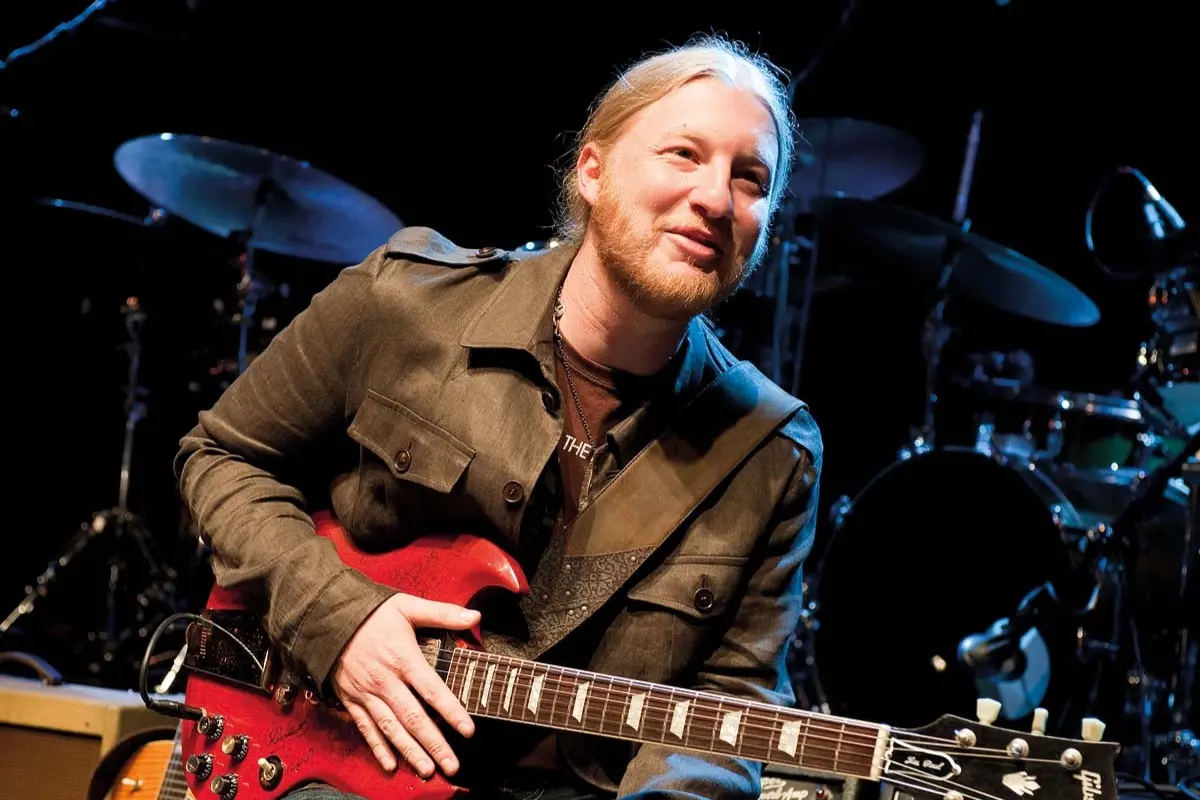
Trucks is associated with Gibson SG-style guitars and a very touch-sensitive, vocal slide tone, but copying a rig won’t copy a right hand. Still, studying his live setup and gain staging can help you understand how clean fundamentals support expressive slide playing.
If you want a sanity check on his broader career context, official band pages for timelines and projects are useful for anchoring the story without turning it into mythology.
Conclusion: the real Derek Trucks “sound” is permission
Derek Trucks’ open E and fingers-only approach is less about being different and more about being honest. He changed tuning and technique because it made it “easiest to express what [he] was hearing,” then refused to let nostalgia freeze him in place.
If that feels provocative, good. Guitar needs fewer curators and more adults who are willing to evolve in public.


