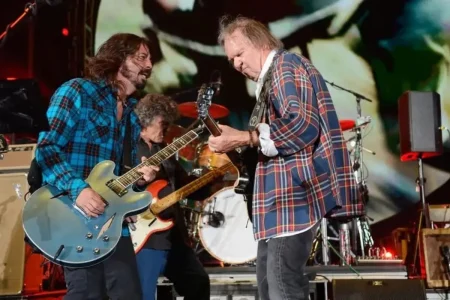
On one autumn night in Cleveland, the Rock & Roll Hall of Fame finally looked like the messy, glorious reality of modern music: a 1960s Brill Building songwriter, a 1990s grunge survivor turned stadium rocker, a Beatle, and the biggest pop star of the streaming era all sharing the same stage.
Carole King and Dave Grohl did not just get new plaques in 2021. Their inductions, alongside performances by Taylor Swift and Paul McCartney, quietly rewrote what “rock” means and who gets to be canonized for it.
The 2021 class: one ceremony, three generations colliding
The 36th Rock & Roll Hall of Fame induction ceremony took place at Rocket Mortgage FieldHouse in Cleveland on October 30, 2021, with a Performer class that included Carole King, Foo Fighters, Tina Turner, The Go-Go’s, JAY-Z and Todd Rundgren.
For King and Grohl, it was more than a career pat on the back. Both joined the rare club of artists inducted twice into the Hall, putting a formal stamp on careers that had already bent popular music in very different directions.

Carole King: the songwriter who took 31 years to be “allowed” onstage
By the time Carole King stepped up for her 2021 induction, she had already spent decades as the quiet architect of other people’s hits, then as the unexpectedly reluctant star of Tapestry, the piano-driven album that became a soundtrack for the 1970s.
King’s path to that Rock Hall stage was not straightforward. Early on she was happiest behind the scenes, battling stage fright and only easing into the spotlight after encouragement from friends like James Taylor, who pushed her to perform her own songs live at Los Angeles clubs.
From Brill Building workhorse to overdue solo icon
In 1990 the Hall finally recognized King – but only as half of the Brill Building duo Goffin and King, honored for writing era-defining singles like Will You Love Me Tomorrow and One Fine Day for others.
That first induction cemented her as a behind-the-scenes genius. It took until 2021 for the Hall to admit that the woman singing at the piano on Tapestry was just as historically important as the teenager cranking out hits in an office cubicle.
Taylor Swift crowns “the greatest songwriter of all time”
The ceremony opened with Taylor Swift walking out not as a pop interloper, but as a disciple. She performed a sleek, reimagined version of Will You Love Me Tomorrow and then formally presented King for her solo induction, underscoring how a 1960s song still cuts through in a 21st century arena.
In her speech, Swift talked about growing up in a house where Carole King records were treated like sacred texts and flatly called King “the greatest songwriter of all time,” framing King’s catalog as a kind of emotional instruction manual for multiple generations.
King’s own acceptance made the subtext explicit. She told the crowd that today’s female singer-songwriters stand on her shoulders, then pivoted to remind everyone that she herself stands on the shoulders of Aretha Franklin, the first woman ever inducted into the Hall.
For anyone watching closely, that was not a polite history lesson. It was a gentle indictment: it should not have taken until the Hall’s fourth decade to fully honor the women who literally wrote its soundtrack.
Dave Grohl and Foo Fighters: the drummer who became the Hall’s house band
On the other side of the generational divide stood Dave Grohl, back in Cleveland with Foo Fighters after being inducted once already as Nirvana’s drummer. Foo Fighters entered the Hall in 2021 as performers, praised for their guitar riffs, live ferocity and workhorse approach to rock.
Grohl’s double induction, both times in the first year of eligibility, effectively canonized him as rock’s default frontman of the past three decades – the guy you call when you need the music to feel loud, human and oddly hopeful at the same time.
Sir Paul hands the torch to the kid who learned from a Beatles songbook
If King’s big generational moment was Swift calling her the blueprint, Grohl’s came from even higher up the food chain. Paul McCartney himself inducted Foo Fighters, drawing a pointed parallel between their stories: each man lost a band to tragedy and had to decide whether to start again.
Foo Fighters then hammered through Best of You, My Hero and Everlong before McCartney rejoined them to rip into Get Back, turning the Rock Hall stage into something closer to a late-period Beatles gig than a museum ceremony.
Grohl confessed from the mic that he never took proper lessons and instead learned rock and roll by wearing out a Beatles songbook and a record player, calling McCartney his unofficial music teacher in front of the man himself.
For anyone who ever learned chords off a dog-eared songbook, that moment was a reminder: theory is great, but obsession, a good ear and a battered instrument can take you just as far.

One night, four eras: how the show actually played
The 2021 ceremony was stuffed with moments designed to underline the historical arc. Swift opened the night, King later performed You’ve Got a Friend, Foo Fighters closed with McCartney, and in between the class of 2021 was threaded together with appearances from Turner, The Go-Go’s and JAY-Z.
What could have been a dusty victory lap for boomers instead felt like an argument that all of this lives on a single timeline: Brill Building pop, Laurel Canyon introspection, grunge, stadium rock, and now streaming-era confessionals.
The double-inductee club – and the Hall’s slow repair job
King’s second induction also came with a telling statistic: she became only the third woman ever to enter the Hall twice, alongside Stevie Nicks and Tina Turner, both of whom had to wait years to be recognized outside of the men they first recorded with.
On the same night, Grohl joined the short list of artists inducted twice with different bands, confirming what fans already knew: the kid bashing drums behind Kurt Cobain has become one of rock’s central authors.
If you wanted a snapshot of the Hall’s historic blind spots, you could put King and Grohl side by side. She had to wait three extra decades to be acknowledged for work she did largely alone at a piano. He was ushered in twice on schedule, as soon as the calendar allowed.
The night the Rock Hall finally embraced pop optics
For purists, the uneasy truth is that the Rock Hall has always been at least half spectacle. In 2021 the institution stopped pretending otherwise. With Swift opening the show, screaming fans in the arena, and social media lighting up, the ceremony felt closer to the Grammys or MTV’s heyday than to a museum banquet.
That was not an accident. Swift’s induction of King drew a younger, largely pop audience into a night anchored by a 1971 piano album, a 1990s guitar band and a 1960s Beatle. The Hall has since leaned into that relationship, displaying Swift artifacts and effectively using her as a bridge between TikTok and the glass cases in Cleveland.
You could frame that as the Rock Hall selling out to pop. Or you could see it as the logical end point of something King and Grohl both embody: rock and roll was never just about distortion. It was always about whoever wrote the songs that people actually lived with.
King vs Grohl: two very different roads to the same stage
| Artist | First Rock Hall induction | Second induction | Primary instrument | Defining strength |
|---|---|---|---|---|
| Carole King | 1990 – songwriter with Gerry Goffin | 2021 – solo performer | Piano, voice | Melodic, emotionally direct songwriting |
| Dave Grohl | 2014 – drummer with Nirvana | 2021 – frontman of Foo Fighters | Drums, guitar, voice | High-energy performance and hooks built for arenas |
For musicians, their parallel stories read like two different career playbooks. King built a life in music by mastering harmony, voice-leading and lyric craft at the piano long before she ever faced a crowd. Grohl started as the drummer in someone else’s band, then quietly wrote and recorded an entire album by himself before he even had a permanent lineup.
What the 2021 ceremony really celebrated was not genre but authorship. The Hall put its stamp on two people who insisted on writing their own material, shaping their own bands and refusing to stay politely in the supporting cast.
What it all means for players and fans
If you are learning your first chords or scales today, there is a blunt lesson in this night for you. The Rock Hall did not put King and Grohl on that stage because they fit some rigid definition of “real rock”. It honored them because, in completely different eras, they grabbed hold of their instruments and wrote songs that refused to go away.
King proved that a shy woman at a piano could define an era without ever screaming into a microphone. Grohl proved that a drummer could step out front, strap on a guitar and become the guy closing the show with a Beatle.
However you feel about the Hall itself, that is the useful takeaway. Learn your instrument. Learn songs by your heroes. Then, like Carole King and Dave Grohl, have the audacity to put your own name at the top of the credits and let the rest of the industry play catch-up.