Every rock legend has a version of themselves that existed before the legend — and usually one person who knew that version best. For Bon Scott, that person was Irene Thornton.
They met in Adelaide in 1971, when Bon was the singer of Fraternity, a hard-gigging local band with big ambitions and thin returns. He was nearly a decade into a music career that had produced two teen-pop chart runs and no security: first with the Valentines, then with Fraternity, who had just won Australia’s biggest battle-of-the-bands prize and convinced themselves the world was next. He was charming, restless, tattooed and skint; she was a sharp-eyed Adelaide girl who took him exactly as he was. They married in early 1972 — years before “AC/DC” meant anything to anyone.
The unglamorous years
The marriage coincided with the least romantic stretch of Bon’s life. Fraternity took their prize money and relocated to Britain chasing a break that never came, with Irene along for the ride. Her later account of that period is one of the most valuable documents in the whole AC/DC literature precisely because it refuses to gild anything: bitter London winters in shared houses, a band and its partners crammed into group living, frayed tempers, heavy drinking, odd jobs to keep the lights on, and the slow deflation of a dream as the gigs failed to materialise. At one point Bon was reduced to working in a wig factory. This was the future legend as a struggling nearly-man in his mid-twenties — talented, unlucky, and starting to wonder if the window had closed.
They came home to Australia with the band effectively spent. And then things got worse. In May 1974 Bon crashed his motorcycle and spent days in a coma, an accident that wrecked him physically and closed the Fraternity chapter for good. Irene was there for the pieces — the hospital, the long recovery, the drifting man who emerged.
It was in that low, aimless stretch that friends intervened. Vince Lovegrove, Bon’s old Valentines bandmate, threw odd jobs his way — driving, postering, anything — and made the introduction that changed rock history: a young Sydney band called AC/DC needed a singer with more grit than the one they had. By late 1974, Bon — nine years older than the Young brothers and written off by nearly everyone — was their frontman.
Separated, never estranged
The marriage didn’t survive the takeoff. The life that came with AC/DC — permanent touring, permanent chaos — finished what the lean years had started, and Bon and Irene separated as the band began its climb, formally divorcing years later. But here is the detail that lifts this out of the rock-wife footnotes: they never really let go of each other. They stayed close — visits, calls, and letters that kept arriving from tour stops around the world — right up until his death in 1980.
Decades on, Irene finally told her side in the memoir My Bon Scott — a portrait, in her phrase, without the airbrushing. It shows the reader the man behind the swaggering frontman of legend: funny, generous, insecure about his age, devoted to the people who’d backed him early, and carrying his demons with him all the way up. It is, by common consent among AC/DC devotees, the closest thing there is to meeting the private Bon.
What makes the book land is its texture. This isn’t a settling of scores or a hagiography; it’s the recollections of someone who did the man’s laundry and read his mail. The Bon of My Bon Scott frets about money, hams it up in the kitchen, worries he’s too old for the game, and writes home with a warmth that sits strangely — and then not strangely at all — beside the bare-chested hellraiser on the album covers. Irene neither excuses the drinking nor lets it define him. The result is the rarest thing in rock memoir: a fully three-dimensional human being, drawn by someone with no myth to protect.
The version worth knowing
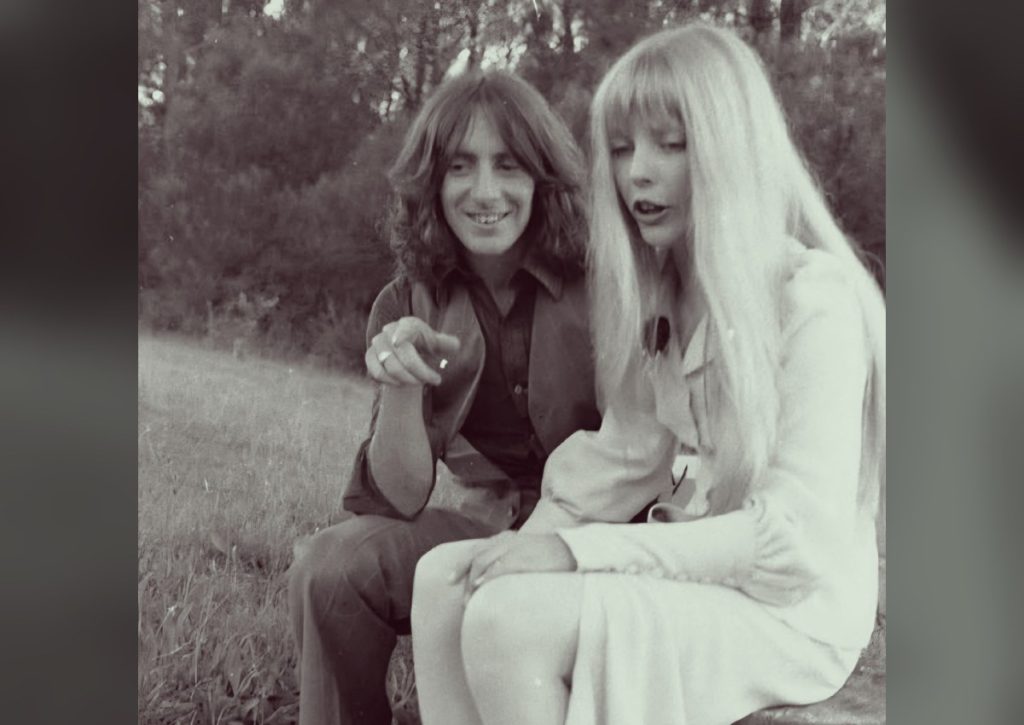
The black-and-white photographs of Bon and Irene from those early-seventies years show what the myth machine never captures: Bon Scott relaxed, unfamous and happy, next to someone who liked him long before there was anything to gain by it. The schoolboy-suited juggernaut and the leering, electric showman came later — and even at the height of it, the letters kept going back to Adelaide.
There’s a reason her account matters more than another tale of excess. Fame arrived so late for Bon — he was 28 when he joined AC/DC, ancient by the standards of the day — that almost everyone in his orbit met the finished product. Irene got the other Bon: the one who scrubbed up for a wedding in 1972, failed gloriously in London, nearly died on a motorbike, and kept turning up in her life long after the paperwork said he didn’t have to.
Ask anyone who’s loved a musician through the broke years. That’s the version worth knowing — and thanks to Irene, we do.