
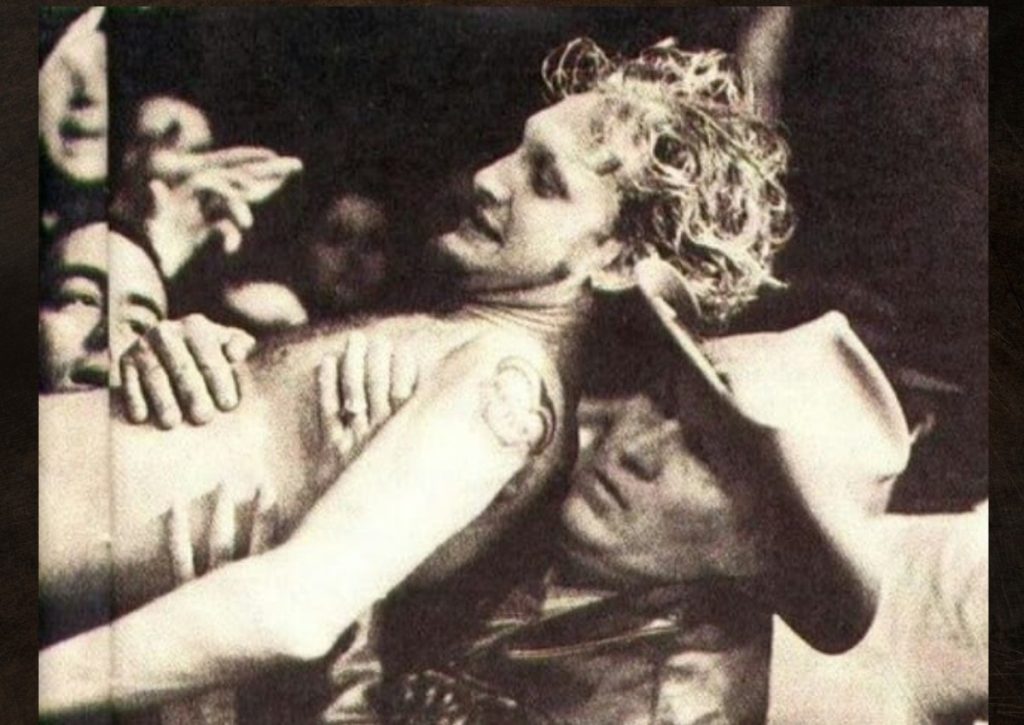
There is a photograph from an Alice in Chains show of Layne Staley being lifted over the crowd barrier by an older man with careful hands and a weathered face. Most fans scrolling past would never guess who the man is. He is Jerry Cantrell Sr. — and if you have ever heard Alice in Chains, you know him already. He is “Rooster”.
The nickname
The name came long before Vietnam. As a boy in Oklahoma, Cantrell Sr. was — by his son’s telling — a cocky little kid whose hair stuck up like a rooster’s comb, and a great-grandfather hung the nickname on him. It followed him into the U.S. Army’s 101st Airborne, whose eagle insignia made it almost official, and through two tours of Vietnam.
What came home from those tours was a man who would not speak of them. Jerry Jr. grew up watching a father locked around his own memories, the untreated weight of the war grinding away at the family until it broke apart. The parents divorced; the son carried the resentments any kid carries when a parent is absent and unreachable — and carried, too, the question of what had actually happened to the man.
Written on Chris Cornell’s couch
“Rooster” was born at a low point in the son’s life. At the start of 1991, temporarily homeless, Cantrell was staying with Chris Cornell and Susan Silver in Seattle, sleeping in their basement with a four-track recorder. It was there, on an acoustic guitar at Cornell’s place, that he wrote the song — and made the imaginative leap that lifts it above every other Vietnam rock song: he wrote it in his father’s voice.
The lyrics walk a jungle patrol from the inside — the stinging sweat, the mosquitoes, the ambush, the flat refusal at the centre of it: they come to snuff the Rooster… you know he ain’t gonna die. Cantrell has said he was deliberately trying to imagine his father’s side of a story his father had never told him. It was, in the most literal sense, a letter to a man he couldn’t talk to, drafted in a borrowed basement.
The song landed on Dirt in 1992, slowed to a crawl and sung by Staley with terrible tenderness. It became one of the album’s defining tracks and one of the era’s few war songs written without politics — just a son trying to see through his father’s eyes.
“You got too close”
The letter was received. Cantrell Sr. eventually heard the song, and later sat for the Mark Pellington video, facing the camera as an older veteran finally, haltingly, speaking about the war — intercut with combat imagery while his son’s riff rolled underneath. His verdict on the lyric, delivered to Jerry directly, has the compression of a man who doesn’t waste words: “You got too close — you hit it on the head.”
Cantrell has been explicit about what followed. In the Music Bank liner notes he called the song the start of the healing process between him and his dad from all the damage Vietnam had caused. The estrangement thawed. The elder Cantrell began appearing at shows — which is how a Vietnam veteran ended up at the barrier of an Alice in Chains concert, lifting his son’s bandmate over the rail, family in every direction.
Musically, the song does something subtle that mirrors its subject. It doesn’t rage. It endures — that slow, rolling riff advancing like a patrol, Staley and Cantrell’s harmonies hanging over it in the band’s signature two-part drone, the choruses rising not in anger but in stubborn refusal. Alice in Chains built their sound on vocal harmony as shared weight, two voices carrying one load, and nowhere does the architecture serve a lyric better. The arrangement is the psychology: pressure, endurance, survival.
The song that keeps serving
“Rooster” has since lived a second life its author never planned. Veterans adopted it — a generation of them, and then another, hearing their own unspoken tours in it. Among a catalogue that made pain its home key, it stands apart: the one Alice in Chains epic about surviving rather than sinking, written for a man who did.
The deeper lesson sits with that barrier photograph. Grunge is remembered as music about broken families and inherited damage, and it was. But “Rooster” is the counter-example the era rarely gets credit for — damage examined instead of inherited, a son doing the work of understanding a father who couldn’t explain himself, in a scene where such resolutions were tragically rare. One song didn’t fix a family. But it opened a door that had been shut since the war, and both men walked through it.
Cantrell has played the song at every show for thirty years, and says versions of the same thing whenever he introduces it: this one’s for the veterans. What began as one son’s attempt to imagine one father’s war has become a standing ritual between a band and the servicemen and women in every crowd — hats off, lighters up, the least likely army anthem ever written doing its nightly work.
They came to snuff the Rooster. He didn’t die. His boy made sure everyone knows it.


