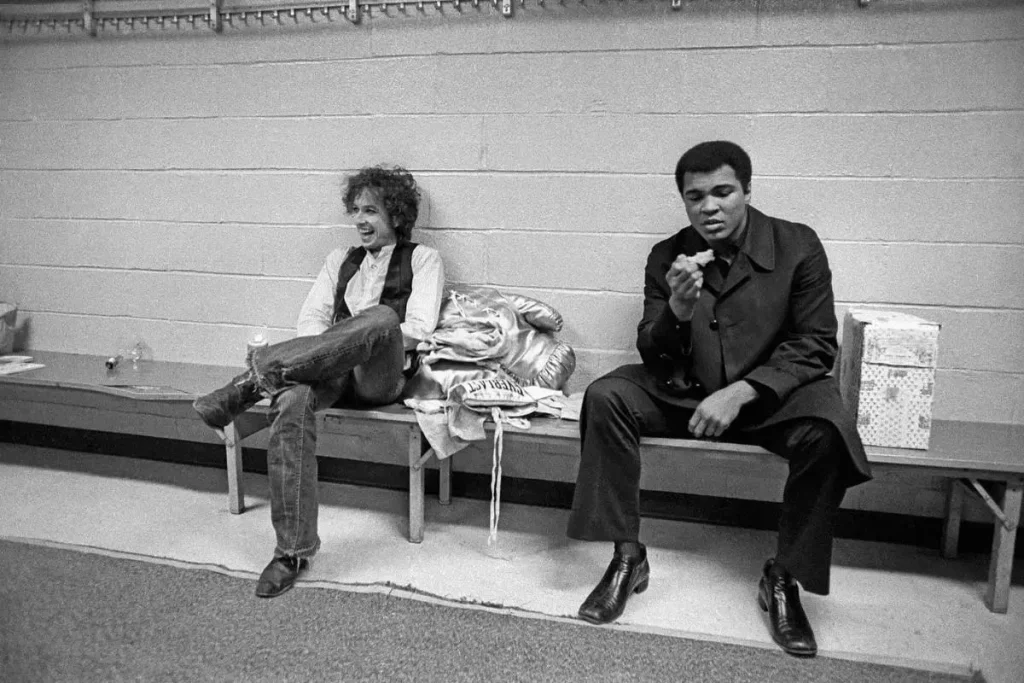
In a single black and white photograph, Bob Dylan sits in stage paint and cowboy hat, grinning like a kid, while Muhammad Ali leans back, relaxed, larger than life. Between them rests an absurdly oversized boxing glove. The shot feels like a joke and a prophecy at the same time: the 1960s protest bard and the heavyweight poet of the ring caught in one candid moment.
Over the years, fans have embroidered that meeting into a kind of urban legend, placing Dylan and Ali together in Zaire before the Rumble in the Jungle, as if they were co-conspirators in the same African epic. The truth is different, and in some ways more interesting. Their real encounter happened not in a far off training camp but in the most American arena imaginable: Madison Square Garden.
The legend everyone tells: Dylan, Ali and Zaire
The easiest story to believe is the glamorous one. Muhammad Ali reclaimed the heavyweight crown from George Foreman in the Rumble in the Jungle, fought in Kinshasa, Zaire, on October 30, 1974, in front of tens of thousands in the stadium and a huge global TV audience. It was already more than a boxing match; it was theater, geopolitics and Black pride rolled into one.
As part of the build up, the Zaire 74 festival brought together American soul and R&B royalty with some of the most important African bands of the era, turning Kinshasa into a three day collision of James Brown funk, B.B. King blues and Congolese rumba, all explicitly tied to Ali vs Foreman. In hindsight, it looks like the perfect stage for a Dylan cameo, which is probably why so many people now casually relocate him there in their memory.
At the same time, Dylan was on his own hot streak. His painfully intimate album Blood on the Tracks was released in January 1975, marking a commercial and artistic rebirth after a more uncertain early 70s period. The idea that this newly recharged Dylan hopped from confessional masterpiece straight into the African jungle to hang out with Ali is seductive. It is also wrong.

The real meeting: Night of the Hurricane, Madison Square Garden
The actual convergence came a year later and an ocean away. On December 8, 1975, Dylan closed the first leg of his Rolling Thunder Revue with a four hour benefit at Madison Square Garden titled “Night of the Hurricane,” raising money and attention for imprisoned middleweight contender Rubin “Hurricane” Carter. It was the opposite of the slick stadium tour: a ragged traveling circus of poets, rock stars and hangers on, suddenly stepping under the brightest lights in New York.
Backstage access on that tour belonged almost exclusively to photographer Ken Regan, who had Dylan’s trust and the run of dressing rooms, rehearsal spaces and corridors. Decades later, a CBS News feature on Regan’s Rolling Thunder photos highlighted one particular image from that Garden show, noting how Muhammad Ali dropped in backstage and presented Dylan with a giant boxing glove, captured sitting on the bench between them. The look on Dylan’s face is not the cool distance of the mid 60s; it is delighted disbelief.
Another account from a photo retrospective by writer Ray Harris spells it out even more bluntly: at the Night of the Hurricane benefit, held at Madison Square Garden in December 1975, Ali visited Dylan backstage and gave him a huge glove, at a concert staged explicitly to support the campaign for justice for Rubin Carter, widely believed to have been wrongly convicted of murder. The famous photograph is not just a meeting of celebrities; it is an image rooted in a specific political cause.
| Year | Event |
|---|---|
| 1967 | Rubin “Hurricane” Carter convicted of triple murder in New Jersey. |
| 1974 | Muhammad Ali defeats George Foreman in the Rumble in the Jungle in Zaire. |
| January 1975 | Bob Dylan releases Blood on the Tracks. |
| November 1975 | Dylan issues the single “Hurricane,” telling Carter’s story. |
| December 8, 1975 | Night of the Hurricane benefit at Madison Square Garden; Ali meets Dylan backstage. |
| 1985 | Carter’s convictions are finally set aside; he is released. |
Hurricane Carter, protest songs and two very different rebels
None of this makes sense without Rubin Carter. A contender for the middleweight title, Carter was convicted in 1967 of a triple homicide amid allegations of racist policing, unreliable witnesses and a stacked jury. Years later, Dylan read Carter’s prison autobiography, visited him behind bars, and co wrote the song “Hurricane” as a rare mid 70s return to explicit protest, built around a detailed retelling of the case.
That song was released as a single in 1975 and then as the opening track on Dylan’s 1976 album Desire, after becoming a nightly centerpiece of the Rolling Thunder Revue. The tour itself was practically a rolling rally for Carter: Dylan’s troupe played his New Jersey prison, then capped the first leg with the Night of the Hurricane benefit at the Garden, and later held a second major fundraiser in the Houston Astrodome.
Ali fit into this picture with unnerving symmetry. By the mid 70s he was no longer just the kid who beat Sonny Liston; he was the man who had refused induction into the U.S. Army during the Vietnam War, lost his license and title, and fought his way back to the championship in the Rumble in the Jungle. Time would later sum him up as a global icon whose stance on war, race and religion turned him from controversial loudmouth into a civil rights hero, the rare athlete whose politics hit as hard as his jab.
Dylan and Ali were very different kinds of rebels. One hid behind masks, characters and shifting stories; the other made his own face, voice and body the message. Yet on that December night they were on the same side of the same fight: using celebrity to drag a forgotten boxer into the public conscience.
Reading the photograph
Look again at the Ken Regan image with that context in mind. Dylan, painted and costumed, leans forward with a kind of shy amusement, like a fan who suddenly finds himself in the presence of the real thing. Ali sprawls back, mid sentence, owning the room without trying. The glove between them is almost comically large, the physical embodiment of the cause that brought them together.
The power of the shot is that it punctures both myths at once. Dylan, the supposed reluctant activist who spent much of the 70s insisting he was just an entertainer, is there precisely because he decided to throw his weight behind a controversial legal case. Ali, so often frozen in museum posters as the kinetic knockout artist, is here in a quieter mode, mentoring a fellow celebrity, lending his authority to someone else’s protest song.
In a decade when both men were accused of being past their prime, the photograph catches them in the act of proving otherwise. Dylan’s creative resurgence and Ali’s second championship reign are distilled into a private joke and a shared mission, all in one backstage frame.
Music, sport and the 70s culture wars
The 1970s were full of awkward marriages between sport, politics and pop music. Zaire 74 in Kinshasa had already shown what happened when a dictator, an American boxing promoter and a roster of Black American and African stars tried to turn a heavyweight title fight into a pan African cultural statement. Rolling Thunder and the Night of the Hurricane were the scruffier, more idealistic cousins of that spectacle.
For older fans, that is part of why the Dylan Ali meeting still resonates. It represents a time when guitarists and prizefighters were expected to take positions, not just endorsement deals. Even today, beginner guitarists are still cutting their teeth on Dylan standards like “Knockin’ on Heaven’s Door,” a staple four chord sing along that sites like Know Your Instrument recommend as an ideal early acoustic strummer. The idea that the man who wrote those songs once sat nodding along to Ali’s courtroom rhymes feels like a bridge between eras.
Seen from today’s more cautious celebrity culture, the Night of the Hurricane looks almost reckless. A major rock star pinned his reputation to a controversial court case; the most famous athlete in the world stepped onto someone else’s stage to criticize the justice system that had tried to crush him. You do not get that kind of risk without the messy, morally charged energy of the late 60s and 70s still echoing through the decade.
The lasting punch of a brief encounter
By all accounts, Dylan and Ali did not become close friends. Their paths crossed for one night, in one arena, in service of one boxer whose name is now remembered largely because artists refused to let him disappear. Yet the photograph that survives from their brief meeting carries a cultural weight far beyond its few seconds of shutter time.
The myth about them meeting in Zaire is romantic, but the truth is tougher and more interesting. It situates both men squarely in the trenches of American battles over race, justice and power, not on some exotic distant stage. In that sense, the Night of the Hurricane might be the most honest portrait of the 70s you can ask for: protest music, heavyweight politics and show business all crammed together in a dressing room, framed by a ridiculous glove and two very serious minds.