Ronnie Wood is often introduced as “the Rolling Stones’ guitarist,” then politely filed away as a rock aristocrat with famous friends. That version misses the more interesting story: Wood is a trained visual artist who’s spent decades documenting modern music culture with a painter’s eye, not a fan’s camera. His art is not a vanity project. It’s a parallel career with its own craft, hustle, and critics.
“There’s no real difference between painting and playing – it’s all about improvisation.”
Ronnie Wood, official RonnieWood.com site
Before the Stones: art school, not stage school
Wood’s first “identity” wasn’t guitarist – it was art student. Long before stadium tours, he studied at Ealing College of Art, a famously fertile training ground for British musicians who thought visually as much as sonically.
That background shows up in the way he frames people: strong silhouettes, performance lighting, bodies caught mid-gesture. Even when he draws a friend in a pub, it reads like a scene with blocking, not a snapshot.
What Ronnie Wood actually makes (and what he avoids)
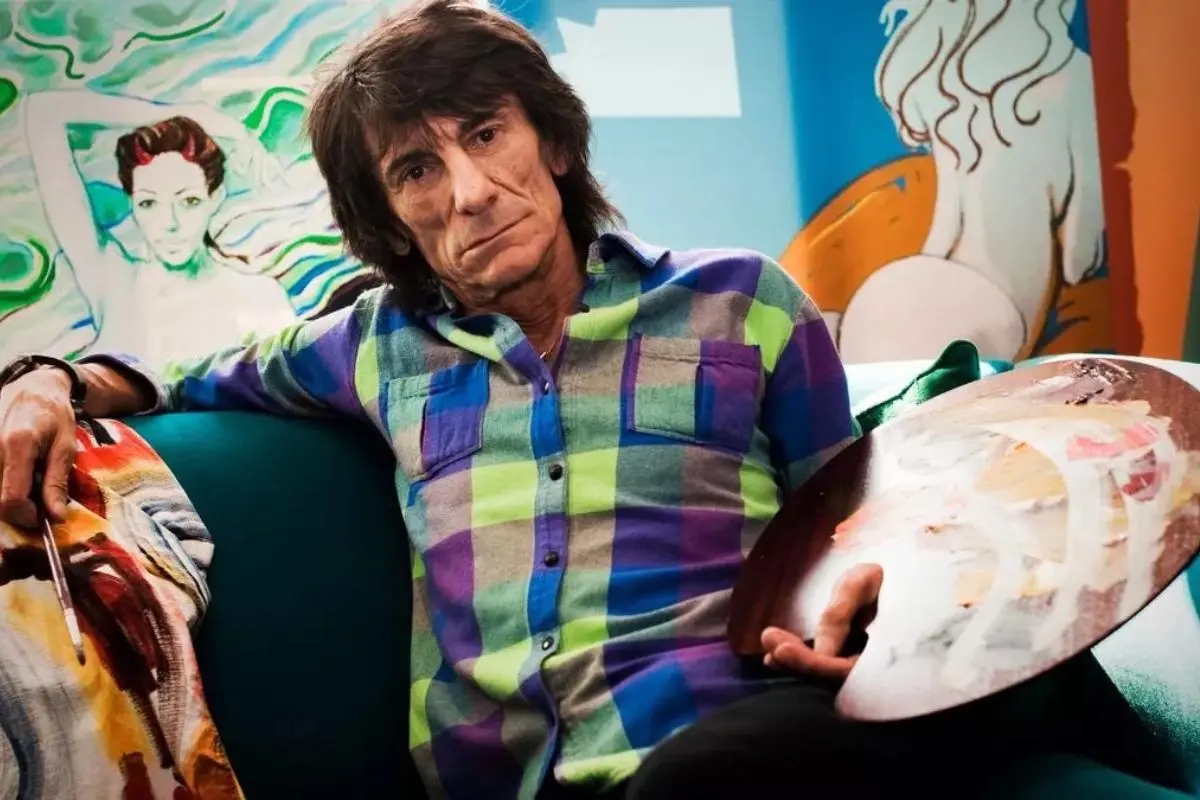
Wood’s output spans drawing, painting, and printmaking. He’s best known for figurative work: portraits of musicians, band scenes, and slightly mythic renderings of the rock ecosystem. His artist profile describes a practice centered on portraiture and music subjects, with an active market for prints and works on paper.
He is not chasing contemporary-art fashion. You don’t go to Wood for cold conceptualism, ironic minimalism, or theory-heavy installations. The work is emotional, character-led, and frequently documentary in spirit – like a tour diary that learned how to paint.
Common motifs in Wood’s art
- Portraits of musicians (friends, heroes, rivals, legends)
- Live performance scenes with dramatic stage lighting
- Backstage or studio moments that feel private but not exploitative
- Loose linework that favors energy over polish
- Warm palettes and skin tones that flatter without airbrushing reality
The “rock star painter” problem: authenticity vs merch
Let’s be blunt: celebrity art is usually a grift, a brand extension, or a tax-efficient hobby. The art world has good reasons to roll its eyes. Wood is different, but he still lives inside the same suspicion. His advantage is that he didn’t “discover art” after fame; he trained, worked, and kept making images while his music career exploded, a throughline emphasized across his official biography and art-focused pages.
The edgy claim is this: Wood’s paintings often function as cultural evidence. When a photographer points a lens at a megastar, the subject performs. When Wood sketches fellow musicians, the vibe shifts – he’s a peer, not a press pass. The result can feel less like publicity and more like witness.
How his musician brain shapes his brushwork
Wood’s art reads like a guitarist’s phrasing. Lines behave like riffs: repeated, varied, and pushed forward by momentum. Faces are built from quick decisions rather than meticulous glazing. That’s not laziness; it’s a stylistic commitment to “first take” intensity.
If you’re a musician, the translation is easy: some painters compose like classical orchestrators. Wood paints like a band that trusts the groove.
A quick comparison table
| In music | In Wood’s painting |
|---|---|
| Improvisation inside structure | Loose lines inside recognizable likeness |
| Tone and touch | Color temperature and pressure of mark-making |
| Live energy over perfection | Gesture and attitude over photographic realism |
| Rhythm section keeps it moving | Strong outlines keep figures anchored |
Portraits: the core of his reputation
Wood’s portraits are the heart of his painting career, and they’re where his access turns into artistic value. He depicts musicians as working bodies: hunched shoulders, clenched hands, bent knees, mouths caught between speech and song. The effect is often affectionate, but not worshipful.
His official art section consistently foregrounds portraits and music-related series, presenting the work as a long-running practice rather than occasional “celebrity drops.”
Prints, editions, and the real economics of being “collected”
A lot of Wood’s art circulates as limited-edition prints, which makes sense for a musician with a large fanbase: editions create affordability and reach. That also invites cynicism. But prints are also a legitimate fine-art medium with its own standards: paper quality, plate work, registration, edition control.
Some of the clearest evidence that the editions trade beyond pure fandom is that his works appear in secondary-market listings and categories for prints and works on paper.
Buyer beware (and why it matters)
- Look for clear edition info: number, total edition size, and medium.
- Ask about provenance: where it was purchased and any documentation.
- Condition is everything: paper tone, foxing, creases, and framing materials.
Auctions and visibility: when the art world takes it seriously
One way to measure whether a “celebrity artist” has traction is whether auction houses will list, describe, and sell the work repeatedly. Wood’s name appears in fine-art sales contexts, including searchable auction results for Ronnie Wood works.
Bonhams also returns dedicated search results for Ronnie Wood works, suggesting routine handling rather than novelty one-offs.
This doesn’t automatically equal museum-level importance, but it does indicate something more durable than a one-season headline: an established collector base willing to transact publicly.
Exhibitions, press, and the credibility loop
Wood’s art is periodically covered as “the other career,” but the better framing is “the career that never stopped.” Design and culture outlets track his art-related news and events as part of his broader creative output, including roundups that follow his exhibitions and releases over time.
Mainstream UK press hubs also compile ongoing coverage of his exhibitions and releases, which is a useful breadcrumb trail for readers who want to follow specific shows and series over time, including ongoing topic coverage that collects related updates.
Photography vs painting: why Wood’s images still matter
We live in an era where every backstage moment can be documented in 4K. So why do Wood’s paintings matter at all? Because painting edits reality in a way cameras don’t. A painted portrait decides what counts: the angle of arrogance, the fatigue under charisma, the humor that survives addiction-era chaos.
And yes, it’s worth saying out loud: rock history is full of myth-making, and Wood contributes to that myth. But he also counters it by showing performers as human-scale characters. The best works land in that tension: iconic, but not corporate.
How to see Ronnie Wood’s art with a musician’s eye
If you’re coming from music rather than galleries, here’s a practical way to “read” his work without pretending to be an art critic.
A 5-point listening-style checklist
- Is there groove? Follow the linework like you’d follow a rhythm guitar part.
- Where’s the hook? In portraits, it’s often the eyes, mouth, or hand position.
- What’s the tone? Warm colors feel like major keys; harsh contrasts feel like distortion.
- Does it swing? Good gesture drawings “move” even when nothing is happening.
- Is it honest? Not “pretty” – honest. Does the subject feel observed?
The verdict: a legitimate second legacy, not a footnote
Ronnie Wood’s painting career isn’t a celebrity side quest. It’s an ongoing practice rooted in training, sustained by obsession, and sharpened by a life spent inside the very scenes he depicts. If you want glossy rock icons, buy posters. If you want a musician’s insider portrait of modern music culture, Wood’s work has real bite.
In a world where nostalgia is endlessly monetized, his best paintings do something rarer: they remember the past while still feeling alive.
Further exploring: quick places to start
- Browse Wood’s current series and releases listings to see how the work is framed and categorized publicly.
- Compare market categories and mediums via an overview of his prints and works on paper.
- Check major auction search results to understand edition types and pricing spread.
Conclusion: Ronnie Wood doesn’t paint to prove he’s more than a Rolling Stone. He paints because it’s the same impulse as playing guitar: capture a feeling before it disappears.