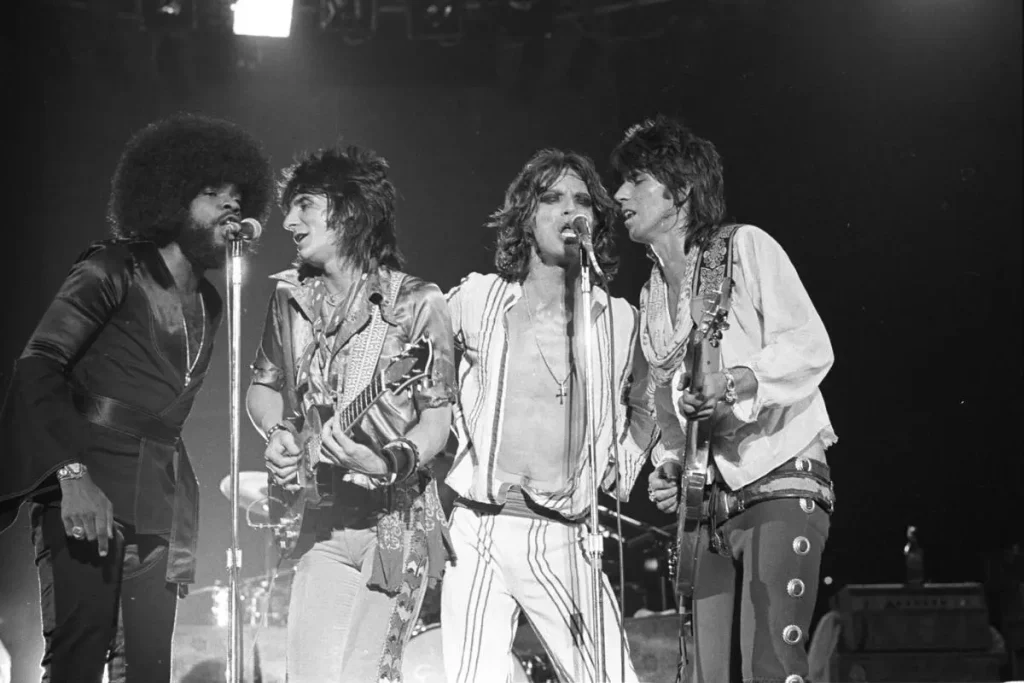
Picture a mid 70s Rolling Stones show: lotus petals opening, an inflatable phallus twitching to life, and Mick Jagger swinging over the crowd on a trapeze. In the middle of this circus, the band suddenly turns into the backing group for a smiling Texan in a white suit: Billy Preston.
For a few minutes each night in 1975 and 1976, the Stones handed their stage to the man the Beatles once billed as a co-star. Those segments were more than a gimmick. They were the moment the Beatles and Stones worlds quietly fused in public, with George Harrison sitting invisibly at the center of the web.
From Altamont’s chaos to arena spectacle
By the mid 70s the Rolling Stones had already lived through the dark side of rock mythology. The Altamont Free Concert in 1969 – complete with Hells Angels “security,” constant fights and the killing of fan Meredith Hunter in front of the stage – had turned their supposed West Coast Woodstock into a fatal disaster.
The lesson the band seemed to take was not to get smaller, but to get more controlled and more spectacular. Over the next decade they leaned hard into grandiose stage productions, from Hyde Park to the stadium marathons of the early 80s, becoming the template for the modern mega-tour.
Meanwhile, the Beatles retreat to the lab
While the Stones dug deeper into touring, the Beatles had already turned their backs on the road. By the time they made Revolver, they were treating the studio itself as an instrument, layering tape loops, backwards guitar and string quartets in ways that made old-style live shows feel obsolete.
That split in priorities – Stones as live spectacle, Beatles as studio alchemists – makes it even stranger that the man who best bridged both worlds was not Jagger, Richards, Lennon or McCartney, but Billy Preston.
1975: Ronnie Wood joins a very different Stones
The Tour of the Americas ’75 was a turning point. It was the first Stones tour after Mick Taylor quit, with Ronnie Wood brought in as the new guitarist. At first he was only announced as playing with the band on the tour, and was not officially named a Rolling Stone until that December.
The lineup shake-up coincided with a radical rethink of the show. Out went the familiar horn section of Bobby Keys and Jim Price. In came Billy Preston on keyboards and Ollie Brown on percussion, giving the band a harder funk and gospel undercurrent.
Visually, the tour bordered on the obscene and the surreal. The centerpiece was a lotus flower stage that opened like a giant metal bloom, revealing Jagger perched high on a petal. There was a giant inflatable phallus and, at some shows, a confetti-spewing dragon head lunging at the front rows.
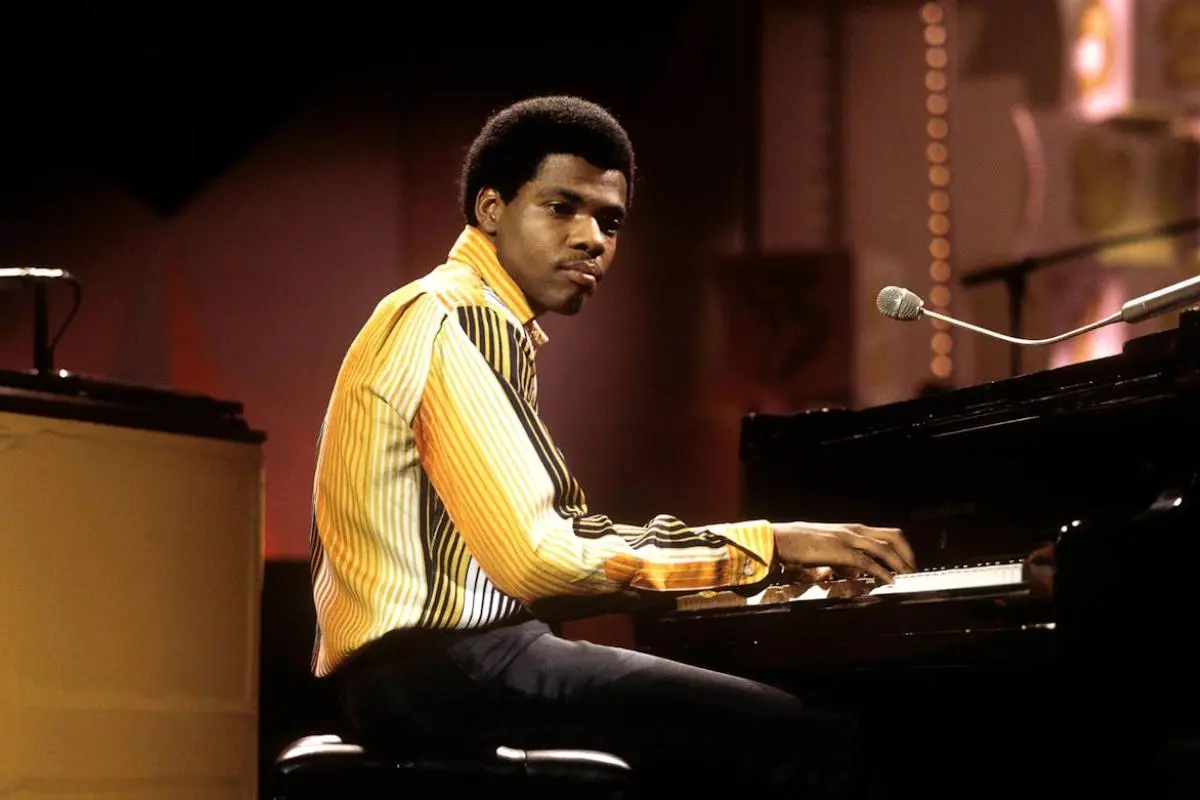
Billy Preston, the only man in both gangs
By 1975 Billy Preston had already lived several musical lives. He had been a child prodigy in gospel, a teenage sideman for Little Richard and Sam Cooke, and a first-call keyboardist for Ray Charles and others.
Crucially, George Harrison invited Preston into the tense Let It Be sessions in early 1969, where his playing and personality cooled the temperature in the room. The resulting single “Get Back” was credited to “The Beatles with Billy Preston,” the only time the band ever shared label credit with another artist.
Preston’s soulful organ is all over “Don’t Let Me Down” and the rooftop performance, and contemporaries started calling him a “fifth Beatle.” Later writers have gone further, noting that he is the only musician who both recorded and toured with the Beatles and the Rolling Stones, in effect breaching rock’s greatest tribal divide.
He was hardly just a sideman. In the early 70s he racked up his own hits with “Outa-Space,” “Will It Go Round in Circles” and “Nothing from Nothing,” blending churchy groove with clavinet funk and topping both pop and R&B charts.
By the time he officially became the Stones’ primary touring keyboardist, Preston had already played on Sticky Fingers, Exile on Main St., Goats Head Soup, It’s Only Rock ’n’ Roll and Black and Blue, subtly shifting the band toward a slinkier, more rhythmic sound.
Two Preston songs, every night: when the Stones became the backing band
Here is where things get wild. On the 1975 tour, the Stones did not just give Preston a solo; they gave him a feature block. Typical set lists show “That’s Life” sung by Preston and then “Outa-Space” led by him right in the middle of the show, with the Stones essentially acting as his band.
A long, nerdy blog on the Lotus stage design spells it out even more clearly: Billy Preston, as touring keyboardist, “was given two songs during the set – ‘That’s Life’ and ‘Outta Space.'” During “Outta Space” a trapeze rope came down from the lighting rig and Jagger literally swung out over the first rows like a rock ’n’ roll ringmaster.
By the following year’s Tour of Europe ’76, Preston’s slot had mutated into a full-blown soul revue moment. Contemporary accounts of the Zurich show describe his “spirited two-song solo star turn” on “Nothing From Nothing” and “Outa Space” late in the set, and point out that the band had dumped their horn section entirely in favor of Preston and percussionist Ollie Brown to chase a heavier funk reggae groove.
A handwritten 1976 set list by Jagger for the Cologne show even tags “NFN” and “OS” as “Billy’s tunes,” confirming that everyone understood this part of the night belonged to Preston.
One deep-dive Preston discography goes further, noting that on the 1975 and 1976 Stones tours he “played two of his own songs, backed by the Stones, in the middle of every concert.” On paper that sounds generous. In practice, it was a very Stones way of sharing the spotlight: let the genius loose, then swing past him on a trapeze to remind everyone whose circus this really is.
A quick timeline of this strange alliance
| Year | Beatles world | Billy Preston | Stones world |
|---|---|---|---|
| 1969 | Let It Be sessions, rooftop concert | Plays on “Get Back,” credited with the Beatles | Cutting Let It Bleed, still a lean live band |
| 1971 | Concert for Bangladesh | Steals the film with a dancing, gospel-funk “That’s the Way God Planned It” | Heading toward Sticky Fingers / Exile swagger |
| 1973 | Post-breakup solo years begin in earnest | Tours Europe as Stones’ opening act and keyboardist | European Tour ’73, band still relatively stripped-down |
| 1975-76 | Ex-Beatles off on solo paths | Mid-show star turn on Stones’ arena tours, two songs a night | Lotus stage, inflatable props, funk-heavy Black and Blue era |
George Harrison’s invisible fingerprints
If Preston was the bridge between Beatles and Stones, George Harrison was the quiet engineer who built that bridge. He produced Preston’s Apple single “That’s the Way God Planned It” and championed him as more than a sideman, then put him on stage at the Concert for Bangladesh, where Preston famously left his organ mid-song to dance across the stage in a burst of gospel joy.
Their friendship did not end with the Beatles. Harrison used Preston extensively on his solo records and tours, and Preston’s Big Apple and Los Angeles stints often overlapped with Harrison’s own sessions. Their bond was so tight that a later documentary on Preston leans heavily on interviews with Olivia Harrison and other members of George’s circle to explain how central he was to that post-Beatles world.
The web gets even tighter: Harrison co-wrote “Far East Man” with Ronnie Wood, years before Wood was officially a Rolling Stone, and in 1975 played guitar (under the jokey alias Hari Georgeson) on “That’s Life” for Preston’s album It’s My Pleasure – the very song that would become part of Billy’s slot on the Stones’ 1975 tour.
So when a bearded ex-Beatle watched his old protégé bring a stadium of Stones fans to church in the middle of an arena rock bacchanal, it was not some random cameo. It was Harrison’s long game playing out in public: a gospel-soul player he had nurtured now temporarily bending the world’s biggest rock band to his own feel.

The man who was “a Beatle and a Stone”
Rock Hall speeches are usually full of polite clichés, but Ringo Starr’s line when Billy Preston finally received his Musical Excellence Award in 2021 cut right to the truth. Preston, he said, “was a Beatle – and a Rolling Stone,” summing up in one sentence how deeply the keyboardist had infiltrated both camps.
Plenty of session players worked with either band, but only Preston shared label credit with the Beatles, cut on classic Stones albums, then strode to the front of a Stones stage to sing his own number one hit while Mick Jagger swung overhead.
That double life came at a cost. Later documentaries and profiles have laid bare the addiction, legal trouble and private turmoil Preston fought in the 80s and 90s, including the strain of being a Black gay man raised in a strict church environment. But in the crucial window between 1969 and 1976 he was one of the most dangerous musicians in rock – dangerous not because he courted outrage with sexist billboards or biker gangs, but because he could walk into the tightest inner circles in pop and quietly take over the room.
Why that mid 70s moment still matters
For Beatles fans, Billy Preston is often frozen at the piano on the Apple rooftop. For Stones fans, he may just be the guy behind the keyboards on Love You Live. The truth is far more subversive.
On those 1975 and 1976 tours, the Stones were at their most visually extreme, flirting with soft-core imagery and cartoon violence while punk rumbled in the distance. Yet the most radical thing happening in their show was a gospel-trained keyboard player, shaped by George Harrison and baptized in the Let It Be chaos, turning the world’s loudest rock band into his own backing group for two songs a night.
Call him the fifth Beatle, the sixth Stone or just the funkiest man in the building. For a brief stretch in the mid 70s, Billy Preston made the Beatles-Stones rivalry irrelevant by simply standing at the center of it – and playing everybody off the stage.