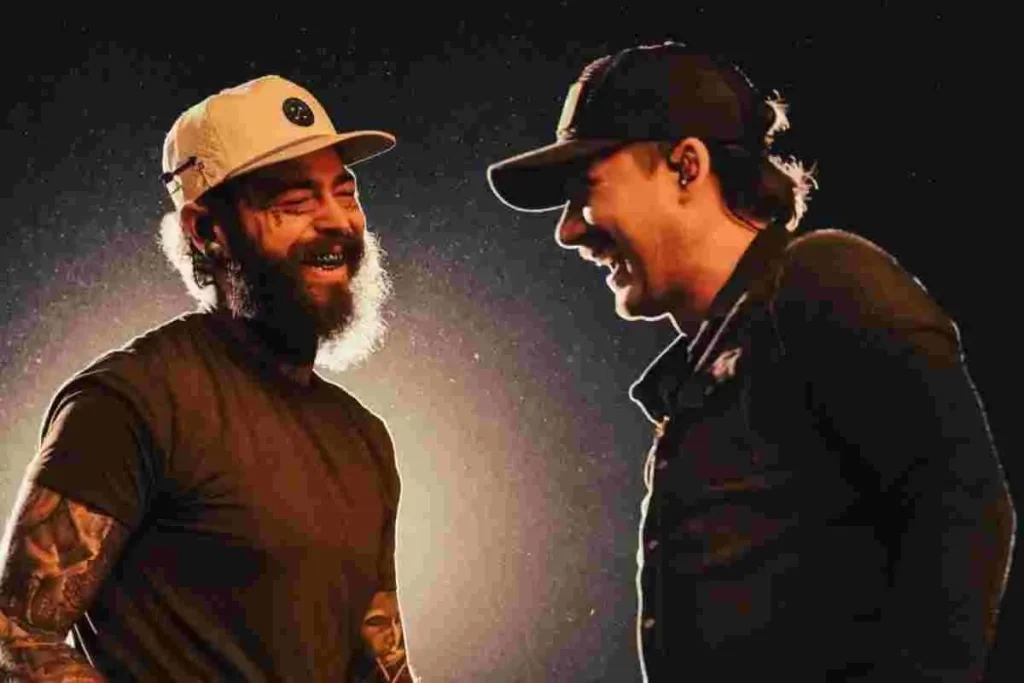
When Post Malone and Morgan Wallen finally locked into the same record, it didn’t feel like a “stunt collab.” It felt like a dare: what happens when the streaming-era king of genre blur meets country’s biggest hitmaker and both refuse to apologize for liking everything?
Their relationship is less about friendship selfies and more about musical gravitational pull. One guy grew up loving country and rock but became a pop-rap star; the other built a stadium-country empire that already borrows from hip-hop cadence and pop structure. The surprise is not that they connected, but that it took this long.
The moment it became official: “I Had Some Help”
The clearest proof of their musical relationship is the collaboration itself: “I Had Some Help,” billed as Post Malone featuring Morgan Wallen. The record was widely framed as a major crossover moment, with both artists leaning into a country-rock groove that still plays like modern radio-pop in its pacing and hook design. A full-on team-up rather than a background cameo is basically the point.
On YouTube, the official music video (and the comments under it) tells you something interesting: fans aren’t arguing over which genre “wins.” They are arguing over which voice sells the regret better, which is a much healthier debate.
Why the song works (and why it could have flopped)
In a lot of crossovers, the guest star parachutes in, does “their thing,” and leaves. Here, both singers are living in the same emotional weather: self-justification with a smirk. The track’s release context and credits reinforce that this is a formal, front-page collaboration with shared writing and production muscle behind it.
“Blame-shifting is the oldest trick in the breakup book.”
– A theme embedded in the lyrics of “I Had Some Help,” performed by Post Malone and Morgan Wallen
Musically, it’s built to unify audiences. Country listeners get guitars, grit, and a storyline; Post’s crowd gets a tight, chantable hook and the kind of rhythmic vocal phrasing that feels native to playlists, not just radio.

It’s not just a duet: it’s a strategic genre merger
Post Malone has been inching toward a country lane for years, and his official site has treated that direction as part of the broader “Post universe,” not a side quest. Morgan Wallen’s official site, meanwhile, reflects the scale of his mainstream reach – he’s not positioned as “niche country,” but as a top-tier pop-culture draw.
That matters because this pairing is as much about audience overlap as artistry. Both fanbases are streaming-native, comfortable with genre-mixing, and loyal to voices that sound human rather than polished to death.
The provocative take: this is country’s next power grab
Country music has always absorbed popular sounds, but streaming made the absorption faster and more shameless. The edgy claim is this: the Post-Malone-to-country pipeline is not “country going pop,” it’s country trying to become the default American mainstream again.
And Morgan Wallen is the perfect co-sign because his biggest records already use pop repetition and hip-hop-influenced rhythm. Post Malone is the perfect recruit because he brings crossover credibility without reading like a label-manufactured “country cosplay.”
How their styles actually complement each other
Their chemistry comes down to craft choices that older listeners will recognize from earlier eras of crossover (think soft rock meeting Nashville), just updated for modern loudness and streaming pacing.
1) Melody-first writing
Both artists prioritize melody that can survive alone on an acoustic guitar. That is a classic country standard and also a pop requirement. The collaboration feeling native to platforms where both artists dominate is part of the point, and Post Malone’s current visibility as a major live draw only amplifies how quickly big melodies travel.
2) Conversational phrasing
Wallen’s phrasing often sits slightly behind the beat, giving a laid-back pull. Post has a similar habit, developed from hip-hop and sing-rap. Put them together and you get a unified “talk-sing” pocket that reads natural instead of stitched.
3) Shared subject matter: remorse with swagger
Neither singer is afraid to sound guilty while still sounding confident. That blend is central to modern country’s anti-hero streak and Post’s pop persona. It’s also why the record feels like a bar confession, not a press release.
Songwriting and credits: where the relationship becomes professional
If you want the “paper trail” version of their connection, the songwriter and publisher databases are as close as it gets to official documentation. A quick way to sanity-check public momentum is to look at the song’s chart presence in the UK ecosystem rather than relying on hype alone.
That’s the part casual listeners skip, but it’s the part that shows how genre blending becomes a repeatable business model. Once publishing relationships exist, more sessions, more co-writes, and more “surprise” features become easier.
Performance culture: why this collab was built for stadiums
Post Malone’s touring footprint is massive, and he’s consistently positioned as an arena and festival force, which makes a duet like this more than a streaming play – it’s a future setlist weapon that’s built for huge rooms.
Older music fans sometimes roll their eyes at “playlist music,” but this is where the old rules return: big choruses matter again because big venues demand them. Crossovers that can be sung by 40,000 people beat clever niche experiments every time.
Reception and chart life: the crossover proof
In 2025, it’s hard to separate “hit song” from “streaming behavior,” and Spotify’s global weekly chart shows how cross-genre records can rack up momentum fast when they travel outside US radio formats.
What this means for musicians (and for listeners who miss “real bands”)
Here’s the practical takeaway: Post and Wallen are demonstrating a new template that still respects old-school songwriting values. If you’re a guitarist, a singer, or a weekend bandleader, there are lessons you can apply immediately.
Steal these arrangement moves (legally)
- Keep the chord loop simple so the vocal personalities carry the record.
- Let the hook arrive early – streaming audiences decide fast, but live crowds also love quick payoff.
- Use contrast in vocal tone instead of stacking more instruments.
- Write a “quotable” title line that can survive as a chant.

A quick listener’s guide: what to focus on
| Listen for | Why it matters |
|---|---|
| How the vocals sit in the groove | The shared pocket is the real glue between genres. |
| Guitar texture vs. drum weight | It’s country color on a modern pop spine. |
| Lyric perspective | Both artists sell the same “we both messed up” angle. |
The bigger picture: are we headed for a full Post Malone country era with Wallen as the gateway?
It’s tempting to treat this as a one-off. But the infrastructure is there: publishing ties, audience overlap, touring scale, and a song that doesn’t require listeners to “translate” between styles.
The modern market watches first-week numbers, streaming velocity, and format crossover closely, and industry tracking culture around chart and streaming performance reflects exactly the conditions that encourage more pairings like this.
The relationship between Post Malone and Morgan Wallen, musically, is best understood as a mutual permission slip. Wallen gives Post country legitimacy to the skeptical crowd; Post gives Wallen a passport to broader pop spaces without having to change his accent, his storytelling, or his brand.
Conclusion
Post Malone and Morgan Wallen didn’t just collaborate, they demonstrated how mainstream country and mainstream pop can share the same bones again: melody, confession, and a chorus big enough to shake an arena. If this is the future, it’s not genre collapse – it’s genre consolidation, and it’s happening in plain sight.