
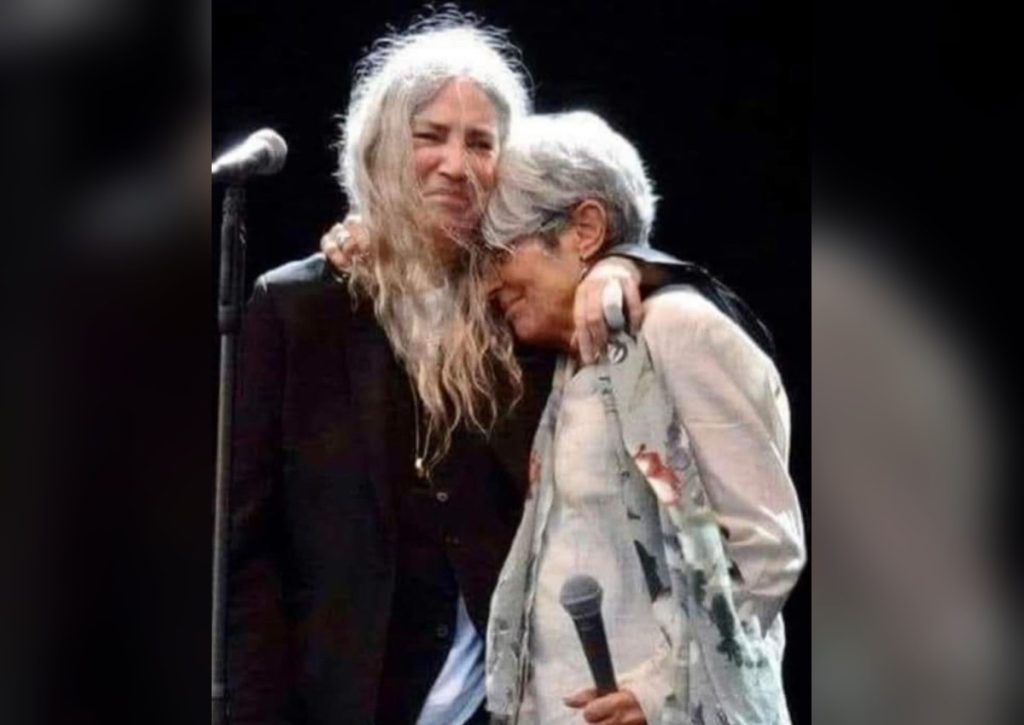
On the evening of August 2, 2018, on Roncalli Platz in the shadow of Cologne Cathedral, Patti Smith’s concert briefly stopped being a concert and became something closer to a handover ceremony. Joan Baez walked out unannounced, the two women embraced, and together they sang Bob Dylan’s “A Hard Rain’s A-Gonna Fall” — the punk poet and the folk conscience, arm in arm, both visibly in tears before the end.
Two tours crossing paths
The timing gave the night its weight. Baez, then 77, was in the middle of her farewell tour — a deliberate, years-long goodbye to the road after six decades of singing truth at power. Smith, 71, was doing what Smith does: touring as if the calling had no retirement age. Their itineraries happened to cross in Cologne, and Baez did not stand on ceremony. No announcement, no billing — she simply appeared at her friend’s show, in front of a cathedral that took six centuries to finish, to sing a song about apocalypse that has refused to age since 1963.
The setting did half the work. Roncalli Platz sits hard against the cathedral’s south face, close enough that the spires fill the sky above the stage — an open public square in the middle of a city, not a ticketed arena. Summer concerts there have a particular civic intimacy: office workers drift in at the edges, tourists stop mid-step, and on this night thousands of them ended up witnesses to something nobody had advertised.
Fan footage of the duet shows exactly what the reports described: two voices that have weathered very differently — Baez’s silvered, Smith’s still a controlled storm — finding each other line by line, and two faces struggling to hold composure. The audience understood what it was watching. Some moments are performed; this one was witnessed.
Why that song, of all songs
Neither of them chose it casually. “A Hard Rain’s A-Gonna Fall” was written by a 21-year-old Dylan and released on The Freewheelin’ Bob Dylan — a cascade of visions structured like an old border ballad, and one of the first songs to prove pop could carry prophecy. Baez’s relationship with it is generational: she was the one carrying Dylan’s songs to the world before the world knew his name, pulling him onto festival stages and folding his writing into her repertoire until the two of them became the twin faces of the folk revival.
Smith’s relationship with it is, if anything, even more charged. It was the song she chose to perform at Dylan’s Nobel Prize ceremony in Stockholm in 2016, standing in for the absent laureate before kings and academics. Midway through, her nerves swallowed the words; she stopped the orchestra, apologised — telling the room how nervous she was — and asked to begin the verse again. The stumble became the story: a room full of dignitaries watching one artist honour another so earnestly that the failure moved them more than perfection would have. Smith later wrote about the experience as a lesson in humility she had come to treasure.
Nor was Cologne Smith’s first time keeping Dylan company. Twenty-three years earlier, Dylan had pulled her out of a period of grief and semi-retirement by inviting her to open his 1995 tour, where the two duetted nightly on “Dark Eyes” — the older icon extending a hand to the younger one, exactly as Baez had once done for him. The lineage isn’t a metaphor; it’s a documented relay, and Smith has spent her career honouring her leg of it.
So when these two women stood on the same stage with that song between them, three lifetimes of history were singing along: Dylan’s apocalyptic hymn, Baez’s decades of bearing witness, and Smith’s own vow — publicly fumbled and publicly kept — to carry the flame.
The torch, actually passing
Rock is drowning in manufactured “iconic moments”: the surprise duet as content strategy, the tribute engineered for the cameras. This wasn’t one. There was no single to promote, no documentary crew, no anniversary peg — just one legend nearing the end of her touring life and another carrying the repertoire forward, meeting inside a song about hard truths while a Gothic cathedral looked on.
Baez has always been candid about what a life of witness costs — the documentary about her, I Am a Noise, lays it out with startling honesty — and she has spent her whole career threading through other people’s legends, from Newport with Dylan to crashing the Rolling Stones’ Glasgow party in 1965. Smith, for her part, has spent decades insisting that rock and roll is a communal inheritance, not private property — that the songs belong to whoever will keep them alive and mean them.
For one song in Cologne, the theory became visible. Two women, 77 and 71, holding each other up through a lyric neither of them wrote and both of them own. The hard rain keeps falling; the song keeps being handed on. That night, in front of the cathedral, everyone watching could see exactly how that happens: not through tribute albums or award speeches, but through one artist walking on stage, unannounced, to stand beside another while the words are still true.


