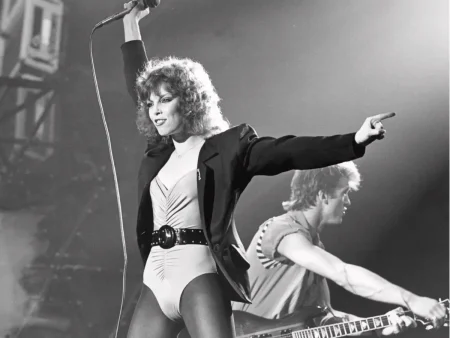
At a Nashville airport, a grey haired woman in jeans and a scarf grips a young lawmaker’s hands and launches into the old anthem We Shall Overcome. Passersby pull out phones; the moment goes viral. The singer is Joan Baez, decades past her chart prime and still instinctively turning transit lounges into protest stages.
That impromptu duet with Tennessee state representative Justin Jones, fresh from being expelled over a gun control protest, is not a nostalgic cameo. It is proof that Baez, now in her eighties, refuses to become background music to history.
From teenage prodigy to reluctant folk royalty
Baez‘s rise began in Boston and Cambridge coffeehouses as a shy teenager with a Spanish guitar and a soprano that could slice through cigarette smoke. Her 1959 Newport Folk Festival appearance led quickly to a self titled debut in 1960 and a run of best selling folk albums that pulled traditional ballads into the pop charts.
She became one of the defining faces of the urban folk revival that turned backroom singalongs into a national craze. In the early 1960s, Greenwich Village clubs, college auditoriums and festivals like Newport became ground zero for politicised acoustic music, with Baez sharing space with Pete Seeger, Peter, Paul & Mary and a wave of would be troubadours.

The woman who made Bob Dylan unavoidable
By the time a scruffy Bob Dylan arrived from Minnesota, Baez was already folk royalty, selling out concert halls and landing magazine covers. She hauled the unknown songwriter onstage during her shows and took him on tour, effectively plugging his jagged songs into the massive sound system of her fame.
History has often flipped that story, treating Baez as Dylan’s ethereal side character rather than the star who first amplified him. In interviews around the documentary Joan Baez: I Am a Noise, she describes an epiphany while painting his portrait at home, listening to those early songs and weeping as she realised how lucky she had been to witness that explosion up close, bitterness finally draining out of the old heartbreak she had already immortalised in Diamonds & Rust.
Turning a guitar into a weapon
Baez’s angelic tone hid a ferocious political will. Guided by a Quaker upbringing and an early encounter with Martin Luther King Jr., she marched, sang and spoke at civil rights rallies, including the 1963 March on Washington where she led the crowd at the Lincoln Memorial in We Shall Overcome – a performance captured on records and photos that helped cement the song as the movement’s unofficial anthem.
When the Vietnam War escalated, she did not just sing about peace. She publicly refused to pay the portion of her taxes that funded the war, founded the Institute for the Study of Nonviolence and was jailed after blocking the door of an Oakland draft induction center, urging young men to resist conscription.
Across the decades she marched with farmworkers, joined Amnesty International tours, stood outside prisons on execution nights and lent her name to countless human rights causes. Historians of popular music frequently point to Baez as one of the first major recording artists to treat commercial success as raw material for organised political resistance rather than personal comfort.
I Am a Noise: a saint shatters her own statue
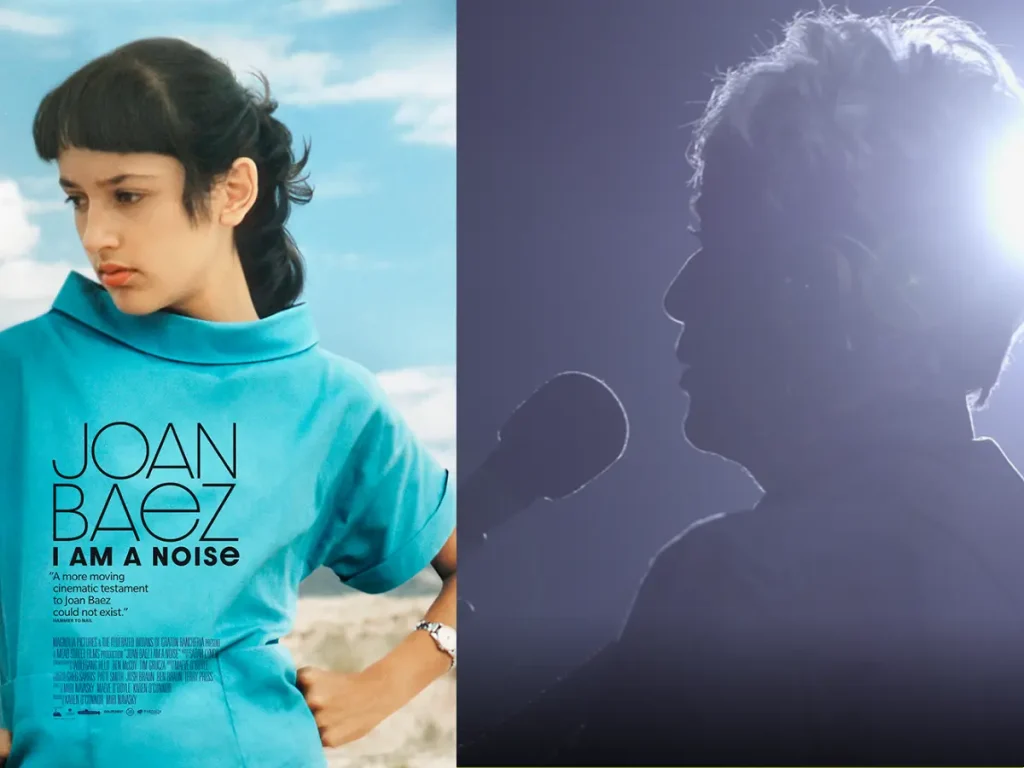
Joan Baez: I Am a Noise refuses the soft focus hagiography legends are usually offered. Directed by Karen O’Connor, Miri Navasky and Maeve O’Boyle, it follows Baez on her 2018 Fare Thee Well tour while diving into an extraordinary private archive of home movies, diaries, artwork and therapy tapes she had stored away for decades.
The film and recent interviews reveal that behind the composed stage presence was a woman living with crippling panic attacks and what she believes were buried memories of childhood abuse by her father, a respected physicist. Baez describes how midlife therapy unearthed those fragments and how she still wrestles with the ambiguity of memory, harm and forgiveness, refusing the neat victim narrative in favour of something messier and more human.
Critics have largely embraced the film as more than fan service. With an approval rating in the mid 90s on Rotten Tomatoes and praise for its unsparing psychological honesty, I Am a Noise lands as both a career overview and a jagged journey from pain toward a fragile, hard won peace.
Falling off the pedestal and climbing back
Like most 1960s icons, Baez eventually watched the spotlight swivel away. Through the 1980s her audiences shrank, her records landed on smaller labels and she found herself adrift between the radical purity that had defined her youth and a music industry chasing drum machines and MTV gloss.
The reset came quietly, with later records that treated aging not as a liability but as material. Her 2018 album Whistle Down the Wind pairs a weathered voice with contemporary protest writers and coincided with a year billed as her final extended tour, a run praised for its defiant, unsentimental farewell tone.

Wrinkles as a final act of rebellion
One of the film’s quietly radical choices is to let Baez’s face simply exist. Close ups linger on deep lines, sun spots and the famously thick hair now gone silver, while she jokes in interviews about belonging to a no facelift club and admits she was tempted, then refused, to surgically erase time.
In a culture where even middle aged pop stars are digitally airbrushed, a woman who first graced magazine covers at 21 choosing to let the camera see every crease is a political gesture. Aging, in Baez’s hands, becomes one more site of truth telling rather than a flaw to be fixed.
After the ovation: upside down drawings and sharp edged poems
Retiring from full scale touring did not mean retreat. Baez has thrown herself into visual art, first with large portraits of mischief makers like King and Dylan, then with the 2023 book Am I Pretty When I Fly? An Album of Upside Down Drawings, a collection of loose, wry sketches she creates upside down with her non dominant hand to keep surprise and imperfection front and center.
She has also kept showing up where power gathers. In Geneva she sat down with United Nations officials to talk about the Sustainable Development Goals, warning that the climate crisis is the defining struggle of this era and insisting that action is the antidote to despair for anyone overwhelmed by the news.
Closer to home, Baez has shifted some of her outrage from song to page, publishing new poems that rage against immigrant detention, democratic backsliding and what she sees as a politics of cruelty. She describes herself as a thorn in the side of governments and seems entirely at ease being mad as hell in public well past the age when most stars choose comfort.
What musicians can still steal from Joan Baez
- Let the song do the shouting. Her arrangements stay brutally simple: voice, guitar, maybe a second instrument. The clarity forces you to confront the lyric, which is why her protest anthems still land like fresh news.
- Use your platform as a ladder, not a throne. From hauling a young Dylan onstage to championing lesser known writers on Whistle Down the Wind, Baez treats fame as something to spend on other people’s work, not just her own catalogue.
- Accept the changing instrument. Her early crystalline soprano softened into a narrower, grainier range, yet she leaned into that texture instead of chasing impossible high notes, finding new emotional colours in old songs.
- Stay dangerous. Most heritage acts settle into safe nostalgia; Baez keeps warning presidents, challenging courts and writing angry poems. For working musicians, the message is simple: if your art no longer risks anything, you are coasting.
Living legend, not living museum piece
I Am a Noise will not please every fan who wants floaty memories and greatest hits. It is jagged, sometimes uncomfortable and unafraid to show the cost of being the conscience of three or four generations.
For listeners who grew up with 50s doo wop, 60s folk or 70s singer songwriters, Baez’s latest chapter is a reminder that your instrument is not just the guitar in your hands. It is also your aging body, your politics, your scars and your willingness to stay loud when the world would rather you go quietly.