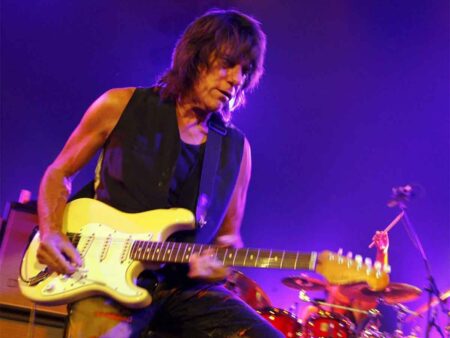
Jeff Beck may be the only guitarist who turned a simple gear choice into a philosophy lesson. He once contrasted his beloved Gibson Les Paul with the Fender Stratocaster, saying the Les Paul had a heavier feel but a tone “the Fender will never have”, yet after seeing Hendrix he decided, “I’ll stick with the Strat”.
Decades later he was still railing against players who only felt safe with an “instantly recognizable guitar sound”, insisting that using the same old guitar to create unheard noises was what really turned him on, as he told one interviewer. For anyone who grew up on the rock of the 60s through the 90s, those two ideas cut right through the myths we tell ourselves about tone, gear and what our “main instrument” should be.
What Beck was really saying about Les Paul vs Strat
On the surface his quote sounds like simple gear chat: Les Paul for fat tone, Strat for Hendrix fireworks. Underneath is the question almost every serious player faces at some point: do you commit to one guitar as your voice, or keep chasing new toys in the hope that one of them will finally “sound like the record”?
Beck knew the tradeoffs well. A typical Les Paul style guitar uses a solid mahogany body, a glued in neck and dual humbuckers that produce a thick, powerful signal ideal for sustain and drive, at the cost of extra weight on your shoulder, very much like many classic rock instruments reviewed in beginner friendly Les Paul style options. A Stratocaster leans the other way: lighter body, bolt on neck, three single coils and less output, but far more top end definition and the famous vibrato bridge.
You can hear that design philosophy in modern production models too. A US made Strat like the American Special pairs a lightweight alder body with three bright single coil pickups and a vintage style synchronized tremolo that almost begs you to lean on the bar and the volume knob for expression, as you see on many mid priced Stratocaster style guitars. A comparable single cut in the Les Paul camp gives you more mass, more midrange and usually a fixed bridge that puts sustain and tuning stability ahead of whammy theatrics.
Stripped of logo worship, the two archetypes really are different tools. You can absolutely play blues, fusion or hard rock on either, but they push your hands in different directions.
| Feature | Typical Les Paul style | Typical Stratocaster style |
|---|---|---|
| Body & weight | Thick mahogany (often with maple cap), tends to be noticeably heavy. | Thinner contoured alder or ash, usually lighter and more ergonomic. |
| Scale length & feel | Shorter scale, slightly slinkier string tension and chunky feel. | Longer scale, tighter feel and a snappier, more percussive attack. |
| Pickups | Two humbuckers, higher output, thick mids, low noise. | Three single coils, lower output, bright and articulate but noisier. |
| Bridge | Fixed tune o matic and stop tailpiece, rock solid sustain. | Synchronized vibrato bridge that can be set to float for bends and shimmers. |
| Typical strengths | Huge sustain, fat rock rhythm tones, creamy leads. | Chimey chords, expressive bends, funky clarity and vocal like lead lines. |
| Typical challenges | Shoulder fatigue, risk of muddy tone if you are careless with gain. | Single coil hum, can sound thin, trem can wreak havoc with tuning if badly set up. |
Beck’s point was brutally practical: you cannot fully exploit both personalities at once. At some stage you choose which set of compromises will live on your shoulder night after night.

Why Beck ultimately bet on the Strat
In the 60s Beck bounced across guitars – Telecasters, early Les Pauls and more – while rewriting the Yardbirds sound with feedback and fuzz. By the mid 70s he had the now legendary 1954 “Oxblood” Gibson Les Paul that appeared on the cover of Blow By Blow, a guitar that recently sold for around a million pounds at a Christie’s auction of his collection.
The twist is that the guitar that really unlocked his mature voice was the Stratocaster. By the time of Jeff Beck’s Guitar Shop in 1989 he had dropped the pick and was using a Strat almost as a controller: thumb for the strings, index on the vibrato arm, and ring or pinky riding the volume knob so notes could swell, choke or scream in a single phrase.
Guitar educators who have pulled his style apart point out that this late period vocabulary depends on exactly what a Strat does best: a floating tremolo for scooped notes and vocal like vibrato, natural harmonics that bloom into feedback, and constant volume knob swells that blur the pick attack until the guitar sounds almost like a synth or a voice, as a number of in depth Jeff Beck lessons have shown.
Music theorists writing about Beck after his death noted that his basic rig was almost comically traditional – a standard tuned Strat, fuzz or distortion, some echo, and classic Fender and Marshall amps. The sorcery came from how deeply he manipulated pitch and timbre between the frets, riding the bar, volume and tone controls in real time instead of treating them as set and forget hardware.
Seen that way, his decision to stick with the Strat was not tribal brand loyalty. It was a recognition that the Strat’s ergonomics – trem placement, knob layout, body balance – fit the kind of microtonal, vocal approach he wanted far better than a heavier, fixed bridge Les Paul ever could.
Jeff Beck vs the tone police
That brings us to his other grenade. Beck said he did not understand players who only accept a guitar if it has an “instantly recognizable guitar sound”, because the real thrill for him was finding fresh noises on “the same guitar people have been using for 50 years”, as he explained in one wide ranging interview late in his career. In the same breath he talked about breaking supposed rules several times in every song and caring more about emotion than about avoiding mistakes.
Coming from a player who could have coasted forever on vintage Les Paul into Marshall crunch, that is a provocation. Beck was telling every weekend warrior and touring pro alike that if your tone makes listeners immediately say “nice Strat” or “classic Les Paul”, you might actually be playing it a little too safe.
He even admitted that he loved it when people heard his records and could not work out what instrument was making the sounds at all. That attitude is sacrilege to brand obsessed guitar culture, yet it lines up perfectly with his choice to treat the Strat not as a museum piece but as raw material to be twisted out of shape.
In other words, Beck chose a very familiar platform and then tried his best to make it unrecognizable. Most of us do the opposite: we buy ever more exotic guitars and then dial the amp to a famous settings preset and call it a day.

What Beck’s choice means for your main guitar
Decide what you want your hands to do
Beck’s Les Paul versus Strat dilemma is less about model names and more about mechanics. If your playing is about long sustaining notes, simple bends and a big, thick center to the sound, a Les Paul style instrument will flatter that. If you want to live on the vibrato bar, smear notes into each other and work the volume knob as often as you pick the strings, the Strat layout helps you instead of fighting you.
Before worrying about headstock logos, ask yourself a few ruthless questions. Do you actually use the vibrato bridge in musical ways, or is it just bolted flat to the body? Do you ride the volume and tone controls while you play, or leave everything on ten and reach for another pedal instead? Your honest answers tell you far more about whether you are really a Strat person, a Les Paul person, or simply copying photos from old album covers.
Les Paul people vs Strat people, in plain English
As a crude rule of thumb, here is how the two tribes usually shake out. None of this is mandatory, but it is a useful mirror.
- If you live in the low and mid registers, hit the strings hard and want singing sustain with minimal fuss, a Les Paul or similar single cut with humbuckers will feel like coming home.
- If you love subtlety, volume swells, harmonics, trem flutters and “is that even a guitar?” textures, a Strat style guitar with a responsive vibrato will reward the hours you spend learning to control it.
Channel your inner Beck, not your inner collector
Beck also quietly killed another sacred cow: the idea that the “right” main instrument is the one that will be worth the most on the vintage market. The irony is that his battered Oxblood Les Paul and 50s Stratocaster ended up fetching eye watering prices only because he treated them as tools, played them hard on stage and let them collect scars instead of keeping them mint.
For the rest of us, the real takeaway is brutally simple. Pick a platform, live with its flaws, and then abuse every control on the thing until it stops sounding like anyone else. That might mean drilling weight relief holes in a too heavy single cut, floating a Strat bridge until it wobbles at the lightest touch, or simply turning down the gain and letting your hands do the work.

Conclusion: choose your side, then make it weird
If you strip away the famous quotes, Jeff Beck’s message to guitarists is harsh but liberating. You cannot have every tone in one hand, so at some point you pick a main instrument and accept its limitations.
What you do after that is where the art really lives. You can chase “instantly recognizable” tones and become a tribute act to your heroes, or you can do what Beck did and use a 50 year old design to make sounds that do not even register as “guitar” at first. The gear choice matters, but the real decision is whether you are willing to scare yourself a little every time you plug in.