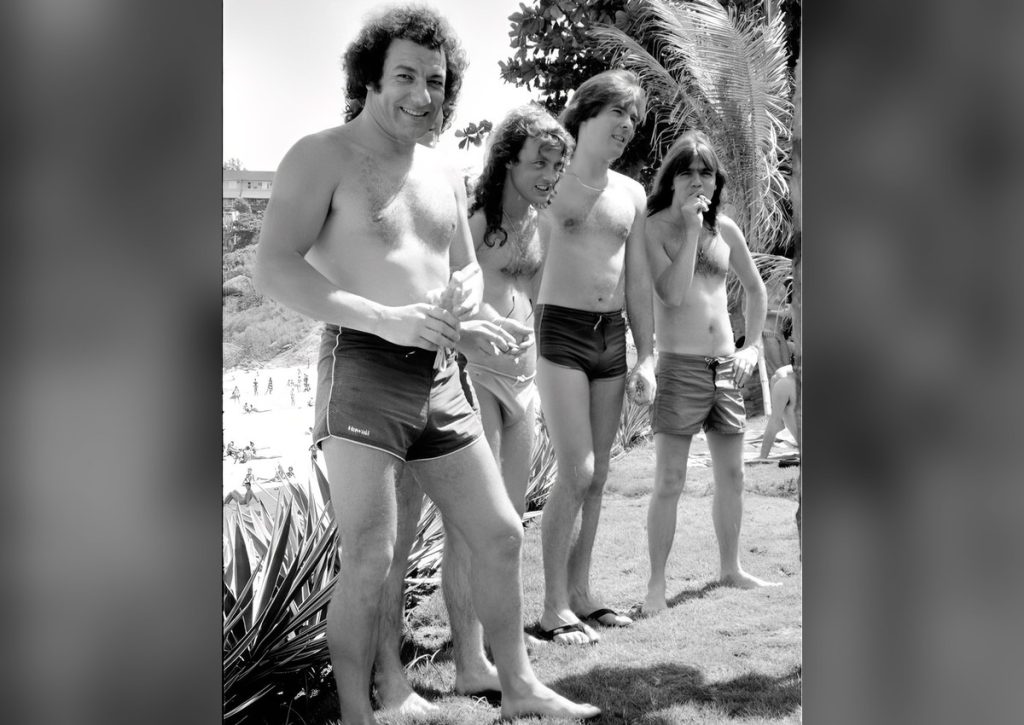
There’s a black-and-white photograph from January 1985 of four shirtless men strolling Ipanema Beach like any other tourists — sunburn candidates, not superstars. Look closer and the grin on the left gives it away: Brian Johnson, flat cap presumably left at the hotel, with his AC/DC bandmates around him, squinting happily into the Brazilian summer. Days later, the men in that photo would stand in front of one of the biggest crowds any rock band had ever drawn.
The festival nobody had attempted before
In January 1985 Brazil staged something genuinely unprecedented. Rock in Rio was not a field with a stage in it; it was a purpose-built festival city — the “Cidade do Rock”, constructed on the outskirts of Rio de Janeiro — hosting ten days of the biggest names in rock and pop. Queen, Iron Maiden, Whitesnake, Ozzy Osbourne, Scorpions, Yes and George Benson all made the trip, and across the festival’s run the site drew well over a million people. Nothing on that scale had ever been attempted in South America, a continent the big touring machines of the seventies and eighties had largely ignored.
For Brazilian rock fans, starved of international shows for decades, it was a dam bursting. For the bands, it was a leap of faith: fly to the other side of the world, to a venue that hadn’t existed a year earlier, and find out whether the audience was really there.
Two nights, a quarter of a million people
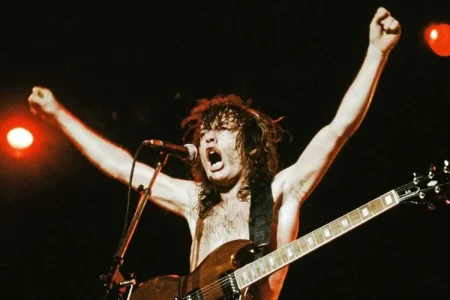
AC/DC — Johnson, Angus and Malcolm Young, Cliff Williams and drummer Simon Wright — headlined two nights, January 15 and 19, sharing the second bill with Scorpions, Whitesnake and Ozzy. It was the band’s first time in South America, squeezed into a break from the sessions that would become Fly on the Wall. The January 19 crowd alone was reported at around a quarter of a million people — the kind of number that turns a concert into weather.
And the audience was very much there. From the opening bell tolls of “Hells Bells”, the Cidade do Rock got precisely what a sweaty Glasgow club or a Sydney pub got: the same riffs with the fat trimmed off, the same duck-walking schoolboy detonating across the stage, the same refusal to add one unnecessary note. AC/DC didn’t scale their show up for 250,000 people, because there was nothing to scale — the thing was already built to withstand any size of room. Brazil had waited a generation for bands like this, and AC/DC answered by treating the biggest crowd of their lives exactly like every other crowd. It’s arguably the most AC/DC compliment they could have paid.
It was also a subtly new-look AC/DC doing it. Simon Wright was barely a year into the drum seat, having stepped into the huge shoes of Phil Rudd in 1983 — Rio was among the biggest tests any new member of this band ever faced, and the machine didn’t so much as hiccup. Behind them sat the half-finished Fly on the Wall, due later that year; ahead of them, a decade of stadiums. Rio caught them mid-stride, which for AC/DC has always been the natural gait.
The unbothered band
Which is what makes the beach photograph so good. Between soundchecks and the biggest shows they had ever played, AC/DC did what any Novocastrian or Sydneysider does when handed January sunshine: went to the beach. No entourage in shot, no styling, no performance of celebrity — four blokes on the sand at Ipanema, one of them days away from singing to a city-sized crowd.
That unbotheredness was always the band’s secret weapon, and 1985 was a year they needed it. They were between career peaks — the Back in Black supernova a few years behind them, the critical tide temporarily out — and lesser bands might have treated Rio as a make-or-break spectacle. AC/DC treated it as a gig. Malcolm ran the engine, Angus ran amok, the schoolboy suit did its eternal work, and the band that had kicked its way into America the hard way added a continent to the map without changing a single thing about itself.
The festival that became a rite of passage
Rock in Rio outgrew even its founders’ ambitions — it became one of the world’s defining festivals, a stage where careers are minted and legends occasionally bleed for their art. But the 1985 original belongs to that first wave of bands who flew into the unknown: no template, no guarantee a purpose-built rock city in Brazil could possibly work, and a quarter of a million people waiting to prove it could.
The photograph endures because it catches the moment just before all that — the calm, sunlit afternoon of a band on the verge of something enormous, acting like it was nothing at all. For AC/DC, famously, that was never an act. It was the whole philosophy: the show is the show, whether it’s a pub or a city. The beach was just the soundcheck.