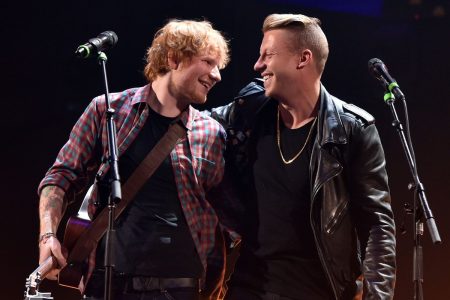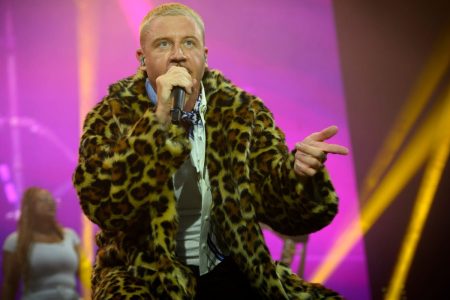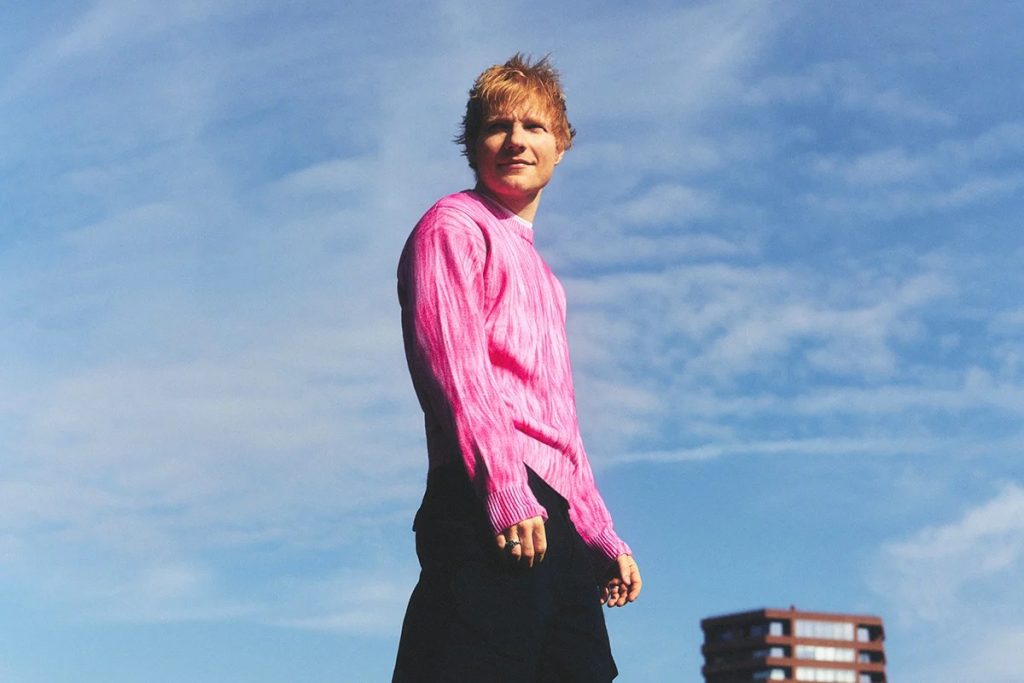
Ed Sheeran has no opening acts left on his Loop Tour. Within a few hours on Tuesday, all four remaining support acts — Irish singer-songwriter Aaron Rowe, the folk band Beoga, Finneas, and Denmark’s Lukas Graham — withdrew from their remaining dates, one after another, in support of Macklemore, who had been removed from the tour a day earlier over an onstage call for a free Palestine.
It is an unusual thing to happen to a stadium headliner mid-tour, and it did not come out of nowhere. The dispute has been building for more than a week, it involves an NFL team owner, and the people at the center of it are telling noticeably different versions of how the decision was made.
How the tour got here
Macklemore played two shows on Sheeran’s tour in New Jersey on September 4 and 5. At one of them he called for a “Free Palestine” before performing a pro-Palestinian protest song. Within days, pro-Israel groups and a petition campaign were pushing for his removal from the remaining dates.
On Monday, he was dropped. The promoter of the tour told Rolling Stone that venues had notified them they would not allow a concert to go ahead with Macklemore on the lineup, and that six NFL stadium owners had said so.
The most prominent of them made his position public. New England Patriots owner Robert Kraft, whose Gillette Stadium is due to host Sheeran on September 25 and 26, issued a statement saying the stadium does not “provide a platform for hate speech” and that allowing Macklemore to perform would “cross that line.” Kraft’s statement pointed to the New Jersey remarks and also referred to what he described as a broader history of antisemitic rhetoric and imagery. It did not cite specific examples.
Macklemore rejects that characterization. He has said his criticism of the Israeli government should not be conflated with antisemitism, and argued that one of the most effective ways of silencing critics has been to weaponize the accusation. In 2014 he apologized for an onstage costume, including a false nose, which he acknowledged afterward could be read as a Jewish caricature.
Kraft, who has spent years funding campaigns against antisemitism, closed his statement by saying he would welcome the chance to sit down with Macklemore directly: “Ultimately our goal is the same – peace for all people, an end to suffering and an end to all hate.”
Where the accounts diverge
This is the part worth reading carefully, because the three central figures do not describe the same sequence of events.
Macklemore’s account is that Sheeran told him Kraft had rallied other stadium owners and that they had collectively delivered an ultimatum: if Macklemore stayed on the tour, Sheeran would not be allowed to play their venues. Kraft’s statement neither confirmed nor denied that claim.
Sheeran’s account, posted to Instagram on Tuesday, puts the decision entirely with the promoter. “Macklemore coming off tour was the promoter’s decision, it was not mine,” he wrote. “Macklemore’s contract for the tour was with the promoter, not me.” He said he had spoken with the venues at length across the week to try to build a bridge and find a resolution, but that the venue’s and promoter’s decision was final.
He also addressed the criticism that his silence on Gaza amounted to endorsement. “I am appalled by the conflict between Israel and Palestine,” he began, before writing: “I am not complicit. I have my personal views on this devastating conflict.” He argued that his audience “includes young people, often children, of all backgrounds” who “do not expect a political forum,” and that he prefers to “maintain diplomacy and keep conversations open, not closed.” Comments on the post were disabled.
Macklemore, for his part, has been notably sympathetic to Sheeran personally, describing him as having been put in a difficult position and acknowledging that his own remarks had been hurtful to people Sheeran had spoken with.
Four acts, four statements
The walkouts followed Sheeran’s statement rather than preceding it.
Aaron Rowe went first. “I have made the decision to withdraw as a support act for Ed Sheeran’s ‘The Loop’ North American Tour,” he wrote, adding that he did not take the decision lightly and that “Ed has been a friend to me and has changed my life.” He framed his choice in Irish terms, writing that “as Irish people, we know all too well about genocide, forced famine and violent occupation.”
Beoga followed. The band have played with Sheeran for years — they co-wrote and performed on some of his best-known Irish-inflected material — and they opened by stressing that “we have been friends with Ed for over 10 years now and will continue to be.” They described themselves as founding members of the Irish Artists For Palestine movement.
Finneas, the producer and songwriter best known for his work with his sister Billie Eilish, was due to open six South American dates in late November and early December. “Artists must not be silenced when they speak up for the oppressed,” he wrote. “I have decided to withdraw from my upcoming tour dates with Ed Sheeran. I stand with Palestine and its people.”
Lukas Graham was last. “Money doesn’t give you the right to own the conversation,” he wrote. “Nobody’s bank balance should decide who gets to speak or which suffering we’re allowed to acknowledge.” He was careful to separate the decision from the friendship: “I love Ed, and I’m grateful for everything we’ve shared. That hasn’t changed. But I can’t put these words out into the world and carry on with this tour as things stand.”
What happens next
The Loop Tour resumes on September 19 at Lincoln Financial Field in Philadelphia, followed by the two Gillette Stadium dates on September 25 and 26. As of Tuesday night, no support acts were listed for any of the remaining North American shows, and it is not clear whether replacements will be brought in or whether Sheeran — a performer who built his reputation alone on a stage with a loop pedal — will simply play longer.