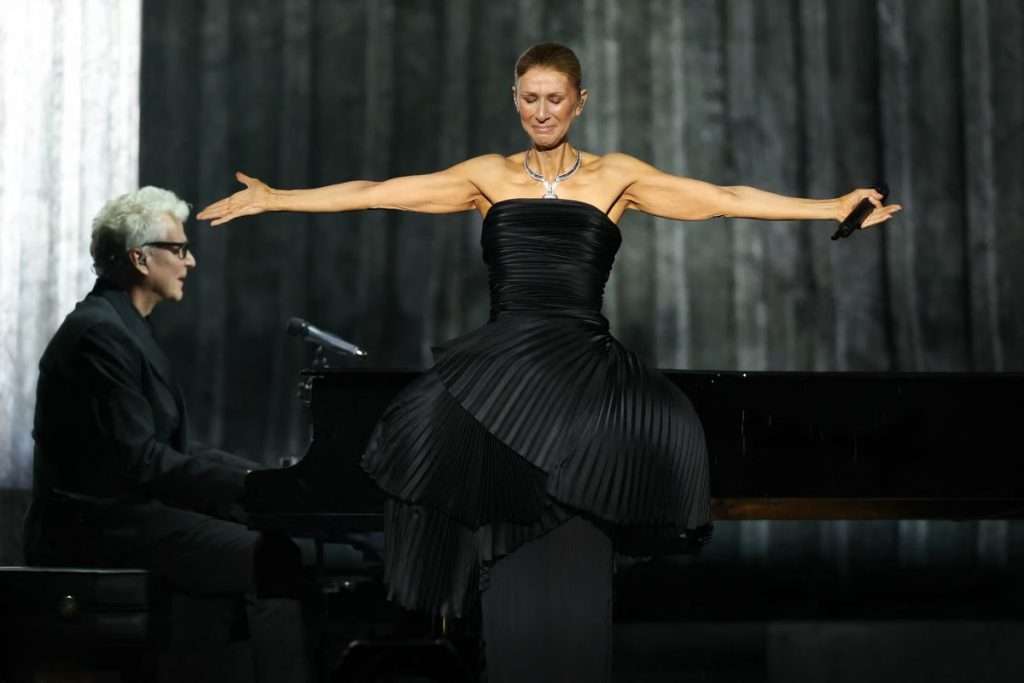
Celine Dion got only a few lines into “On ne change pas” on Saturday night before she had to stop. The lights had gone down at the Plenitude Arena in Nanterre, west of Paris, a crowd AFP put at around 30,000 had screamed itself hoarse, and the first full concert she had played in six years was barely a minute old. She stood in a black strapless gown and a diamond choker, and wept.
“I had promised myself not to cry,” she told the arena, according to Variety. “I don’t keep my promises. But I’m so happy to see you all. I missed you.”
She finished the song. The crowd chanted her name at the end of it. Parade reported that she wiped her face and added: “These are tears of joy, of course. I’m so happy to see you.”
The choice of opening number was not accidental. “On ne change pas” — “One Doesn’t Change” — was written for her by the Parisian songwriter Jean-Jacques Goldman and released in 1998, and it is a song about remaining recognizably yourself through everything that happens to you. She has spent the last four years being told, in effect, that she might not get to.
The six years behind the tears
Dion’s last headlining run, the Courage World Tour, stopped in March 2020 when the pandemic closed the touring industry. It never restarted. In December 2022 she disclosed that she had been diagnosed with stiff person syndrome, a rare autoimmune neurological disorder that causes severe muscle rigidity and spasms. For a singer it attacks the instrument directly: the muscles that control breath and pitch stop obeying.
She has described the physical reality of it in unusually blunt terms — the sensation of being strangled, and cramps violent enough to have broken her ribs.
What she disclosed more recently is how long it had been going on. In an interview with Harper’s Bazaar in August, Dion said she had been living with symptoms for seventeen years before anyone gave them a name in 2022, and that she had spent those years blaming cancelled shows on sinus infections and coughs. She also pushed back on the vocabulary around it. “It is a progressive condition. I don’t like to say ‘disease,'” she told the magazine.
That is the context for a woman stopping ninety seconds into a concert. It is also why the recovery has been slow and unglamorous. A source told Us Weekly that the work Dion put in to regain strength and mobility has been “constant, consistent” — the kind of quote that usually reads as PR filler and, in this case, is probably just accurate.
Her only significant public performance in the interim came at the 2024 Paris Olympics, when she sang Edith Piaf’s “Hymne à l’amour” from the Eiffel Tower. That was one song, staged, and about four minutes long. A residency is a different proposition entirely: two hours a night, repeatedly, on a schedule.
Paris turned the city over to her
The welcome was not subtle. The suburban train station serving the arena was temporarily renamed “Céline.” A metro station nearby was decorated with lyrics from her best-known songs. Galeries Lafayette opened a merchandise pop-up, the city organized a mass karaoke event, and on Friday the Olympic cauldron rose over the Tuileries Garden with a line from “Hymne à l’amour” — “I’d go and fetch the moon if you asked me to” — projected across the balloon alongside her first name.
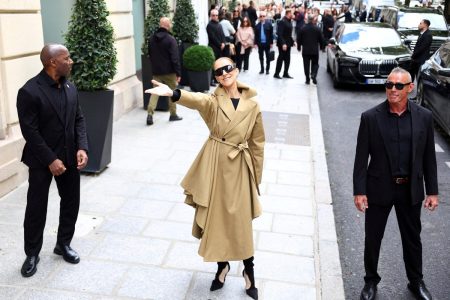
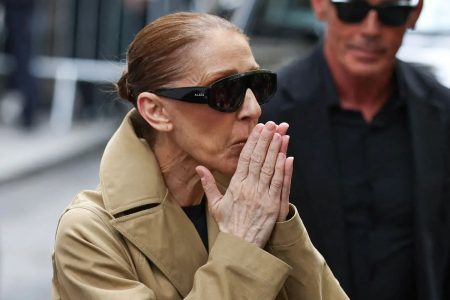
Fans flew in from Quebec, São Paulo and as far as Tahiti. Some had been waiting outside her hotel, Le Royal Monceau, since six in the morning; she has been going out to greet them for two weeks, occasionally singing with them in the street. Chloe and Katy Rydquist told AFP they had spent around £1,500 on tickets and considered it justified. “She’s a legend, she’s iconic,” one of them said.
“She’s a fighter,” an Italian fan, Aurelie Chabroll, told Reuters. “She really proved that to us and her return is just magical.”
How long this actually runs is less clear than it looks
Here the coverage stops agreeing with itself, and it is worth flagging rather than papering over.
Billboard and EntertainmentNow both describe a 26-show residency running across roughly eight months, announced in March on Dion’s 58th birthday. AFP breaks that down as 16 sold-out dates in September and October, followed by another 10 in May 2027. Parade, however, reports only 10 shows between September 12 and October 14 — a figure that matches neither of the others and appears to undercount the autumn leg.
The 26-date structure is the one carried by the most outlets and matches the original announcement, so it is the safest reading. But anyone booking travel should check the official dates rather than a news summary, including this one.
What is not in dispute is the harder question underneath the numbers, which is whether a body that spent seventeen years quietly failing can hold up to a schedule like this. Saturday answered it for one night. Dion, for her part, framed the whole thing as unfinished business rather than a victory lap.
“The path was rockier than expected,” she told the arena. “But I held on to a faint ray of light in the distance, deep in the mountains. Tonight, I want to sing for you, sing for myself, sing for life.”