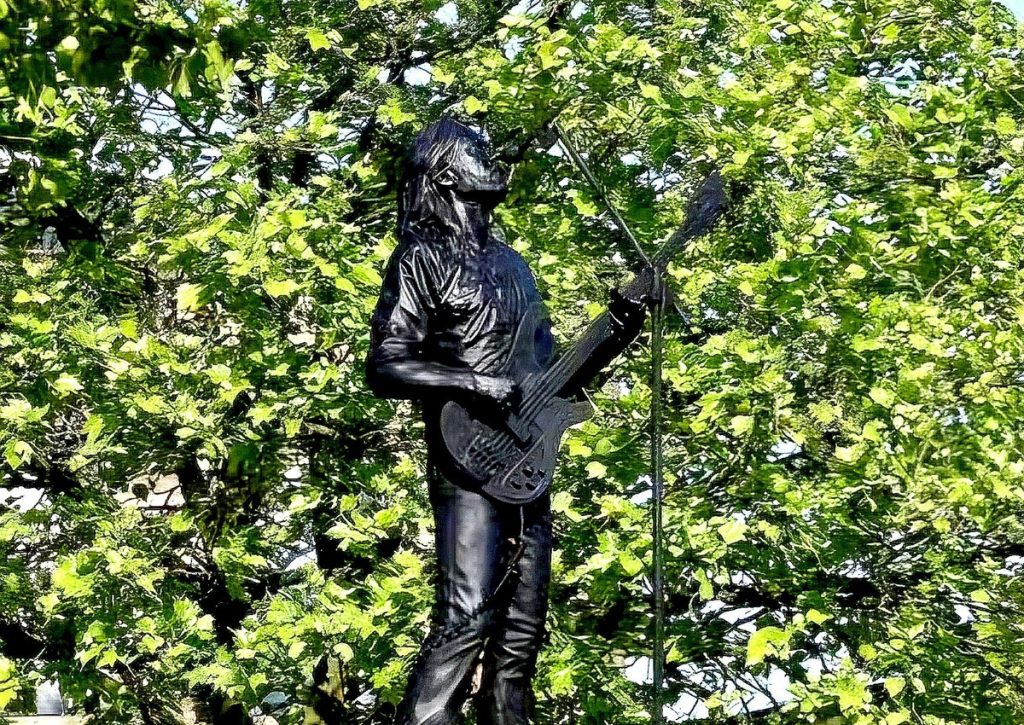
At Fishing Boat Harbour in Fremantle, Western Australia, between the fish-and-chip shops and the moored trawlers, a bronze man struts atop a bronze Marshall amplifier — shirtless, grinning, mid-performance forever. Tourists queue to photograph it in numbers most civic monuments never see. It is Bon Scott, and the statue’s location is no accident: this port town, about as far from the world’s music capitals as geography allows, is where AC/DC’s immortal frontman actually came from. Mostly.
Kirriemuir to the harbour
The “mostly” is the good part. Ronald Belford Scott was born on July 9, 1946 in Kirriemuir, a small town in the Scottish county of Angus, and spent his first years there before the family emigrated to Australia — settling eventually in Fremantle when Bon was a boy. The nickname followed the geography: another Ron at school meant the new kid became “Bonnie Scotland”, worn down to Bon.
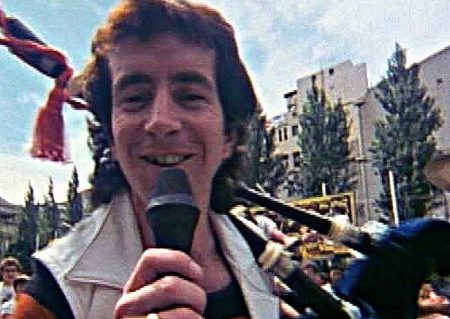
Fremantle is where the legend’s raw materials were assembled. He drummed in the local pipe band as a kid — a bagpipe connection that would later resurface gloriously on record — left school at fifteen, did his stint of dead-end jobs and juvenile trouble, and worked his way through a decade of Australian bands, from teen-pop outfits to the Adelaide years with Fraternity and his marriage to Irene Thornton, before AC/DC finally called in 1974. He was nearly thirty when fame arrived, a fact that always gave his swagger its particular flavour: this was not a boy discovering the world, but a dockside veteran collecting overdue winnings.
The statue
Bon died in London in 1980, and Fremantle is where he was laid to rest — his grave became such a site of pilgrimage that heritage authorities eventually listed it. But the town’s most visible tribute arrived on the waterfront in 2008, when local sculptor Greg James’s bronze was unveiled at Fishing Boat Harbour.
James made two perfect choices. He put Bon on top of a Marshall amp — the frontman’s natural pedestal, swapping the general’s horse for the only plinth that ever mattered to him — and he caught the strut: chest out, head back, caught between lines of a song. There is nothing solemn about it, which is exactly right. Civic statuary usually embalms its subjects; this one looks like it might finish the verse. It has since become one of the most photographed landmarks in the city, with fans leaving guitar picks and posing mid-strut beside him.
Kirriemuir, for its part, eventually claimed its share of the story — the Scottish birthplace later raised a statue of its own and hosts an annual festival in his honour. Two towns on opposite sides of the planet, both insisting on the same wandering son: few rock stars are so thoroughly, so affectionately, doubled.
The harbour setting has done its own quiet work on the tribute. The statue was later given pride of place on a raised platform overlooking the water, and it has accumulated the rituals that only genuinely loved monuments attract: guitar picks wedged into the bronze, beer cans left at its feet on his birthday, buskers setting up in its shadow to borrow the audience. City councils can commission statues; they cannot commission any of that. The rituals are the town voting, continuously, that it got the right man.
Why a port town keeps a rock star
It’s worth asking what exactly Fremantle is commemorating, because it isn’t only record sales. Bon Scott’s legend is inseparable from a particular working-class Australian self-image — the migrant kid from nowhere special who took a bar band’s virtues to the largest stages on earth without acquiring a single air or grace along the way. He wrote like a dockworker with a poet’s timing, sang like a man permanently delighted by his own luck, and treated stardom as a marvellous joke he was in on.
That’s what the bronze fixes in place. Not a genius on a pedestal — a local boy on an amplifier. The distinction is the whole point, and it’s why the statue works on people who couldn’t name three AC/DC songs. Every port town in the world has a version of that kid: too restless for the docks, too charming to write off, bound for glory or trouble or, in this one case, both.
It also completes a circle the man himself would have appreciated. Bon spent his first Australian years in Fremantle’s migrant hostels and modest streets, one more assisted-passage kid whose family had gambled everything on the other side of the world. The town he arrived in as nobody now points tourists toward him as its favourite son. Immigration stories rarely get monuments; this one got a bronze frontman on an amplifier, which feels like the correct exchange rate.
Fremantle watched him leave, buried him too soon, and then did the loveliest thing a hometown can do for its wildest son. It stood him back up by the harbour, mid-song, and let him keep performing — for everyone, forever, admission free. Somewhere, you’d have to think, Bon finds that arrangement absolutely correct.