Some live performances don’t just “go well.” They land like a verdict – a room suddenly agrees on what matters. That is the vibe people remember from the night Jamey Johnson and Alison Krauss stepped into “Seven Spanish Angels” in Washington, D.C., with Willie Nelson sitting close enough to watch every breath.
This is not a song you can fake. It is a story-song with the emotional directness of a folk ballad, the moral weight of a tragedy, and the pacing of a prayer. And when you perform it with Willie in the building, the song’s original co-star, you are basically taking a classic car for a test drive while the designer stands beside you, arms folded.
The moment: a tribute performance with the original legend watching
“Seven Spanish Angels” is best known as the 1984 duet by Ray Charles and Willie Nelson, released on Charles’ Friendship album. That studio version set the template: Ray’s gospel-grit vocal, Willie’s plainspoken tenderness, and a narrative that ends in sacrifice rather than victory.
Years later, at a major Washington, D.C. celebration of Willie, Jamey Johnson and Alison Krauss took the song and treated it like what it is – sacred material. The interest was not only in whether they could sing it, but whether they could carry it in front of Willie without turning it into karaoke-with-respect.
Why Willie’s reaction became the real headline
Willie Nelson is famously unflashy. He is not the guy who stands up to make sure the camera sees him being moved. His entire style is understatement, from his vocal phrasing to the way he lets a band breathe. That is why his reaction mattered: when Willie looks genuinely delighted, it reads as earned, not performed.
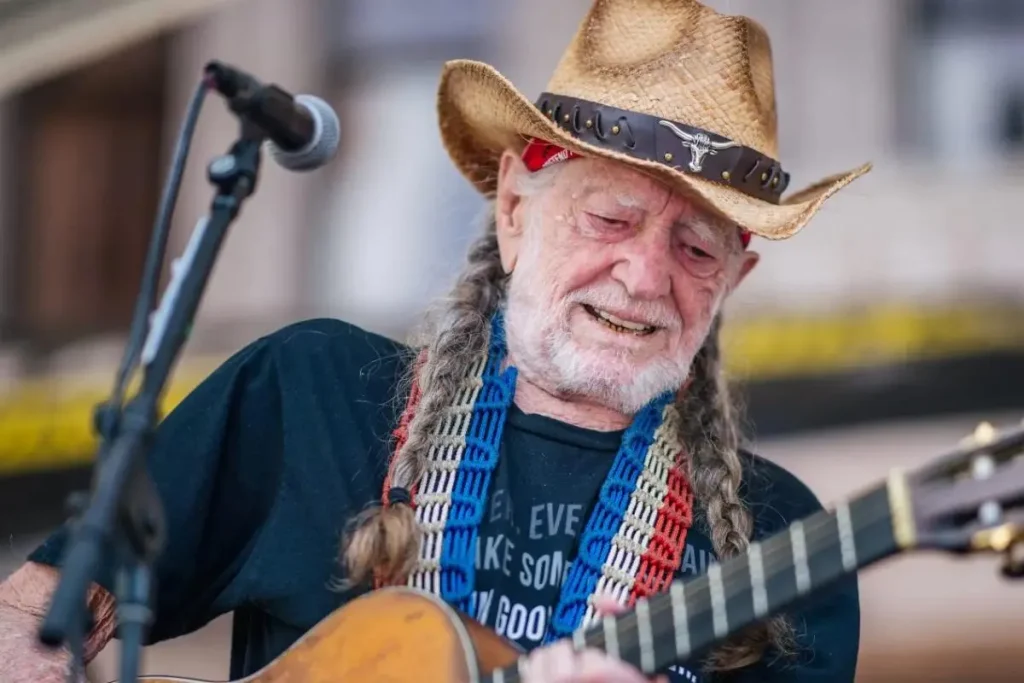
In the widely shared live footage and fan reposts of the D.C. performance, Willie’s face tells a story in real time. He watches like a craftsman watching another craftsman. He grins at certain lines. He nods at phrasing choices. And when the harmony locks, he looks like a man watching his own song turn into someone else’s moment without losing its soul.
“If I could sing like that, I’d stop writing.” – Willie Nelson, quoted in an interview discussing great singers and the power of a vocal performance
That quote gets passed around because it is vintage Willie: humble, funny, and dead serious about the voice as an instrument. Even when he is joking, he is telegraphing the same truth his reaction revealed that night – and the widely shared live footage of the D.C. performance shows exactly why he’d respect it when the craft is real.

What makes “Seven Spanish Angels” so hard to pull off live
This song looks simple on paper. Two singers, a classic country-gospel groove, a narrative with big images. In practice, it punishes singers who over-act.
1) You have to tell the story, not decorate it
The lyric is cinematic: outlaw lovers, a standoff, and a final shot. The temptation is to “perform tragedy.” The better move is to report it like a witness. The lane Willie and Ray carved out is why the song still hits decades later, because the narrative is built to land with plainspoken force.
2) The duet balance is brutally exposed
Great duets are not two leads competing. They are one emotional engine with two human voices. With Krauss’ famously pure tone and Johnson’s gravel-and-smoke baritone, the mix can either sound like magic or like two separate songs happening at once.
3) The chorus is a trap
The chorus is where singers often go too big. But the lyric’s power is the contradiction: beauty (“seven Spanish angels”) arrives at the most violent moment. If you oversing it, you miss the chill.
Why Jamey Johnson and Alison Krauss were an unusually smart pairing
On paper, this pairing looks almost provocative. Johnson is an outlaw-country stylist whose phrasing leans conversational and raw. Krauss is precision, restraint, and angelic control. That contrast is exactly why it works – it mirrors the original duet’s tension between Ray’s church-bred intensity and Willie’s quiet truth-telling.
Krauss has long been praised for a vocal style that stays controlled even at peak emotion, which lets the listener do the crying instead of the singer. Johnson, meanwhile, has a singer’s instinct for when to let a line scrape rather than shine. Put them together and the song stops being a “cover” and becomes a re-reading.
The “Willie test”: what he likely loved about it
We cannot climb inside Willie’s head, but his visible reaction, plus what he has consistently valued across his career, makes the likely reasons pretty clear.
| What the performance did | Why it fits Willie’s taste |
|---|---|
| Kept the tempo unhurried | Willie’s best work lives in pocket and patience, not rush |
| Let the lyric stay legible | He writes and sings like a storyteller first |
| Used harmony as emotional punctuation | He loves ensemble moments that feel earned, not “big” |
| Avoided vocal gymnastics | His aesthetic is sincerity over spectacle |
The other thing Willie likely loved is something fans often miss: when someone nails one of his songs, it is not just flattering. It is proof the song has become bigger than its author. Willie has always treated songwriting like a form of public service, not private property.
Context: the song’s origin story gives the performance extra weight
“Seven Spanish Angels” did not start as a duet vehicle for tribute concerts. It is a major chapter in a historic album cycle: Ray Charles’ Friendship, built around cross-genre duets and country storytelling. The track’s success helped cement the idea that country music and soul music were not “crossovers” so much as cousins who had been separated at birth.
That is part of why the D.C. performance mattered. It was not just “country stars doing a classic.” It was a reminder that Willie’s catalog is one of the great meeting places in American music, where gospel feeling, blues phrasing, and country narrative all coexist without fighting.
How to watch it like a musician (and spot the exact ‘Willie grin’ moments)
If you want to catch the details that make Willie’s reaction so satisfying, do not watch it like a fan first. Watch it like a bandmate.
Listen for these three cues
- Breath timing before the hook: When both singers take their breath together, the chorus lands as one unit.
- Consonants on story lines: When “shot” or “gun” or other hard words are articulated cleanly, the narrative stays sharp.
- Dynamic control on the final section: The best versions get quieter at the emotional peak rather than louder.
Now watch Willie. The moments where he nods or smiles are often tied to these exact musical choices: phrasing that respects the lyric, and restraint that trusts the room. That is a master songwriter responding to a masterclass in not overdoing it.
A slightly edgy take: this performance exposes a problem with modern country tributes
Here is the uncomfortable truth: many modern “tribute” performances are about proving vocal dominance, not honoring the song. The bigger the note, the more the crowd screams, the more everyone pretends that is the point.
“Seven Spanish Angels” punishes that approach. It is an anti-flex song. It rewards singers who are brave enough to be plain. That is why Johnson and Krauss winning Willie’s visible approval feels so satisfying – it is a small rebellion against the trend of turning every classic into a vocal decathlon.
What it teaches singers: how to honor a classic without copying it
If you sing, play, or lead a band, this performance is useful homework.
Practical takeaways
- Do not imitate the original tone – imitate the original intention.
- Pick a key that preserves storytelling rather than showing range.
- Agree on who leads each verse so the narrative stays coherent.
- Let the band stay secondary – this song is vocal and lyric first.
When the original artist is in the room, the goal is not to impress them with tricks. The goal is to prove you understand why the song survives.

Conclusion: Willie’s reaction is the stamp that matters
The most telling part of that Washington, D.C. performance is not a vocal run or a dramatic ending. It is Willie Nelson, sitting there, watching his own musical history happen in real time, looking delighted rather than possessive.
That reaction says: the song still works, the story still hurts, and the next generation can carry it. In a music world addicted to novelty, that is a rare kind of approval.